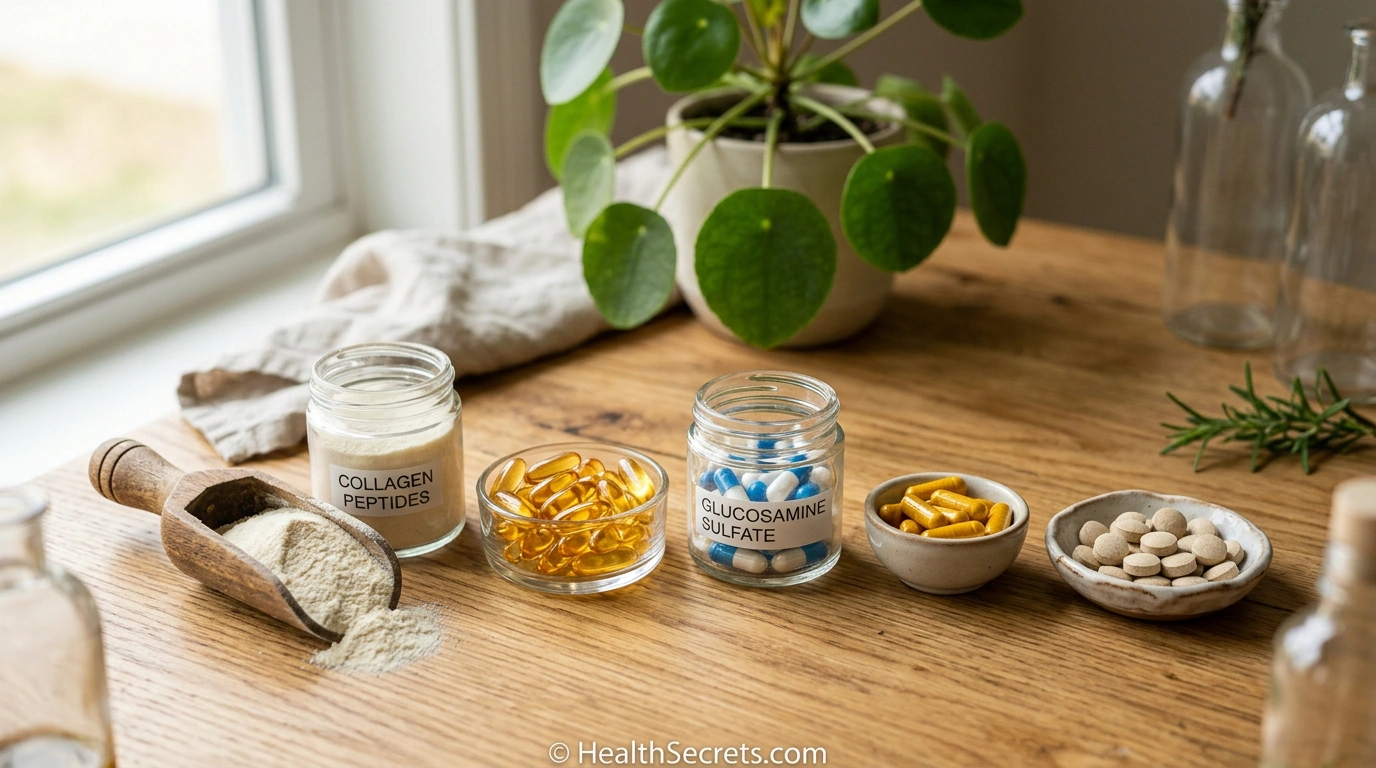
 Pin It
 Supplements for Joint Health: Complete Guide
Who This Is For
Best for readers who want a grounded introduction to supplements.
Who Should Be Careful
Not for emergency decisions or personalized treatment planning.
Affiliate Disclaimer | This article may contain affiliate links to products we trust. If you choose to buy through them, we may earn a small commission at no extra cost to you. Full disclosure
Medical Disclaimer | For informational purposes only. Not a substitute for professional medical advice. Read full disclaimer
Key Takeaways
Thorne Curcumin Phytosome (Meriva)
Editor's ChoiceThorne Curcumin · Anti-inflammatory joint support with enhanced bioavailability
Move Free Advanced Plus MSM
Best ValueMove Free · Comprehensive glucosamine-chondroitin-MSM combination at an accessible price
Vital Proteins Collagen Peptides
Best CollagenVital Proteins · Cartilage support and overall joint and connective tissue health
Nordic Naturals Ultimate Omega
Best Omega-3Nordic Naturals · Reducing systemic inflammation and supporting joint lubrication
Life Extension 5-LOX Inhibitor with ApresFlex
Best BoswelliaLife Extension · Targeted OA pain relief through 5-lipoxygenase inhibition
NOW Foods UC-II Undenatured Type II Collagen
Best UC-IINOW Foods · Immune-modulated cartilage support and exercise-related joint discomfort
Doctor's Best MSM with OptiMSM
Best MSMDoctor's Best · Anti-inflammatory sulfur support for joint tissue repair
NOW Foods Hyaluronic Acid 100mg with MSM
Best Hyaluronic AcidNOW Foods · Joint lubrication and synovial fluid support
Read the detailed review cards below before opening any retailer link
Let me be straight with you — if you've spent any time searching for joint health supplements, you've probably noticed the shelves are packed with options. Glucosamine bottles here, turmeric capsules there, collagen powders everywhere. It gets overwhelming fast.
And honestly? Not all of them deliver what they promise.
But here's the good news: clinical research has identified several supplements that genuinely help. A 2026 systematic review confirmed that glucosamine and chondroitin are generally effective and well-tolerated for managing osteoarthritis and joint pain, with over 90% of efficacy studies reporting positive outcomes. Meanwhile, curcumin and boswellia showed encouraging evidence for pain reduction and improved function. The key is knowing which ones actually work, at what dose, and for what type of joint issue.
That's exactly what this guide covers. We've reviewed the clinical evidence for eight major joint supplements, tested leading products, and built this complete resource to help you make informed decisions about your joint health.
For foundational supplement knowledge, see our complete supplements guide and our guide to supplement safety. If inflammation is a primary concern, explore our inflammation and pain relief guide.
What Should You Look for When Choosing Joint Health Supplements?
The most important factors when selecting joint supplements are evidence-based ingredients at clinical doses, bioavailable formulations, and third-party quality verification. Look for specific forms like glucosamine sulfate (not hydrochloride), curcumin with piperine or phytosome technology, and UC-II or hydrolyzed collagen — these deliver measurably better results than generic alternatives.
Which Forms and Doses Have the Strongest Evidence?
The form of a supplement matters enormously for joint health. Glucosamine sulfate at 1,500mg daily has stronger evidence than glucosamine hydrochloride. Curcumin with enhanced bioavailability (Meriva phytosome or BioPerine) absorbs up to 29 times better than standard curcumin. For collagen, UC-II (undenatured type II collagen at 40mg) works through a different immune-modulating mechanism than hydrolyzed collagen peptides (10g), and both have clinical support.
Key evidence-based doses:
- Glucosamine sulfate: 1,500mg daily
- Chondroitin sulfate: 1,200mg daily
- Curcumin (enhanced form): 500–1,000mg daily
- Boswellia serrata (AKBA-enriched): 100–250mg daily
- UC-II collagen: 40mg daily
- Hydrolyzed collagen peptides: 10–20g daily
- Omega-3 (EPA+DHA): 2–3g daily
- MSM: 1,500–3,000mg daily

How Do You Verify Supplement Quality?
Third-party testing is non-negotiable. Look for certifications from NSF International, USP (United States Pharmacopeia), or ConsumerLab.com [18]. These organizations independently verify that products contain what the label claims, are free from contaminants like heavy metals, and meet manufacturing quality standards. A 2026 review noted that supplement quality varies significantly, with contamination and inaccurate labeling affecting 20–50% of products tested.
What About Combination Products vs. Single Ingredients?
Combination products can be convenient, but they often contain sub-clinical doses of individual ingredients. Check that each ingredient meets its evidence-based dose. A glucosamine/chondroitin combo with 1,500mg/1,200mg respectively is properly dosed. A "joint health complex" with 500mg glucosamine, 200mg chondroitin, and five other ingredients at micro-doses is unlikely to deliver meaningful results.
How Did We Evaluate These Joint Health Supplements?
We evaluated joint supplements based on five criteria: clinical evidence strength, ingredient form and bioavailability, third-party testing verification, value per effective dose, and real-world user experience. Products with published clinical trials, verified certifications, and transparent labeling scored highest in our assessment.

Our Evaluation Criteria
- Clinical Evidence: Priority given to ingredients with randomized controlled trials and systematic reviews published in peer-reviewed journals (PubMed, NIH databases)
- Dosing Accuracy: Each product must contain clinically studied doses — not token amounts in proprietary blends
- Bioavailability: Enhanced absorption forms (phytosome, piperine-enhanced, chelated) preferred where evidence supports them
- Third-Party Testing: Products verified by NSF, USP, or ConsumerLab receive priority
- Transparency: Clear ingredient sourcing, manufacturing practices, and company track record
- Value: Cost per effective daily dose, not just cost per pill
How Should You Take Joint Supplements for Best Results?
For optimal results, take glucosamine and chondroitin with meals to reduce gastrointestinal discomfort, split larger doses across morning and evening, and allow 8–12 weeks before evaluating effectiveness. Fat-soluble supplements like curcumin and omega-3s absorb significantly better when taken with a meal containing dietary fat.
What Is the Optimal Timing and Dosing Schedule?
- Glucosamine (1,500mg): Take with food, either as a single dose or split into 500mg three times daily. Consistent daily use for at least 8 weeks is needed before evaluating results.
- Chondroitin (1,200mg): Take with food alongside glucosamine. Some studies used 400mg three times daily.
- Curcumin (500–1,000mg): Take with a fat-containing meal for better absorption. Enhanced forms (Meriva, with BioPerine) require lower doses than standard curcumin.
- Collagen peptides (10g): Take on an empty stomach or with vitamin C to support collagen synthesis. Morning is generally preferred.
- UC-II collagen (40mg): Take once daily, ideally on an empty stomach before bed.
- Boswellia (100–250mg): Take with meals. Look for AKBA-enriched extracts.
- Omega-3 (2–3g EPA+DHA): Take with the largest meal of the day to maximize absorption and minimize fishy aftertaste.
- MSM (1,000–3,000mg): Split into two or three doses with meals. Start with 1,000mg and gradually increase.
Can You Combine Multiple Joint Supplements?
Yes, and research suggests certain combinations may provide synergistic benefits. Glucosamine plus chondroitin is the most studied combination, with the GAIT trial showing the pair was effective for moderate-to-severe knee pain. Pairing curcumin with boswellia targets inflammation through complementary pathways. Collagen plus vitamin C supports collagen synthesis naturally.
However, avoid taking everything at once — space supplements throughout the day and start with one or two, adding others after 4–6 weeks to track individual responses. For more on combining supplements effectively, see our supplement stacking guide.
Are Joint Health Supplements Safe, and What Are the Risks?
Most joint supplements have favorable safety profiles when used at recommended doses. Glucosamine and chondroitin have been used safely in clinical trials lasting up to three years, with side effects generally limited to mild gastrointestinal discomfort. However, specific populations need caution — particularly those on blood thinners, people with shellfish allergies (for glucosamine), and individuals with diabetes.

Who Should Avoid or Use Caution With Joint Supplements?
- Blood thinner users: Chondroitin may have mild blood-thinning effects. Omega-3s, turmeric, and boswellia also affect blood clotting. Consult your doctor before combining these with warfarin, aspirin, or other anticoagulants.
- Shellfish allergy: Some glucosamine is derived from shellfish. Choose vegetarian glucosamine (from corn fermentation) if you have a shellfish allergy.
- Diabetes: Glucosamine may affect blood sugar levels in some individuals. Monitor blood glucose more closely when starting glucosamine supplementation.
- Pregnant or breastfeeding: Limited safety data for most joint supplements during pregnancy. Consult your healthcare provider.
- Before surgery: Stop omega-3s, turmeric, and boswellia at least 2 weeks before scheduled surgery due to blood-thinning effects.
- Autoimmune conditions: UC-II collagen works through immune modulation — consult your rheumatologist if you have an autoimmune condition.

What Are Common Side Effects?
Side effects are generally mild and may include nausea, diarrhea, constipation, or stomach upset. Turmeric can cause digestive discomfort at high doses. Fish oil may cause fishy burps (enteric-coated or emulsified forms reduce this). MSM occasionally causes headaches or insomnia when starting. If you experience persistent or severe side effects, stop the supplement and consult your healthcare provider.
What Is the Best Step-by-Step Plan for Improving Joint Health with Supplements?
Start with a medical evaluation to identify the cause of your joint pain, then implement a phased supplement plan alongside lifestyle changes. Phase 1 focuses on foundation supplements with the strongest evidence (weeks 1–4), Phase 2 adds targeted support (weeks 5–8), and Phase 3 involves optimization and reassessment (weeks 9–12).
Phase 1: Foundation (Weeks 1–4)
- See a healthcare provider to evaluate joint pain and rule out conditions requiring specific treatment
- Start glucosamine sulfate (1,500mg) + chondroitin sulfate (1,200mg) daily with meals
- Add curcumin (500mg enhanced bioavailability form) with a fat-containing meal
- Begin anti-inflammatory dietary changes (increase omega-3 rich foods, reduce processed foods and added sugars)
- Start low-impact exercise (swimming, cycling, walking — 150 minutes per week)
Phase 2: Targeted Support (Weeks 5–8)
- Add collagen peptides (10g daily) or UC-II (40mg daily) based on your primary concern
- Consider boswellia (100–250mg) if inflammation remains a primary issue
- Increase omega-3 supplementation if dietary intake is insufficient (2–3g EPA+DHA)
- Incorporate strength training to support joint stability (2–3 sessions per week)
- Track pain levels, stiffness, and mobility using a daily journal or app
Phase 3: Optimization (Weeks 9–12)
- Evaluate which supplements are providing noticeable benefit
- Discontinue any supplements that haven't produced improvement after 8–12 weeks
- Consider adding MSM (1,500–3,000mg) for additional anti-inflammatory support
- Reassess with your healthcare provider — discuss progress and adjust plan
- Establish a long-term maintenance protocol with your most effective supplements

Top Recommended Products
Thorne Curcumin
Thorne Curcumin Phytosome (Meriva)
Thorne's Meriva curcumin is one of the most bioavailable curcumin forms available. The phytosome technology wraps curcumin in sunflower lecithin, dramatically improving absorption without requiring piperine, which can interfere with some medications.
Pros
- + NSF Certified for Sport verified
- + Meriva phytosome technology for superior absorption
- + clinically studied form
- + no piperine needed
Cons
- - Higher price per serving than standard curcumin
Why we included it: Thorne's Meriva curcumin is one of the most bioavailable curcumin forms available. The phytosome technology wraps curcumin in sunflower lecithin, dramatically improving absorption without requiring piperine, which can interfere with some medications.
Retailer link opens on Amazon after the review details above
Move Free
Move Free Advanced Plus MSM
Move Free offers a convenient all-in-one formula at an accessible price point. While the chondroitin dose is lower than ideal, the glucosamine and MSM doses are clinically relevant, making this a solid starting point for joint support.
Pros
- + Combines three key joint ingredients
- + affordable per serving
- + widely available
- + includes MSM for additional support
Cons
- - Chondroitin dose below clinical threshold of 1
- - 200mg
- - contains shellfish-derived glucosamine
Why we included it: Move Free offers a convenient all-in-one formula at an accessible price point. While the chondroitin dose is lower than ideal, the glucosamine and MSM doses are clinically relevant, making this a solid starting point for joint support.
Retailer link opens on Amazon after the review details above
Vital Proteins
Vital Proteins Collagen Peptides
Vital Proteins delivers a generous 20g dose of hydrolyzed collagen peptides with NSF certification for quality assurance. The unflavored powder mixes seamlessly into coffee, smoothies, or water, making consistent daily use effortless.
Pros
- + NSF certified quality
- + flavorless and dissolves easily in hot or cold liquids
- + grass-fed and pasture-raised source
- + 20g collagen per serving
Cons
- - Higher price per serving than some competitors
- - bovine-sourced only
Why we included it: Vital Proteins delivers a generous 20g dose of hydrolyzed collagen peptides with NSF certification for quality assurance. The unflavored powder mixes seamlessly into coffee, smoothies, or water, making consistent daily use effortless.
Retailer link opens on Amazon after the review details above
Nordic Naturals
Nordic Naturals Ultimate Omega
Nordic Naturals consistently ranks among the highest-quality fish oil brands with USP verification and sustainable sourcing. The triglyceride form ensures excellent absorption, critical for achieving anti-inflammatory effects in joints.
Pros
- + USP verified for purity and potency
- + triglyceride form absorbs better than ethyl ester
- + sustainably sourced
- + lemon flavor reduces fishy aftertaste
Cons
- - Need 2–3 servings to reach therapeutic joint dose of 2–3g EPA+DHA
Why we included it: Nordic Naturals consistently ranks among the highest-quality fish oil brands with USP verification and sustainable sourcing. The triglyceride form ensures excellent absorption, critical for achieving anti-inflammatory effects in joints.
Retailer link opens on Amazon after the review details above
Life Extension
Life Extension 5-LOX Inhibitor with ApresFlex
Life Extension's boswellia uses the ApresFlex extract, a clinically studied form that delivers superior AKBA bioavailability. At just 100mg daily, this is one of the most convenient and evidence-supported options for OA pain relief.
Pros
- + Clinically studied ApresFlex form
- + effective at low 100mg dose
- + affordable
- + well-tolerated
Cons
- - Single-ingredient product requires additional supplements for comprehensive joint support
Why we included it: Life Extension's boswellia uses the ApresFlex extract, a clinically studied form that delivers superior AKBA bioavailability. At just 100mg daily, this is one of the most convenient and evidence-supported options for OA pain relief.
Retailer link opens on Amazon after the review details above
NOW Foods
NOW Foods UC-II Undenatured Type II Collagen
UC-II works through a fundamentally different mechanism than hydrolyzed collagen — it trains the immune system to stop attacking joint cartilage. Clinical trials show it outperformed glucosamine/chondroitin for knee comfort at just 40mg daily.
Pros
- + Unique immune-modulating mechanism
- + tiny 40mg dose is convenient
- + well-studied in clinical trials
- + GMP certified
Cons
- - Results may take 90+ days
- - different mechanism than hydrolyzed collagen
- - chicken-derived
Why we included it: UC-II works through a fundamentally different mechanism than hydrolyzed collagen — it trains the immune system to stop attacking joint cartilage. Clinical trials show it outperformed glucosamine/chondroitin for knee comfort at just 40mg daily.
Retailer link opens on Amazon after the review details above
Doctor's Best
Doctor's Best MSM with OptiMSM
Doctor's Best uses OptiMSM, the most clinically studied form of MSM, purified through distillation rather than crystallization. This ensures the highest purity level, and at this price point, it is excellent value for adding sulfur-based joint support.
Pros
- + Clinically studied OptiMSM form
- + vegan-friendly
- + very affordable
- + high purity distillation process
Cons
- - Evidence for MSM is less robust than glucosamine or curcumin
- - may cause mild GI effects initially
Why we included it: Doctor's Best uses OptiMSM, the most clinically studied form of MSM, purified through distillation rather than crystallization. This ensures the highest purity level, and at this price point, it is excellent value for adding sulfur-based joint support.
Retailer link opens on Amazon after the review details above
NOW Foods
NOW Foods Hyaluronic Acid 100mg with MSM
NOW Foods pairs hyaluronic acid with MSM at a fair price point. While oral HA research is still developing, early studies show promise for joint comfort, and the combination with MSM adds anti-inflammatory support.
Pros
- + Combines HA with MSM for dual benefit
- + GMP quality
- + affordable
- + good serving count
Cons
- - Oral HA absorption is still being researched
- - lower MSM dose than standalone products
Why we included it: NOW Foods pairs hyaluronic acid with MSM at a fair price point. While oral HA research is still developing, early studies show promise for joint comfort, and the combination with MSM adds anti-inflammatory support.
Retailer link opens on Amazon after the review details above
Further Reading
Further Reading
"The Arthritis Cure: The Medical Miracle That Can Halt, Reverse, and May Even Cure Osteoarthritis"
by Jason Theodosakis
Evidence review of glucosamine and chondroitin research; practical supplement dosing protocols; exercise programs for joint health; dietary recommendations for arthritis management
Why it adds value here
Dr. Theodosakis brought glucosamine and chondroitin research to mainstream attention and provides a physician's perspective on integrating supplements with conventional joint care.
Best for: Anyone seeking a comprehensive, physician-written guide to glucosamine, chondroitin, and integrative joint health strategies
View book detailsFurther Reading
"The Anti-Inflammation Zone: Reversing the Silent Epidemic That's Destroying Our Health"
by Barry Sears
Scientific explanation of inflammation pathways; Zone Diet protocols for reducing systemic inflammation; omega-3 dosing strategies; practical meal plans supporting joint health
Why it adds value here
Understanding inflammation is central to managing joint health. Dr. Sears provides the dietary framework that maximizes supplement effectiveness for long-term joint care.
Best for: Readers wanting to understand how diet and inflammation drive joint degeneration and how to address it systemically
View book detailsAEO FAQ
Frequently Asked Questions
12 common questions answered
Most clinical trials show improvements after 8–12 weeks of consistent daily use. Some people notice reduced stiffness within 4–6 weeks, but the full cartilage-protective benefits require longer-term supplementation. If you see no improvement after 3 months, the supplement may not be effective for your specific condition.
You should avoid shellfish-derived glucosamine if you have a shellfish allergy. However, vegetarian glucosamine derived from corn fermentation is available and equally effective. Check product labels carefully, as most standard glucosamine is shellfish-sourced.
Curcumin is the active compound in turmeric responsible for anti-inflammatory effects. Curcumin supplements provide concentrated, standardized doses with enhanced bioavailability, making them significantly more effective than turmeric spice for joint inflammation. Look for curcumin with piperine (BioPerine) or phytosome technology for best absorption.
UC-II (undenatured type II collagen) works through immune modulation at a tiny 40mg dose, training the immune system to stop attacking cartilage. Hydrolyzed collagen (10–20g) provides amino acid building blocks for cartilage repair. They work through different mechanisms and can be used together.
Joint supplements should not replace prescribed medications without your doctor's guidance. Supplements like glucosamine and curcumin may complement conventional treatment, and some studies show the glucosamine/chondroitin combination is comparable to celecoxib for mild-to-moderate osteoarthritis. Always discuss changes with your healthcare provider.
Yes, most joint supplements can be safely combined, and certain combinations like glucosamine plus chondroitin are specifically studied together. However, be cautious about blood-thinning effects when combining omega-3s, turmeric, and boswellia — especially if you take anticoagulant medications. Start with one or two and add others gradually.
Yes. Studies using radioactive-labeled collagen peptides confirmed that hydrolyzed collagen is absorbed in the gut, enters the bloodstream, and accumulates in joint cartilage. A 2026 systematic review found that type I collagen hydrolysate significantly improved joint pain and mobility across multiple randomized controlled trials.
For knee osteoarthritis, the strongest evidence supports glucosamine sulfate (1,500mg) plus chondroitin sulfate (1,200mg), curcumin (500–1,000mg enhanced form), and boswellia (100–250mg). A 2024 meta-analysis of 25 trials found chondroitin reduced knee OA pain and improved function, while glucosamine slowed joint space narrowing.
Joint supplements can benefit younger, active individuals too. UC-II collagen has shown benefits for exercise-related joint discomfort in healthy adults. Collagen peptides may support recovery from intense training. However, young athletes should prioritize proper training, nutrition, and recovery before supplementation.
MSM has modest evidence for joint pain relief. Some trials show 1,500–3,000mg daily reduces pain and improves function in knee osteoarthritis, but a 2026 evidence review noted that MSM currently lacks strong support compared to glucosamine, curcumin, or boswellia. It is best considered as an add-on rather than a primary joint supplement.
It depends on the supplement. Glucosamine, chondroitin, and boswellia are best taken with food to reduce GI discomfort. Curcumin and omega-3s should be taken with fatty meals for better absorption. UC-II collagen works best on an empty stomach. Hydrolyzed collagen can be taken any time but is commonly taken in the morning.
Track specific metrics over 8–12 weeks: pain levels on a 1–10 scale, morning stiffness duration, ability to perform daily activities, and exercise tolerance. Take baseline measurements before starting. If you see no meaningful improvement after 12 weeks of consistent use at proper doses, the supplement likely is not effective for you.
Was this article helpful?
Written & Reviewed By Experts
Author
Dr. Sarah Chen
Medical Reviewer
Dr. Sarah Chen
All content is evidence-based, peer-reviewed by qualified professionals, and updated regularly. Our editorial team follows strict guidelines for accuracy and transparency.
References & Citations
18 sources cited
Medical Disclaimer
This article is for informational purposes only and does not constitute medical advice. Read the full medical disclaimer. Always consult with a qualified healthcare provider before starting any new supplement, treatment, or major dietary change.