
If you've been living with IBS, you already know the drill. The unpredictable flare-ups, the constant bathroom anxiety, the mental gymnastics of figuring out what's safe to eat. It's exhausting—and honestly, it can feel pretty isolating.
Here's the thing, though. You're not alone. Irritable bowel syndrome affects somewhere between 10–15% of people worldwide, making it one of the most common gastrointestinal disorders on the planet. And while there's no single "cure," research over the past decade has uncovered a growing list of natural strategies that genuinely work for natural IBS relief.
This isn't another generic list of tips you've already heard. We're diving into 10 evidence-based approaches—backed by clinical trials and systematic reviews—that target the root mechanisms of IBS: gut-brain axis dysfunction, visceral hypersensitivity, dysbiosis, and food intolerances.
Whether you're dealing with IBS-D (diarrhea-predominant), IBS-C (constipation-predominant), or IBS-M (mixed), there's something here for you. We'll cover dietary interventions, targeted supplements, stress-reduction techniques, and lifestyle changes that can genuinely shift the needle.
You'll walk away with a clear, step-by-step plan you can start implementing this week. For more foundational context, check out our complete gut health guide.
What Do You Need to Know Before Starting a Natural IBS Relief Protocol?
Before diving into specific strategies, it helps to understand what you're actually dealing with. IBS is a disorder of gut-brain interaction—meaning the communication between your brain and your digestive system has gone haywire. This leads to visceral hypersensitivity (your gut overreacts to normal sensations), altered motility (things move too fast or too slow), and often, gut microbiome imbalances.
| Subtype | Primary Symptom | Key Triggers | Best Strategies |
|---|---|---|---|
| IBS-D (Diarrhea) | Loose/frequent stools | Stress, high-FODMAP foods, bile acid | Low FODMAP, probiotics, peppermint oil |
| IBS-C (Constipation) | Infrequent/hard stools | Low fiber, dehydration, inactivity | Soluble fiber, magnesium, hydration |
| IBS-M (Mixed) | Alternating D and C | Variable—often stress and diet | Low FODMAP, hypnotherapy, probiotics |
What to expect: Most natural strategies take 4–8 weeks of consistent application before you'll notice meaningful improvement. This isn't a quick fix—it's a systematic approach to retraining your gut-brain connection. For a deeper understanding of the IBS and SIBO overlap, see our dedicated guide.

How Do You Start the Low FODMAP Elimination Diet?
The low FODMAP diet is the most extensively studied dietary intervention for IBS, reducing symptoms in 50–86% of patients according to multiple systematic reviews and meta-analyses. FODMAPs—fermentable oligosaccharides, disaccharides, monosaccharides, and polyols—are short-chain carbohydrates that draw water into the intestine and produce gas through bacterial fermentation.
The three-phase approach:
- Elimination phase (2–6 weeks): Remove all high-FODMAP foods—including garlic, onion, wheat, lactose, certain fruits (apples, pears), legumes, and sugar alcohols
- Reintroduction phase (6–8 weeks): Systematically test one FODMAP group at a time (fructans, lactose, fructose, polyols, galacto-oligosaccharides) to identify your personal triggers
- Personalization phase (ongoing): Build a long-term diet that avoids only your specific triggers while maintaining nutritional diversity
A 2026 umbrella review of meta-analyses confirmed the low FODMAP diet significantly reduces IBS Symptom Severity Scale scores and improves quality of life across diverse populations [21]. However, long-term strict restriction can reduce beneficial Bifidobacteria, so the reintroduction phase is critical.
Important: Work with a registered dietitian experienced in FODMAPs. The Monash University FODMAP app is an excellent resource for food guidance. For our complete low FODMAP diet guide, see the dedicated article.

Which Probiotic Strains Actually Help IBS?
Not all probiotics are created equal for IBS—strain specificity matters enormously. The World Gastroenterology Organisation guidelines state that Bifidobacterium infantis 35624 has "the best evidence base for efficacy in IBS," and clinical trials back this up consistently.
Top evidence-based strains for IBS:
- Bifidobacterium infantis** 35624 (Alflorex/Align):** Significantly reduces abdominal pain, bloating, gas, and composite symptom scores across all IBS subtypes. Works by normalizing the IL-10/IL-12 cytokine ratio—essentially calming gut inflammation at the immune level [20]Gastroenterology [20][20]
- Lactobacillus plantarum** 299v:** Shows benefits particularly for abdominal pain and bloating
- Saccharomyces boulardii: Particularly helpful for IBS-D due to anti-diarrheal properties
- VSL#3 (multi-strain): Shows benefit for bloating and flatulence in some trials
A 2021 systematic review and meta-analysis found that six single-strain probiotics and three probiotic mixtures showed significant efficacy for at least one IBS outcome measure eClinicalMedicine [19][19]. The key is choosing a strain with clinical evidence, not just any generic "gut health" probiotic.
Dosing: Follow the manufacturer's recommended dose. Most clinical trials use 1 billion CFU daily for B. infantis 35624. Take consistently for at least 4–8 weeks before judging effectiveness. Check out our guide on the best probiotics for IBS for detailed strain comparisons.
How Does Peppermint Oil Reduce IBS Pain?
Enteric-coated peppermint oil is one of the most effective and well-studied natural treatments for IBS abdominal pain. A 2022 systematic review and meta-analysis of 10 RCTs (1,030 patients) found peppermint oil was significantly superior to placebo for both global IBS symptoms (NNT = 4) and abdominal pain (NNT = 7) [6]Aliment Pharmacol Ther [6][6].
The active compound, menthol, works as a calcium channel antagonist—it relaxes the smooth muscle of the intestinal wall, reducing spasms and the visceral pain signals they trigger. Think of it as a natural antispasmodic that targets the gut directly.
How to use it effectively:
- Choose enteric-coated capsules only—regular peppermint oil can cause heartburn by relaxing the lower esophageal sphincter
- Standard dose: 0.2–0.4 mL (180–400 mg) per capsule, taken 2–3 times daily
- Timing: 30–60 minutes before meals for best results
- Duration: Benefits often appear within 2–4 weeks
A 2019 meta-analysis of pooled clinical data confirmed enteric-coated peppermint oil is a "safe and effective therapy for the relief of abdominal pain and global symptoms in adults with IBS" [5]BMC Complement Altern Med [5][5]. The American College of Gastroenterology also recommends it for overall IBS symptom improvement.
Can Digestive Enzymes Improve IBS Symptoms?
Digestive enzymes can be particularly helpful if your IBS symptoms worsen after meals—especially when eating foods containing lactose, fats, or complex carbohydrates. The idea is straightforward: if your body isn't producing enough enzymes to fully break down certain foods, supplementing them can reduce the fermentation and gas that trigger symptoms.
Key enzymes for IBS:
- Lactase: Essential if lactose intolerance contributes to your symptoms (which is common in IBS)
- Alpha-galactosidase (Beano): Breaks down galacto-oligosaccharides in beans, lentils, and cruciferous vegetables
- Lipase: Helps with fat digestion—useful if fatty meals trigger symptoms
- Broad-spectrum blends: Combinations that cover multiple food types simultaneously
Enzyme supplementation isn't a standalone solution, but it can be a helpful adjunct—especially during the FODMAP reintroduction phase when you're testing trigger foods. Our digestive enzymes guide covers this in more detail.
How Does Stress Management Reduce IBS Flare-Ups?
This one's huge—and often underestimated. Stress doesn't just make IBS symptoms feel worse; it physically amplifies visceral hypersensitivity through the gut-brain axis. When you're stressed, your hypothalamic-pituitary-adrenal (HPA) axis ramps up cortisol production, which directly increases intestinal permeability, alters gut motility, and heightens pain sensitivity in the gut.
Gut-directed hypnotherapy (GDH) deserves special attention here. A 2026 systematic review and meta-analysis of 12 studies (1,158 patients) found that GDH significantly improved global IBS symptoms, with sustained benefits at 12-month follow-up [7]Neurogastroenterol Motil [7][7]. Research from Monash University showed 81% of GDH participants experienced clinically significant symptom reduction [8].
GDH works by retraining the brain's response to gut sensations—essentially dialing down the volume on visceral hypersensitivity. Apps like Nerva (developed by Monash researchers) make this accessible from home.
Other evidence-based stress techniques for IBS:
- Cognitive behavioral therapy (CBT): Strong evidence for IBS symptom reduction
- Diaphragmatic breathing: 5–10 minutes daily can reduce gut-specific anxiety
- Progressive muscle relaxation: Particularly helpful before meals
- Mindfulness meditation: Regular practice reduces IBS symptom severity over time
For more strategies, see our stress management guide.

How Do You Optimize Fiber Intake for Your IBS Subtype?
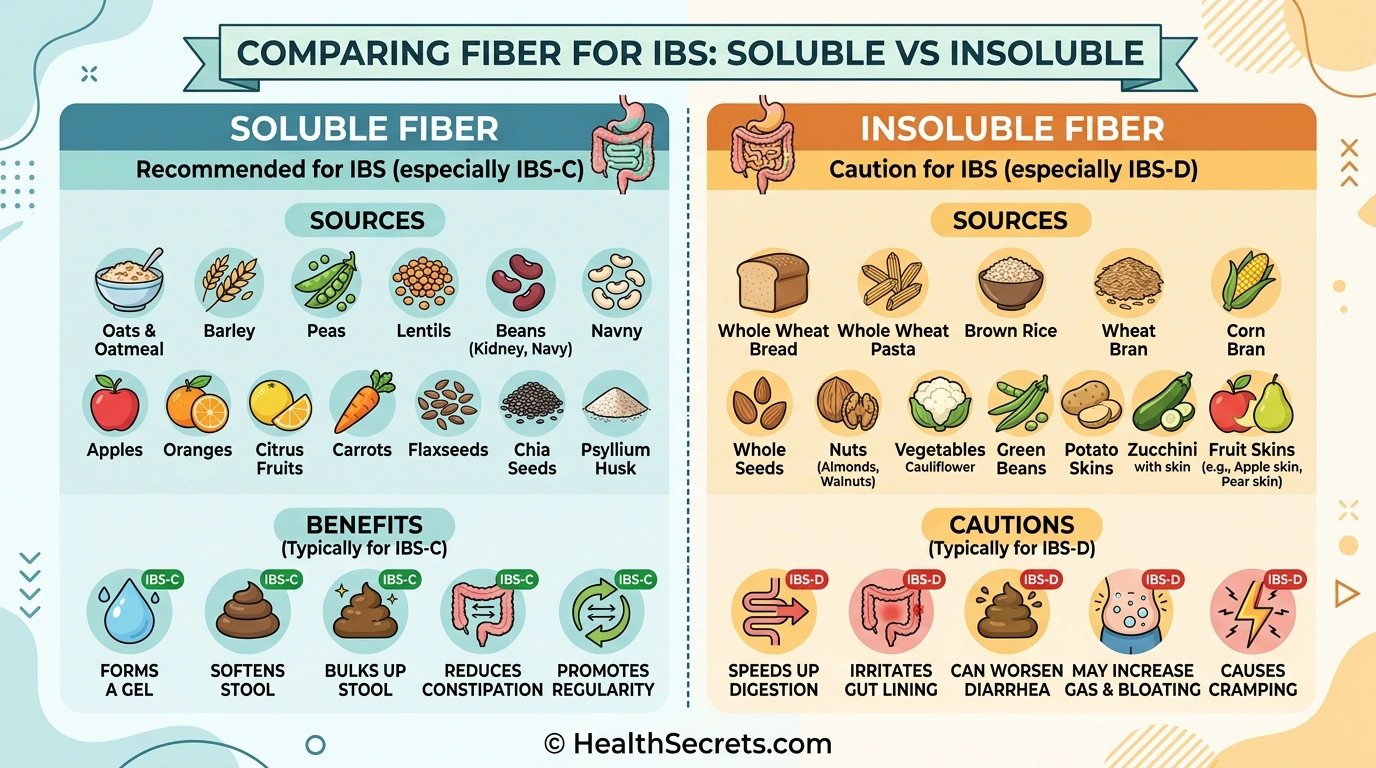
Fiber is where IBS management gets nuanced—because the wrong type can make things significantly worse. The critical distinction is between soluble and insoluble fiber.
Soluble fiber (generally helpful, especially IBS-C):
- Dissolves in water to form a gel-like substance
- Slows transit time (helps diarrhea) and softens stool (helps constipation)
- Sources: psyllium husk, oat bran, flaxseed, chia seeds
- Psyllium has the strongest evidence—start at 1 teaspoon daily and increase slowly
Insoluble fiber (often problematic, especially IBS-D):
- Adds bulk but can increase gas, bloating, and diarrhea
- Sources: wheat bran, whole grains, raw vegetables, fruit skins
- Reduce if symptoms worsen; increase only gradually if tolerated
The golden rule: Start low, go slow. Increase fiber by no more than 2–3 grams per week. Rapid increases—even of soluble fiber—can temporarily worsen bloating and gas as your gut microbiome adjusts.
How Do You Identify and Eliminate Your Personal Food Triggers?
Beyond FODMAPs, individual trigger foods vary enormously from person to person. A food diary is your most powerful diagnostic tool here.
How to keep an effective IBS food diary:
- Record everything: What you ate, when, portion sizes, how it was prepared
- Track symptoms: Type, severity (1–10 scale), timing relative to meals
- Note context: Stress levels, sleep quality, menstrual cycle, physical activity
- Review patterns: After 2–3 weeks, look for consistent food-symptom connections
Common non-FODMAP triggers:
- Caffeine: Stimulates colonic motility—problematic for IBS-D
- Alcohol: Irritates gut lining, increases intestinal permeability
- Spicy foods: Capsaicin activates TRPV1 receptors, increasing gut sensitivity
- Fatty or fried foods: Trigger the gastrocolic reflex, causing cramping
- Artificial sweeteners: Sorbitol, mannitol (these are actually polyol FODMAPs)
Once identified, elimination doesn't have to be permanent. Many people find their tolerance increases as they address underlying gut health through other strategies. For foods that support healing, see our guide on gut-healing foods.
How Do Regular Meals and Hydration Support IBS Management?
This sounds basic, but irregular eating patterns are a surprisingly common IBS aggravator. Your gut has its own circadian rhythm—the migrating motor complex (MMC)—that cleans house between meals. Erratic eating disrupts this housekeeping cycle.
Meal timing strategies:
- Eat at consistent times daily—within a 1-hour window for each meal
- Don't skip meals—gaps longer than 5–6 hours disrupt MMC function
- Eat smaller, more frequent meals if large meals trigger symptoms
- Allow 3–4 hours between meals for the MMC to complete its sweep
- Avoid eating within 2–3 hours of bedtime
Hydration:
- Aim for 8–10 glasses daily—dehydration worsens both constipation and bloating
- Warm water may be better tolerated than cold (less likely to trigger spasms)
- Herbal teas like chamomile and ginger can provide additional soothing benefits
- Limit carbonated beverages—the gas adds to bloating
What Types of Exercise Help Reduce IBS Symptoms?
Regular physical activity improves IBS symptoms through multiple mechanisms: it enhances gut motility, reduces stress hormones, improves sleep quality, and decreases visceral hypersensitivity. But intensity matters—vigorous exercise can actually trigger flare-ups, while moderate activity is consistently beneficial [13]Am J Gastroenterol [13][13].
Best exercises for IBS:
- Walking: 20–30 minutes daily—the simplest and most consistently beneficial
- Yoga: Specifically studied for IBS. Poses like child's pose, supine twist, and knees-to-chest can relieve gas and cramping. Multiple RCTs show significant symptom improvement [12]Clin Gastroenterol Hepatol [12][12]
- Swimming: Low-impact, full-body movement that's easy on the gut
- Cycling: Moderate intensity is well-tolerated by most IBS patients
- Tai chi: Combines gentle movement with stress reduction—dual benefit
Exercise guidelines for IBS:
- Start with 150 minutes per week of moderate activity (per WHO guidelines)
- Exercise in the morning or early afternoon—late evening exercise can disrupt sleep
- Avoid high-intensity training during active flare-ups
- Wait at least 1–2 hours after eating before exercising

How Do Sleep Optimization and Mind-Body Practices Improve IBS?
Poor sleep and IBS form a vicious cycle. Sleep disruption increases visceral pain sensitivity, gut inflammation, and stress reactivity—all of which worsen IBS. And IBS symptoms (nighttime pain, urgency) disrupt sleep. Breaking this cycle is essential.
Sleep optimization for IBS:
- Consistent schedule: Same bedtime and wake time, even weekends
- 7–9 hours minimum: Fewer than 6 hours significantly worsens IBS symptoms
- Cool, dark room: 65–68°F (18–20°C) is optimal
- No large meals within 3 hours of bedtime
- Limit screens: Blue light suppresses melatonin, which also has gut-protective effects
Mind-body techniques:
- Diaphragmatic breathing: 4-7-8 pattern (inhale 4, hold 7, exhale 8)—activates the vagus nerve, calming gut function
- Body scan meditation: Systematically reduces tension held in the abdomen
- Journaling: Processing emotions reduces their impact on the gut-brain axis
- Progressive muscle relaxation before bed: Improves both sleep quality and IBS outcomes
Research shows that poor sleep quality is independently associated with increased abdominal pain and IBS symptom severity the following day, making sleep hygiene a genuine medical intervention—not just a wellness nice-to-have.
What Are the Most Common Mistakes People Make Managing IBS Naturally?
Even with the best intentions, there are pitfalls that can stall your progress or make things worse. These are the errors we see most often.
Common mistakes to avoid:
- Trying everything at once: Implement one strategy at a time (every 2–3 weeks) so you can identify what actually helps
- Staying on strict low FODMAP indefinitely: The elimination phase should last 2–6 weeks maximum—long-term restriction harms your microbiome
- Choosing the wrong probiotic: Generic "gut health" probiotics aren't the same as IBS-specific strains. Strain specificity matters
- Ignoring stress: You can perfect your diet and still flare if chronic stress goes unaddressed
- Increasing fiber too quickly: This is the #1 reason people say "fiber makes my IBS worse"—they added too much too fast
- Expecting instant results: Most strategies need 4–8 weeks of consistent use. Don't abandon something after 5 days
- Self-diagnosing without ruling out red flags: Blood in stool, unexplained weight loss, family history of colon cancer, or symptom onset after age 50 all warrant medical evaluation
Is Natural IBS Management Safe? When Should You See a Doctor?
Natural approaches for IBS are generally very safe, but they're not a substitute for medical care. This distinction matters.
When to see a doctor immediately (red flag symptoms):
- Blood in stool or black/tarry stools
- Unexplained weight loss (>5% in 6 months)
- Persistent vomiting
- Symptoms waking you from sleep
- Severe, worsening pain
- New symptoms after age 50
- Family history of colon cancer, IBD, or celiac disease
- Fever accompanying GI symptoms
Supplement safety considerations:
- Peppermint oil: Avoid with GERD or hiatal hernia (can worsen reflux). Stop if heartburn develops
- Probiotics: Generally very safe. Rare cases of bloating in the first few days—this usually resolves
- Digestive enzymes: Safe for most people. Avoid if allergic to the enzyme source
- Fiber supplements: Start low to avoid gas and bloating. Drink adequate water with psyllium
For information on natural remedies for IBS and the IBS and leaky gut connection, see our dedicated guides.
What Should You Do First to Start Managing IBS Naturally?
Getting started can feel overwhelming with 10 strategies to choose from. Here's your phased action plan to keep things manageable.
Phase 1: Foundation (Weeks 1–2)
- Get a formal IBS diagnosis if you haven't already (rule out celiac, IBD)
- Start a detailed food and symptom diary
- Establish consistent meal timing (3 meals + 1–2 snacks at regular times)
- Begin daily 20-minute walks
- Increase water intake to 8–10 glasses daily
Phase 2: Dietary Intervention (Weeks 3–8)
- Begin the low FODMAP elimination phase with a registered dietitian
- Start an IBS-specific probiotic (B. infantis 35624 or evidence-based strain)
- Introduce soluble fiber gradually (psyllium—start at 1 tsp daily)
- Eliminate identified trigger foods from your diary
Phase 3: Gut-Brain Optimization (Weeks 6–12)
- Begin enteric-coated peppermint oil if abdominal pain persists
- Start gut-directed hypnotherapy (app-based or practitioner)
- Implement a daily stress-management routine (10 min minimum)
- Optimize sleep hygiene (consistent schedule, 7–9 hours)
Phase 4: Fine-Tuning (Weeks 9–16+)
- Complete FODMAP reintroduction phase
- Assess which strategies have been most effective for you
- Build a sustainable long-term maintenance plan
- Consider a gut reset protocol if a plateau occurs


