
You walk into the kitchen and completely blank on why you're there. A colleague's name vanishes mid-sentence. That textbook chapter you studied twice? Gone by morning. Sound familiar? You're not alone — "how to improve memory" pulls over 12,000 monthly searches, and for good reason. Memory sits at the core of everything: learning, career performance, relationships, even identity.
Here's what most people get wrong, though. They assume memory is fixed — you either have a good one or you don't. Neuroscience says otherwise. Your brain rewires itself constantly through neuroplasticity, and the strategies you use directly shape how well you encode, store, and retrieve information.
The research is genuinely encouraging. Spaced repetition can boost long-term retention by up to 200% compared to cramming [1]. Active recall outperforms passive rereading by roughly 50% [2]. Sleep consolidates memories by approximately 40% [3], and regular aerobic exercise increases hippocampal volume by 2% — effectively reversing one to two years of age-related shrinkage [4].
Whether you're a student preparing for exams, a professional wanting sharper recall, or simply someone who keeps forgetting where the car keys ended up — this guide gives you 15 concrete, research-backed strategies organized into clear steps. For broader cognitive health strategies, see our mental wellness guide and nootropics guide.
What Do You Need to Know Before Improving Your Memory?
Before diving into specific techniques, understanding how memory actually works helps you apply these strategies more effectively. Your memory operates through three stages: encoding (getting information in), storage (keeping it), and retrieval (getting it back out).
Your brain has different memory systems.
Working memory holds about 7 items for 20–30 seconds — think phone numbers or mental math.
Long-term memory splits into declarative memory (facts and events, managed by the hippocampus) and procedural memory (skills like riding a bike, handled by the basal ganglia). The hippocampus acts as your memory consolidation center, transferring short-term memories into long-term storage — and it's one of the few brain regions where new neurons actually grow throughout life [24].
The critical insight: every strategy in this guide works by strengthening one or more of these stages. Spaced repetition and active recall improve encoding and retrieval. Sleep improves storage and consolidation. Exercise literally grows the hippocampus. Understanding this lets you stack strategies intelligently rather than randomly.
Who this guide is for: Students, professionals, older adults concerned about cognitive decline, or anyone who wants a sharper, more reliable memory. No prerequisites needed — start wherever makes sense for your life.
Expected timeline: Some techniques (eliminating multitasking, active recall) show immediate benefits. Lifestyle changes (exercise, diet, sleep optimization) typically show noticeable memory improvements within 4–8 weeks. Supplements like bacopa require 8–12 weeks of consistent use.

How Do You Use Spaced Repetition and Active Recall to Remember More?
Spaced repetition and active recall are the two most powerful memory techniques ever studied. Spaced repetition means reviewing information at gradually increasing intervals — day 1, day 3, day 7, day 14, day 30 — instead of cramming everything at once. Research consistently shows this improves long-term retention by 150–200% compared to massed practice [1].
Active recall means testing yourself rather than passively rereading. Close the book, write down everything you remember, then check what you missed. A landmark study found this improved retention by approximately 50% over rereading [2].
How do you implement these techniques?
- Flashcard apps: Anki or Quizlet use spaced repetition algorithms that automatically schedule reviews at optimal intervals
- Practice testing: After studying, close your materials and write down everything you recall. The struggle of retrieval is what strengthens the memory trace
- Feynman technique: Explain what you've learned in simple terms as if teaching a child. If you can't explain it simply, you don't truly understand it

How Do You Use Elaboration and Mnemonics to Encode Memories Deeply?
Elaborative encoding — connecting new information to things you already know — creates stronger, more durable memories than rote memorization. When you ask "why does this matter?" or "how does this connect to what I already know?", you create multiple retrieval pathways in your brain [23].
Mnemonics provide powerful memory scaffolding:
- Memory palace (Method of Loci): Visualize a familiar location and place items you need to remember at specific spots. Memory champions use this to memorize thousands of digits [22]
- Chunking: Group information into meaningful units — a phone number as 555-123-4567 rather than ten individual digits
- Acronyms: HOMES for the Great Lakes (Huron, Ontario, Michigan, Erie, Superior)
- Multi-sensory encoding: Combine visual, auditory, and kinesthetic inputs. Write notes by hand, read aloud, and create diagrams. Multi-sensory learning improves retention by 20–30% [16]
How Does Sleep Consolidate Your Memories?
Sleep isn't downtime for your brain — it's when memory consolidation happens. During deep slow-wave sleep, your hippocampus replays the day's experiences and transfers them to long-term cortical storage. REM sleep then processes procedural memories and emotional content [3].
Sleep deprivation impairs memory consolidation by roughly 40%, and getting fewer than 7 hours affects attention comparable to a blood alcohol level of 0.08% [18].
How do you optimize sleep for memory?
- Get 7–9 hours nightly — non-negotiable for memory consolidation
- Study before bed — information learned within 1–2 hours of sleep is better retained
- Keep a consistent schedule — same bedtime and wake time, even on weekends
- Create a dark, cool environment — 65–68°F (18–20°C) is optimal
For a deep dive, see our sleep optimization guide.
How Does Exercise Grow Your Memory Center?
Aerobic exercise is one of the most powerful interventions for memory. A landmark randomized controlled trial by Erickson et al. (2011) showed that 150 minutes per week of moderate aerobic exercise increased hippocampal volume by 2% in older adults — effectively reversing 1–2 years of age-related volume loss. This translated to measurable improvements in spatial memory [4].
Exercise works through multiple pathways: it increases brain-derived neurotrophic factor (BDNF), which supports neuroplasticity and neurogenesis in the hippocampus. It also improves cerebral blood flow, reduces neuroinflammation, and enhances mood — all of which support better memory encoding.
What exercise routine benefits memory most?
- 150 minutes per week of moderate aerobic exercise — brisk walking, cycling, swimming
- Timing matters: Exercise within 4 hours after learning enhances consolidation. Morning exercise improves focus for the entire day
- Add resistance training 2–3 times per week for additional cognitive benefits
- Consistency beats intensity — regular moderate exercise outperforms sporadic intense sessions

What Should You Eat to Protect and Improve Your Memory?
The Mediterranean diet is the most extensively studied dietary pattern for brain health. A 2026 meta-analysis found that high adherence to the Mediterranean diet reduced Alzheimer's disease incidence by approximately 30% [5]. A separate 2026 study in Nature Medicine showed the diet lowered dementia risk by 35% even in people carrying the high-risk APOE4 gene variant.
What does a brain-healthy diet look like?
- Fatty fish 2–3 times per week — salmon, sardines, mackerel provide DHA omega-3, which makes up 60% of brain fat
- Colorful berries daily — blueberries and strawberries contain flavonoids that improve memory [21]
- Leafy greens and vegetables — 5–9 servings daily for antioxidant protection
- Nuts (especially walnuts) — vitamin E and healthy fats
- Extra virgin olive oil — polyphenols with anti-inflammatory effects
- Avoid: processed foods, excess sugar, and trans fats — all impair cognitive function
Stay hydrated too — even 2% dehydration impairs attention and working memory by up to 20% [20].

Nordic Naturals Ultimate Omega
Best OverallNordic Naturals · Brain structure and DHA supplementation for memory support
Himalaya Organic Bacopa
Best for MemoryHimalaya Organic · Memory enhancement and cognitive processing speed
Thorne B-Complex #12
Best for Brain SupportThorne B-Complex · Neurotransmitter synthesis and homocysteine reduction
NatureMade Vitamin D3 2000 IU
Best ValueNatureMade Vitamin · Affordable neuroprotection and cognitive function support
Optimum Nutrition Micronized Creatine Monohydrate
Best for Working MemoryOptimum Nutrition · Working memory and reasoning enhancement
Read the detailed review cards below before opening any retailer link
Top Recommended Products
Nordic Naturals
Nordic Naturals Ultimate Omega
Nordic Naturals is consistently rated among the highest-quality omega-3 brands, with excellent DHA levels specifically relevant for brain structure and memory support.
优点
- + High DHA content for brain health
- + triglyceride form well absorbed
- + no fishy aftertaste
- + third-party purity tested
缺点
- - Requires 2 softgels per serving
入选理由: Nordic Naturals is consistently rated among the highest-quality omega-3 brands, with excellent DHA levels specifically relevant for brain structure and memory support.
零售商链接将在查看上述评论详情后跳转至 Amazon
Himalaya Organic
Himalaya Organic Bacopa
Bacopa monnieri has the strongest clinical evidence for memory improvement among herbal supplements, with a 2024 RCT showing significant improvements in multiple memory domains.
优点
- + Organic and non-GMO
- + well-studied extract
- + affordable
- + no artificial additives
缺点
- - Requires 8–12 weeks for noticeable effects
- - may cause mild GI upset initially
入选理由: Bacopa monnieri has the strongest clinical evidence for memory improvement among herbal supplements, with a 2024 RCT showing significant improvements in multiple memory domains.
零售商链接将在查看上述评论详情后跳转至 Amazon
Thorne B-Complex
Thorne B-Complex #12
B vitamins in active methylated forms support neurotransmitter production and help reduce homocysteine — elevated levels are linked to accelerated brain atrophy and cognitive decline.
优点
- + Active B vitamin forms for better absorption
- + NSF certified
- + trusted brand
- + comprehensive formula
缺点
- - Premium price point
入选理由: B vitamins in active methylated forms support neurotransmitter production and help reduce homocysteine — elevated levels are linked to accelerated brain atrophy and cognitive decline.
零售商链接将在查看上述评论详情后跳转至 Amazon
NatureMade Vitamin
NatureMade Vitamin D3 2000 IU
Vitamin D deficiency is associated with a 2x risk of cognitive decline. NatureMade's USP verification ensures you're getting what the label claims at a fraction of premium brand pricing.
优点
- + USP verified purity and potency
- + very affordable
- + widely available
- + easy to take
缺点
- - May need higher dose if severely deficient (consult doctor)
入选理由: Vitamin D deficiency is associated with a 2x risk of cognitive decline. NatureMade's USP verification ensures you're getting what the label claims at a fraction of premium brand pricing.
零售商链接将在查看上述评论详情后跳转至 Amazon
Optimum Nutrition
Optimum Nutrition Micronized Creatine Monohydrate
A meta-analysis found creatine supplementation improved short-term memory and reasoning, with the strongest effects in vegetarians and older adults. One of the most cost-effective cognitive supplements available.
优点
- + Strong evidence for working memory improvement
- + Informed Sport certified
- + flavorless
- + very affordable per serving
缺点
- - Requires daily use
- - may cause minor water retention
入选理由: A meta-analysis found creatine supplementation improved short-term memory and reasoning, with the strongest effects in vegetarians and older adults. One of the most cost-effective cognitive supplements available.
零售商链接将在查看上述评论详情后跳转至 Amazon
How Does Stress Management Protect Your Memory?
Chronic stress is genuinely toxic to memory. Sustained cortisol elevation damages hippocampal neurons, impairs neurogenesis, and disrupts memory consolidation [6]. Worse, stress creates a vicious cycle: stress depletes memory capacity, which causes more stress.
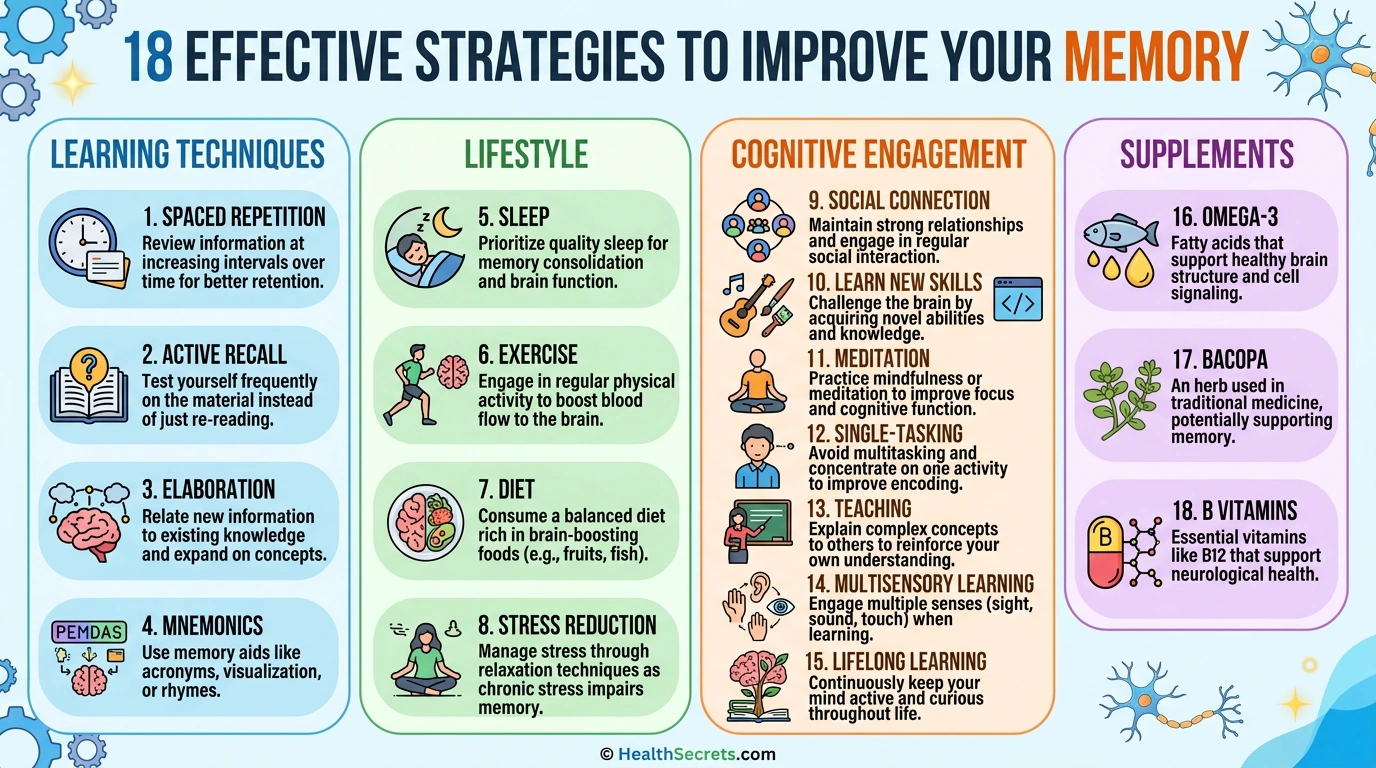
Mindfulness meditation offers a powerful countermeasure. Research shows that 20 minutes of daily meditation for 8 weeks increases gray matter density in the hippocampus and improves working memory and sustained attention [7].
What stress reduction strategies help memory?
- Meditation: 20 minutes daily — apps like Headspace, Calm, or Insight Timer make this accessible
- Deep breathing: The 4-7-8 technique activates the parasympathetic nervous system
- Time in nature: Even 20-minute walks in green spaces reduce cortisol and restore attention
- Social connection: High social engagement reduces dementia risk by up to 50% [8]. Maintain friendships, join groups, and avoid isolation
How Do New Skills and Mental Challenges Build Cognitive Reserve?
Learning new skills forces your brain to create new neural connections. This builds "cognitive reserve" — resilience against age-related decline. The more complex and novel the activity, the greater the neuroplastic benefit.
- Learn a language — bilingualism delays dementia onset by 4–5 years [9]
- Play a musical instrument — engages auditory, motor, and visual brain regions simultaneously
- Dance — combines physical, cognitive, and social challenge. One study found dancing reduced dementia risk by 76% [10]
- Teach others — explaining concepts forces deep retrieval and elaboration (the Feynman technique in action)
- Limit multitasking — divided attention impairs encoding by 30–40%. Single-task for better memory [19]
The principle is simple: keep challenging your brain with novel, demanding activities throughout life.
Which Memory Supplements Have Real Evidence Behind Them?
Supplements should complement — never replace — the lifestyle strategies above. That said, several have meaningful clinical evidence for memory support.
- Omega-3 DHA (1–2g daily): DHA is the primary structural fat in your brain. Supplementation improves memory in older adults with low baseline intake [11]
- Bacopa monnieri (300mg daily, 50% bacosides): A 2024 RCT found significant improvements in short-term memory, working memory, and cognitive skills after 12 weeks. Effects are cumulative — expect 8–12 weeks before noticeable benefits [12]
- B vitamins (B6, B12, folate): B vitamin supplementation slowed brain atrophy by 30% in MCI patients with elevated homocysteine [13]
- Vitamin D (2,000–4,000 IU daily): Optimize to 40–60 ng/mL — deficiency is associated with accelerated cognitive decline [14]
- Creatine (5g daily): Improves working memory and reasoning, especially in vegetarians with low dietary creatine [15]
- Phosphatidylserine (100–300mg daily): Supports neuronal membranes and shows benefits for age-related memory decline
See our nootropics guide for detailed supplement reviews.
What Are the Most Common Memory Improvement Mistakes to Avoid?
Even motivated people make errors that undermine their memory improvement efforts. Avoiding these common pitfalls can accelerate your results significantly.
- Cramming instead of spacing: Massed practice feels productive but produces terrible long-term retention. Always distribute your review sessions
- Passive rereading: Highlighting and rereading create an illusion of learning. Switch to active recall — test yourself instead
- Skipping sleep to study more: This is counterproductive. Sleep deprivation impairs memory consolidation more than the extra study time helps
- Relying on supplements alone: No pill replaces sleep, exercise, and effective learning techniques. Supplements are the final 10%, not the foundation
- Multitasking during learning: Your brain cannot encode information well when attention is divided. Put your phone in another room
- Ignoring stress: Chronic stress silently erodes memory capacity. If you're always stressed, that's the first thing to address
- Expecting instant results: Memory improvement is a gradual process. Give lifestyle changes 4–8 weeks and supplements 8–12 weeks
Memory techniques by situation:
- Studying for exams: Spaced repetition + active recall + study before sleep
- Remembering names: Focus when introduced, repeat the name aloud, create a visual association
- Remembering where you put things: Designate specific spots and verbalize placement ("Keys on the hook")
When Should You Worry About Memory Loss?
Most memory lapses are completely normal — especially occasional name-blanking, tip-of-the-tongue moments, or walking into a room and forgetting why. These happen at every age and increase slightly as you get older.
Concerning warning signs that warrant a doctor visit:
- Frequent memory loss that affects daily life (missing appointments, forgetting medications, unable to manage finances)
- Getting lost in familiar places
- Repeating the same questions within minutes
- Difficulty performing familiar tasks (cooking, following directions)
- Personality changes — confusion, suspicion, or unusual mood swings
- Family members expressing concern
- Sudden or rapid cognitive decline (may indicate stroke or infection — seek immediate care)
Mild Cognitive Impairment (MCI) sits between normal aging and dementia. Approximately 10–15% of people with MCI progress to dementia annually [17]. Early detection matters because lifestyle interventions (exercise, diet, cognitive engagement, social activity) can slow progression.
Medical evaluation typically includes: cognitive testing (MoCA or MMSE), blood work (B12, thyroid, vitamin D), and sometimes brain imaging (MRI). Many causes of memory problems are reversible — depression, medication side effects, thyroid disorders, B12 deficiency, and sleep apnea can all mimic cognitive decline.
Bottom line: if you're worried about your memory, get evaluated early. Early intervention makes a meaningful difference.
Action Plan
What Should You Do First to Improve Your Memory?
Follow the sequence below, work through each phase in order, and use the checklist as your practical implementation guide.
Start with the highest-impact strategies and build from there. This phased approach prevents overwhelm and creates lasting habits that compound over time.
Phase 1 — Foundation (Weeks 1–2):
- Prioritize 7–9 hours of sleep with a consistent schedule
- Eliminate multitasking during important learning — single-task with phone away
- Start using active recall — test yourself instead of rereading
- Begin 150 min/week aerobic exercise (brisk walking counts)
Phase 2 — Techniques (Weeks 2–4):
- Install Anki or Quizlet and start spaced repetition for material you need to remember
- Practice elaborative encoding — ask "why?" and connect new info to existing knowledge
- Start 10–20 minutes of daily meditation (use Headspace or Calm)
- Shift toward a Mediterranean-style diet (add fatty fish, berries, leafy greens)
Phase 3 — Optimization (Weeks 4–12):
- Add memory supplements if desired (start with omega-3 DHA 1–2g daily)
- Consider bacopa monnieri 300mg daily (allow 8–12 weeks for effects)
- Learn a new skill — language, instrument, or dance class
- Increase social engagement — join a group, schedule regular meetups
- Try memory palace technique for specific memorization tasks
Phase 4 — Maintenance (Month 3+):
- Continue all lifestyle habits (sleep, exercise, diet, stress management)
- Use memory techniques automatically in daily life
- Stay mentally and socially active — lifelong learning is lifelong brain health
- Monitor for concerning changes and consult a doctor if worried


