
Here's a thought experiment: your great-grandparents pulled carrots out of the ground, gave them a quick brush-off, and ate them — dirt and all. They drank from streams, worked the soil with bare hands, and had daily contact with billions of environmental microbes their whole lives. You, on the other hand, probably sanitize your groceries.
That disconnect matters more than most people realize. Soil-based probiotics — spore-forming bacteria like Bacillus coagulans, B. subtilis, and B. clausii — are the very organisms our ancestors encountered daily. And a growing body of research suggests they offer unique gut health benefits that traditional Lactobacillus and Bifidobacterium probiotics simply can't match.
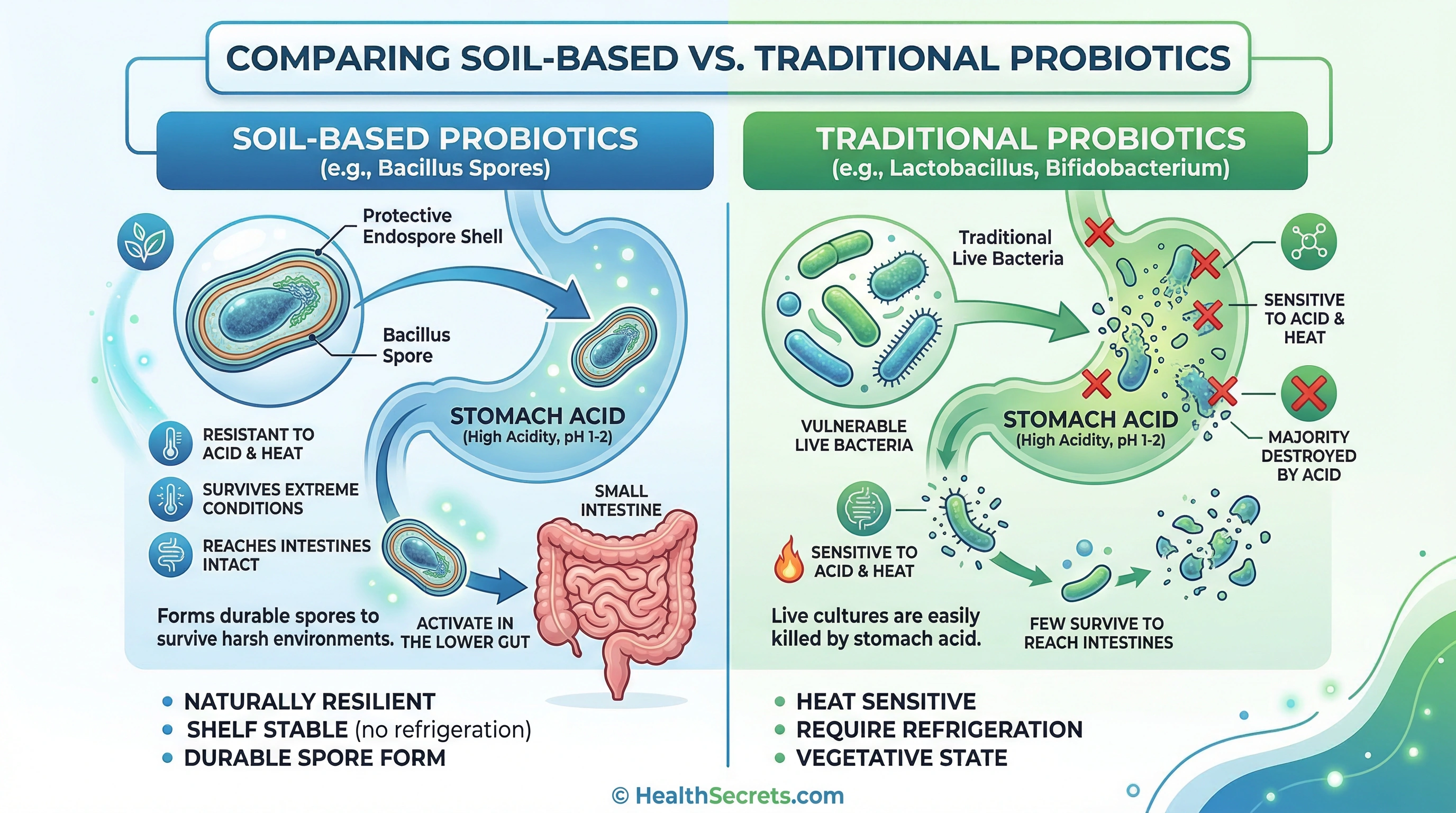
What makes soil-based probiotics different? They form protective spore coatings that let them survive stomach acid, heat, and bile salts — reaching your intestines alive at rates of 95–99%, compared to just 10–40% for most traditional strains. They're shelf-stable (no refrigeration needed), they don't produce histamine, and emerging evidence suggests they're better tolerated by people with SIBO.
This guide breaks down exactly what soil-based probiotics are, which strains matter, how they compare to traditional probiotics, and which products are actually worth your money.
If you're new to gut health, start with our complete guide to gut health for the big picture. Already familiar with probiotics? Our best probiotics guide covers the full landscape, and our prebiotics vs probiotics comparison explains how to combine them effectively.
What Should You Look for in a Soil-Based Probiotic Supplement?
The best soil-based probiotic contains multiple clinically studied Bacillus strains at an effective CFU count (1–5 billion), is third-party tested for purity, and avoids unnecessary fillers or proprietary blends. Shelf stability, strain transparency, and a reputable manufacturer are non-negotiable quality markers.
Which Bacillus Strains Have the Strongest Research?
Not all soil-based strains are equal. Here's what the clinical evidence supports:
| Strain | Key Benefits | Research Level | Best For |
|---|---|---|---|
| B. coagulans | IBS relief, immune support, protein digestion | Strong (most studied SBO) | IBS, general digestion |
| B. subtilis | Antimicrobial compounds, gut barrier, vitamin K2 | Moderate-Strong | SIBO, immune support |
| B. clausii | Antibiotic-associated diarrhea, respiratory health | Moderate (popular in Europe) | Post-antibiotic recovery |
| B. indicus HU36 | Produces carotenoid antioxidants in the gut | Emerging (patented strain) | Antioxidant support |
| Bacillus coagulans (strain BC30) has the deepest evidence base. Research published in Food Science & Human Wellness confirms it alleviates IBS symptoms, supports immune function, and produces antimicrobial compounds that inhibit pathogenic bacteria. |
What Separates SBOs from Traditional Probiotics?
| Feature | Soil-Based Probiotics | Traditional Probiotics |
|---|---|---|
| Stomach acid survival | 95–99% (spore protection) | 10–40% (unless enteric-coated) |
| Shelf stability | Room temperature, no refrigeration | Often require refrigeration |
| Histamine production | Generally none | Some strains produce histamine |
| SIBO tolerance | Better tolerated (colonize large intestine) | May worsen symptoms in some |
| Effective CFU | 1–5 billion sufficient | Often need 10–50+ billion |
- Proprietary blends that hide individual strain amounts
- Extremely high CFU counts — unnecessary for spore-formers and may indicate marketing over science
- Added sugars, artificial colors, or unnecessary fillers
- Brands with no third-party testing or strain-level identification
How Did We Evaluate These Soil-Based Probiotic Supplements?
We assessed over 20 soil-based probiotic products based on strain selection, clinical evidence, CFU count, third-party testing, formulation quality, brand transparency, and value per serving. Products using clinically studied named strains scored highest, while proprietary blends without strain specifics were penalized.

Our evaluation criteria:
- Strain transparency — Does the label identify specific strains (not just species)? Are they clinically studied?
- CFU count and viability — Is the count appropriate for spore-based probiotics (1–5 billion)? Is potency guaranteed through expiration?
- Third-party testing — Independent verification for purity, potency, and contaminant screening
- Formulation quality — Minimal fillers, no unnecessary additives, appropriate capsule technology
- Clinical backing — Strains used in published human studies, not just in-vitro research
- Brand reputation — Company transparency, manufacturing standards (GMP-certified), customer feedback patterns
- Value — Cost per serving relative to quality and strain selection
We also consulted practitioner recommendations, paying special attention to products frequently used in clinical settings for SIBO and histamine-related protocols.
Just Thrive Probiotic
Editor's ChoiceJust Thrive · Overall best multi-strain soil-based probiotic
MegaSporeBiotic
Best Practitioner-GradeMegaSporeBiotic · Clinical protocols and practitioner-guided gut restoration
Jarrow Formulas Ideal Bowel Support 299v
Best Budget OptionJarrow Formulas · Affordable single-strain Bacillus coagulans supplementation
Ancient Nutrition SBO Probiotics Gut Restore
Best SBO + Prebiotic ComboAncient Nutrition · Combined soil-based probiotic and prebiotic support
Garden of Life Dr. Formulated Probiotics Once Daily
Best Hybrid FormulaGarden of · Combining soil-based and traditional probiotic strains
Physician's Choice 60 Billion Probiotic
Best Mainstream OptionPhysician's Choice · Accessible SBO-inclusive probiotic with wide strain diversity
NOW Foods Probiotic-10 25 Billion
Best Value BrandNOW Foods · Budget-friendly probiotic with Bacillus coagulans inclusion
Microbiome Labs RestorFlora
Best for Post-Antibiotic RecoveryMicrobiome Labs · Rebuilding gut flora after antibiotic use
Read the detailed review cards below before opening any retailer link
Top Recommended Products
Just Thrive
Just Thrive Probiotic
Just Thrive is the most popular consumer-facing SBO probiotic with a well-rounded four-strain formula. The inclusion of the patented B. indicus HU36 strain — which produces carotenoid antioxidants directly in the gut — sets it apart.
Плюсы
- + Four clinically studied Bacillus strains
- + antioxidant-producing B. indicus HU36
- + excellent survivability research
- + no refrigeration needed
Минусы
- - Premium price point
- - lower CFU than some competitors (but spores are more effective per CFU)
Почему мы включили это: Just Thrive is the most popular consumer-facing SBO probiotic with a well-rounded four-strain formula. The inclusion of the patented B. indicus HU36 strain — which produces carotenoid antioxidants directly in the gut — sets it apart.
Ссылка на ритейлера откроется на Amazon после ознакомления с деталями обзора выше
MegaSporeBiotic
MegaSporeBiotic
MegaSporeBiotic is the practitioner gold standard for soil-based probiotics. Its five-strain formula provides the broadest Bacillus coverage of any product, and it has published human research showing improvements in intestinal permeability.
Плюсы
- + Five Bacillus strains for broadest coverage
- + the go-to SBO among functional medicine practitioners
- + published research on leaky gut
- + reconditions the gut environment
Минусы
- - Higher price
- - primarily available through practitioners
- - requires gradual dose increase
Почему мы включили это: MegaSporeBiotic is the practitioner gold standard for soil-based probiotics. Its five-strain formula provides the broadest Bacillus coverage of any product, and it has published human research showing improvements in intestinal permeability.
Ссылка на ритейлера откроется на Amazon после ознакомления с деталями обзора выше
Jarrow Formulas
Jarrow Formulas Ideal Bowel Support 299v
If you want to try soil-based probiotics without a big financial commitment, Jarrow's single-strain B. coagulans formula delivers the most studied SBO strain at a fraction of multi-strain product prices.
Плюсы
- + Very affordable
- + clinically studied B. coagulans strain
- + well-tolerated
- + trusted brand with decades of reputation
Минусы
- - Single strain only (less diverse)
- - lower CFU count
- - limited to B. coagulans benefits only
Почему мы включили это: If you want to try soil-based probiotics without a big financial commitment, Jarrow's single-strain B. coagulans formula delivers the most studied SBO strain at a fraction of multi-strain product prices.
Ссылка на ритейлера откроется на Amazon после ознакомления с деталями обзора выше
Ancient Nutrition
Ancient Nutrition SBO Probiotics Gut Restore
Ancient Nutrition combines soil-based Bacillus strains with organic prebiotics and fermented herbs — making it a convenient all-in-one option for people who want probiotic and prebiotic support in a single capsule.
Плюсы
- + Combines SBOs with organic prebiotics
- + higher CFU count
- + includes fermented botanicals
- + good value for dual-action formula
Минусы
- - Contains ingredients beyond pure SBOs (may not suit minimalists)
- - higher CFU count less necessary for spore-formers
Почему мы включили это: Ancient Nutrition combines soil-based Bacillus strains with organic prebiotics and fermented herbs — making it a convenient all-in-one option for people who want probiotic and prebiotic support in a single capsule.
Ссылка на ритейлера откроется на Amazon после ознакомления с деталями обзора выше
Garden of
Garden of Life Dr. Formulated Probiotics Once Daily
If you want the best of both worlds — soil-based survivability plus traditional strain diversity — Garden of Life's hybrid formula is a well-made, shelf-stable option from one of the most transparent supplement brands.
Плюсы
- + Blends Bacillus strains with Lactobacillus and Bifidobacterium
- + shelf-stable formulation
- + trusted brand
- + good for those wanting both SBO and traditional coverage
Минусы
- - Not purely soil-based (hybrid formula)
- - may not be ideal for histamine-sensitive individuals due to Lactobacillus inclusion
Почему мы включили это: If you want the best of both worlds — soil-based survivability plus traditional strain diversity — Garden of Life's hybrid formula is a well-made, shelf-stable option from one of the most transparent supplement brands.
Ссылка на ритейлера откроется на Amazon после ознакомления с деталями обзора выше
Physician's Choice
Physician's Choice 60 Billion Probiotic
Physician's Choice offers accessible entry into SBO-inclusive probiotics with its massive strain diversity and affordable price. The added prebiotic fiber is a nice touch, though purists may want a dedicated SBO product.
Плюсы
- + High CFU count with diverse strain profile
- + includes B. coagulans
- + prebiotic fiber included
- + very popular and widely reviewed
- + affordable
Минусы
- - High CFU count is mostly traditional strains (SBO content is smaller portion)
- - not purely soil-based
Почему мы включили это: Physician's Choice offers accessible entry into SBO-inclusive probiotics with its massive strain diversity and affordable price. The added prebiotic fiber is a nice touch, though purists may want a dedicated SBO product.
Ссылка на ритейлера откроется на Amazon после ознакомления с деталями обзора выше
NOW Foods
NOW Foods Probiotic-10 25 Billion
NOW Foods delivers reliable quality at the lowest price point. While not purely soil-based, the inclusion of B. coagulans gives you some spore-forming benefits alongside a diverse traditional probiotic base.
Плюсы
- + Excellent price per serving
- + includes B. coagulans alongside traditional strains
- + NOW Foods quality reputation
- + larger count per bottle
Минусы
- - Primarily traditional strains with limited SBO content
- - requires refrigeration for some formulations
Почему мы включили это: NOW Foods delivers reliable quality at the lowest price point. While not purely soil-based, the inclusion of B. coagulans gives you some spore-forming benefits alongside a diverse traditional probiotic base.
Ссылка на ритейлера откроется на Amazon после ознакомления с деталями обзора выше
Microbiome Labs
Microbiome Labs RestorFlora
RestorFlora combines the survivability of Bacillus spores with Saccharomyces boulardii — a beneficial yeast with strong evidence for preventing antibiotic-associated diarrhea and C. difficile infection. It's the ideal SBO for post-antibiotic gut restoration.
Плюсы
- + Unique combination of SBO strains with S. boulardii (beneficial yeast)
- + specifically designed for post-antibiotic recovery
- + from the makers of MegaSporeBiotic
- + excellent for C. difficile prevention
Минусы
- - More specialized formula (not general daily probiotic)
- - higher price
- - practitioner-oriented
Почему мы включили это: RestorFlora combines the survivability of Bacillus spores with Saccharomyces boulardii — a beneficial yeast with strong evidence for preventing antibiotic-associated diarrhea and C. difficile infection. It's the ideal SBO for post-antibiotic gut restoration.
Ссылка на ритейлера откроется на Amazon после ознакомления с деталями обзора выше
How Do You Use Soil-Based Probiotics Effectively?
Take one capsule daily with or without food — spore-forming probiotics survive stomach acid regardless of meal timing. Start with a lower dose (one capsule or half-dose) for the first week, then increase as tolerated. Consistency matters more than timing, and most people notice improvements within 30–60 days.
Dosage Guidelines
- Starting dose: 1 capsule daily (or half-dose for sensitive individuals)
- Maintenance dose: 1–2 capsules daily, following product instructions
- Therapeutic dose: Follow practitioner guidance (varies by condition)
Unlike traditional probiotics that need tens of billions of CFUs, soil-based probiotics are effective at 1–5 billion CFU because nearly all spores survive digestion intact.
Timing and Food
Spore-forming probiotics can be taken with or without food — their spore coating protects them either way. Some people prefer taking them with meals for digestive support, but there's no strong evidence favoring one timing over another.
How Long Until You See Results?
- Initial digestive changes: 1–2 weeks
- Noticeable improvement: 30–60 days
- Full benefits: 2–3 months of consistent use
Be patient. Gut microbiome shifts take time. If you don't notice improvements after 60–90 days, the specific product or strain profile may not be ideal for your microbiome.
Can You Combine SBOs with Traditional Probiotics?
Absolutely. Many practitioners recommend using soil-based probiotics as a foundation and adding Lactobacillus or Bifidobacterium strains for broader microbial diversity. Take them at different times of day if you prefer, though there's no evidence they interfere with each other.
For more on combining approaches, see our probiotic and prebiotic supplements guide.

Are There Any Safety Concerns with Soil-Based Probiotics?
Soil-based probiotics are generally well-tolerated with a strong safety profile. Most Bacillus strains used in supplements carry GRAS (Generally Recognized as Safe) status. Side effects are typically mild and transient — gas, bloating, or changes in bowel habits during the first week — and resolve as your gut adjusts.

Common Side Effects (Usually Mild and Temporary)
- Initial gas or bloating — microbiome adjustment period
- Changes in bowel movements — frequency or consistency may shift temporarily
- Die-off symptoms — rare, but possible if displacing pathogenic bacteria (Herxheimer-like reaction)
Minimize side effects by starting with a low dose and increasing gradually over 1–2 weeks.
Who Should Be Cautious?
- Immunocompromised individuals — consult your doctor before starting any probiotic
- People with central venous catheters — theoretical infection risk with any live microorganism
- Pregnant or breastfeeding women — discuss with your healthcare provider first
- Those on immunosuppressive medications — medical supervision recommended
SIBO and Histamine Considerations
If you have SIBO, soil-based probiotics are often the safer probiotic choice. They tend to colonize the large intestine rather than the small intestine, where bacterial overgrowth occurs. Many SIBO practitioners specifically recommend Bacillus-based formulas.
For histamine intolerance, SBOs offer a clear advantage: most Bacillus species don't produce histamine, unlike certain Lactobacillus strains (L. casei, L. rhamnosus) that can worsen symptoms.

Action Plan
What Should You Do First to Start Soil-Based Probiotics?
Follow the sequence below, work through each phase in order, and use the checklist as your practical implementation guide.
Begin with a single-strain or multi-strain Bacillus product at the lowest suggested dose for one week. Track your digestion daily — bloating, bowel habits, energy — then gradually increase to the full dose. This phased approach minimizes side effects and helps you identify which strains work best for your gut.
Phase 1 — Week 1–2: Start Low
- Choose a quality SBO product from our recommendations below
- Take one capsule daily (or half-dose if you're sensitive)
- Note any digestive changes in a simple journal
Phase 2 — Week 3–4: Build Up
- Increase to the full recommended dose
- Continue tracking symptoms
- Add a prebiotic fiber if tolerated
Phase 3 — Month 2–3: Evaluate
- Assess overall digestive improvement (bloating, regularity, comfort)
- Decide whether to continue, adjust dose, or try a different strain profile
- Consider adding traditional probiotics for broader coverage
Phase 4 — Ongoing Maintenance
- Continue your chosen SBO at maintenance dose
- Revisit gut health with your complete gut health protocol
- Consider seasonal or periodic strain rotation


