Let's be honest — when cold season hits, vitamin C is usually the first thing people reach for. Orange juice, supplements, those fizzy drink packets — you've probably tried at least one. But here's the thing most people don't realize: how much vitamin C you take, what form you choose, and when you take it all matter far more than simply "getting some."
Vitamin C (ascorbic acid) isn't just an immune booster. It's an essential nutrient your body literally cannot make on its own. It supports white blood cell production, protects immune cells from oxidative damage, enhances your skin's barrier function, and plays a direct role in fighting infections. A 2023 meta-analysis found that vitamin C supplementation reduces the severity of common colds by 15% — with the greatest benefit on severe symptoms rather than mild ones.
But here's where it gets complicated: the RDA of 75–90mg per day is enough to prevent scurvy, but research suggests much higher doses — 500–2,000mg daily — may be needed for optimal immune support. And with dozens of supplement forms on the market (ascorbic acid, liposomal, buffered, Ester-C, food-based), choosing the right one can feel overwhelming.
That's exactly what this guide is for. We'll break down the science of how vitamin C supports your immune system, compare every major supplement form, give you evidence-based dosing protocols, and review the best products available — so you can make an informed choice, not a marketing-driven one.
Related reading: immune system guide · best immune supplements · vitamin D and immunity
What Is Vitamin C and Why Is It Essential for Immune Health?
Vitamin C (L-ascorbic acid) is a water-soluble essential vitamin that humans cannot synthesize — meaning you must get it from food or supplements daily. It functions as a powerful antioxidant, enzyme cofactor, and immune modulator that directly supports nearly every aspect of your body's defense system, from skin barrier function to white blood cell activity.
Unlike most mammals, humans lost the ability to produce vitamin C due to a genetic mutation in the GULO gene millions of years ago. This makes dietary intake absolutely critical. Without it, you develop scurvy — a condition characterized by bleeding gums, poor wound healing, fatigue, and eventually death. While outright scurvy is rare in developed countries, subclinical deficiency (plasma levels below optimal but above scurvy threshold) is surprisingly common and impairs immune function.
Key facts about vitamin C:
- Water-soluble — not stored in the body, so you need daily intake
- RDA: 75mg (women) / 90mg (men) — but this prevents deficiency, not necessarily optimal health
- Upper limit: 2,000mg/day for adults
- Half-life: approximately 10–20 days at normal intake
- Highest concentrations found in immune cells — white blood cells contain 50–100x the plasma concentration
- Functions as both an antioxidant and a pro-oxidant depending on concentration and context
How Does Vitamin C Support Your Immune System?
Vitamin C supports immunity through multiple overlapping mechanisms — it enhances the production and function of white blood cells, acts as a powerful antioxidant protecting immune cells from self-inflicted oxidative damage during pathogen killing, modulates inflammatory cytokine balance, strengthens epithelial barriers, and promotes the resolution of inflammation after infection.
How Does Vitamin C Enhance White Blood Cell Function?
Vitamin C accumulates in white blood cells at concentrations 50–100 times higher than plasma levels — a clear signal of its importance to immune function. Research published in Nutrients demonstrates that vitamin C enhances neutrophil chemotaxis (migration toward infection sites), phagocytosis (engulfment of pathogens), and reactive oxygen species generation for microbial killing. It also supports lymphocyte proliferation and natural killer (NK) cell activity.
Recent research from Ohio State University found that vitamin C promotes immune cell differentiation by enhancing TET enzyme activity, which removes methyl groups from DNA — specifically enabling B cell differentiation into antibody-producing plasma cells. This means vitamin C directly supports your adaptive immune response.
How Does Vitamin C Protect Immune Cells as an Antioxidant?
When immune cells attack pathogens, they generate massive amounts of reactive oxygen species (ROS) — essentially chemical weapons. The problem? These same ROS can damage the immune cells themselves. Vitamin C protects immune cells from this "friendly fire" by neutralizing superoxide anions, hydroxyl radicals, and other ROS. It also regenerates other antioxidants like vitamin E and glutathione, keeping the entire antioxidant defense system functioning.

Does Vitamin C Reduce Inflammation During Infection?
Yes — vitamin C modulates inflammatory cytokine production, suppressing pro-inflammatory cytokines (IL-6, TNF-α) while promoting anti-inflammatory cytokines (IL-10). This balance is critical: you need enough inflammation to fight infection, but too much causes tissue damage. Research in MDPI confirms that vitamin C helps achieve this balanced immune response, which may be particularly relevant in conditions involving excessive inflammation.
How Does Vitamin C Strengthen Physical Barriers?
Vitamin C is essential for collagen synthesis — the structural protein that maintains skin integrity and mucosal barriers. Your skin and mucous membranes are the first line of defense against pathogens. Vitamin C also enhances the skin's barrier function against environmental oxidative stress and supports wound healing, which is critical for preventing secondary infections.
How Well Is Vitamin C Absorbed — and Which Form Is Best?
Standard ascorbic acid is well absorbed at low doses (nearly 100% at doses under 200mg) but absorption drops dramatically at higher doses — only about 50% at 1,000mg and less at higher amounts. Liposomal vitamin C offers 1.5–5x better bioavailability than standard forms, while buffered ascorbates (calcium or sodium ascorbate) provide similar absorption to ascorbic acid but with significantly less stomach irritation.
How Do Different Vitamin C Forms Compare?
Ascorbic acid (standard form):
- Most studied, most affordable
- Well absorbed at doses under 200mg (nearly 100%)
- Absorption decreases at higher doses (~50% at 1g)
- Can cause stomach upset in sensitive individuals (acidic, pH ~2.5)
- Best for: budget-conscious users who tolerate acidity
Buffered vitamin C (calcium/sodium/magnesium ascorbate):
- pH neutral (~7) — significantly gentler on stomach
- Similar absorption to ascorbic acid
- A clinical study found 62.5% fewer epigastric adverse effects compared to ascorbic acid
- Best for: sensitive stomachs, higher-dose protocols
Liposomal vitamin C:
- Encapsulated in phospholipid spheres (liposomes)
- A 2026 scoping review found 1.2–5.4x higher peak blood levels and 1.3–7.2x higher total absorption (AUC) vs non-liposomal forms
- Another clinical study found 1.77x more bioavailable than standard vitamin C
- More expensive, but you may need less
- Best for: maximizing absorption, therapeutic dosing
Ester-C (calcium ascorbate + metabolites):
- Contains calcium ascorbate plus small amounts of vitamin C metabolites (threonate)
- Research shows higher leukocyte (immune cell) vitamin C levels at 8 and 24 hours vs standard ascorbic acid
- Better retained in the body — lower urinary excretion
- Non-acidic, well-tolerated
- Best for: immune support (retained longer in white blood cells)
Food-based/whole food vitamin C:
- Derived from acerola cherry, rose hips, camu camu, or other whole foods
- Contains naturally occurring bioflavonoids and co-factors
- Lower doses per serving (typically 100–500mg)
- Best for: those who prefer whole-food supplements
Key absorption tip: Regardless of form, vitamin C absorption is most efficient at doses of 200mg or less per serving. For higher daily doses, divide into 2–3 servings throughout the day rather than taking one large dose.

How Much Vitamin C Should You Take for Immune Support?
For general immune maintenance, 500–1,000mg daily divided into 2–3 doses provides optimal support above the basic RDA. During acute illness, 2,000–4,000mg daily in divided doses may reduce cold severity and duration. The key is consistency — daily intake matters more than occasional mega-dosing, since vitamin C is water-soluble and not stored long-term.
| Purpose | Daily Dose | How to Take | Duration |
|---|---|---|---|
| Basic prevention (RDA) | 75–90mg | Diet alone or 1 serving | Ongoing |
| Optimal immune support | 500–1,000mg | Divided 2–3x daily with food | Ongoing |
| Cold/flu season boost | 1,000–2,000mg | Divided 2–3x daily with food | Seasonal |
| During acute illness | 2,000–4,000mg | Divided 4–6x daily (every 3–4 hrs) | Until recovery |
| High physical stress | 1,000–2,000mg | Divided 2x daily with meals | Training periods |
- Take with food to reduce stomach upset and improve absorption
- Divide doses — the body absorbs 200mg most efficiently per serving; absorption drops significantly above 500mg at once
- Morning and afternoon doses are ideal (vitamin C may be mildly stimulating for some people)
- Pair with zinc (15–30mg) and quercetin (500mg) for synergistic immune effects
- During illness, take doses every 3–4 hours to maintain blood levels
Children's dosing:
- Ages 1–3: 15mg/day (up to 400mg upper limit)
- Ages 4–8: 25mg/day (up to 650mg upper limit)
- Ages 9–13: 45mg/day (up to 1,200mg upper limit)
- Ages 14–18: 65–75mg/day (up to 1,800mg upper limit)

NOW Foods Vitamin C-1000 with Bioflavonoids
Editor's ChoiceNOW Foods · Daily immune support at an unbeatable value
LipoNaturals Liposomal Vitamin C
Best AbsorptionLipoNaturals Liposomal · Maximum bioavailability and therapeutic dosing
Solaray Vitamin C 1000mg Buffered
Best for Sensitive StomachsSolaray Vitamin · Those who experience stomach upset from standard ascorbic acid
American Health Ester-C 1000mg
Best for Immune CellsAmerican Health · Maximizing vitamin C levels in white blood cells for immune support
Nature's Way Alive! Vitamin C 500mg
Best Whole FoodNature's Way · Those preferring whole-food-sourced supplements with natural cofactors
NOW Foods Vitamin C Crystals (Ascorbic Acid Powder)
Best PowderNOW Foods · Flexible dosing and those who prefer powder form
Thorne Vitamin C with Flavonoids
Best PremiumThorne Vitamin · Those wanting pharmaceutical-grade quality with added bioflavonoids
Garden of Life Vitamin Code Raw Vitamin C
Best Raw Whole FoodGarden of · Those wanting a raw, whole-food vitamin C with probiotics and enzymes
Read the detailed review cards below before opening any retailer link
Top Recommended Products
NOW Foods
NOW Foods Vitamin C-1000 with Bioflavonoids
NOW Foods delivers pharmaceutical-grade ascorbic acid with added bioflavonoids that enhance vitamin C utilization — at a price that makes consistent daily supplementation affordable for everyone.
Prós
- + Excellent value (250 servings)
- + includes bioflavonoids
- + GMP quality
- + well-studied ascorbic acid form
- + widely available
Contras
- - Acidic form may cause stomach upset in sensitive individuals
Por que incluímos isto: NOW Foods delivers pharmaceutical-grade ascorbic acid with added bioflavonoids that enhance vitamin C utilization — at a price that makes consistent daily supplementation affordable for everyone.
O link do varejista abre na Amazon após os detalhes da análise acima
LipoNaturals Liposomal
LipoNaturals Liposomal Vitamin C
Liposomal encapsulation delivers vitamin C directly to cells with dramatically higher bioavailability — research shows 1.3–7.2x higher total absorption compared to standard forms.
Prós
- + Superior absorption (clinically validated)
- + bypasses GI absorption limits
- + no stomach upset
- + liquid form for flexible dosing
Contras
- - Premium price
- - shorter supply per bottle
- - taste may not suit everyone
Por que incluímos isto: Liposomal encapsulation delivers vitamin C directly to cells with dramatically higher bioavailability — research shows 1.3–7.2x higher total absorption compared to standard forms.
O link do varejista abre na Amazon após os detalhes da análise acima
Solaray Vitamin
Solaray Vitamin C 1000mg Buffered
Clinical research confirms buffered vitamin C causes significantly fewer GI side effects than standard ascorbic acid — making it the clear choice for anyone with a sensitive stomach who wants therapeutic doses.
Prós
- + Non-acidic pH-neutral form
- + 62% fewer stomach side effects than ascorbic acid
- + well absorbed
- + affordable
Contras
- - Provides some calcium (may matter if you already supplement calcium)
Por que incluímos isto: Clinical research confirms buffered vitamin C causes significantly fewer GI side effects than standard ascorbic acid — making it the clear choice for anyone with a sensitive stomach who wants therapeutic doses.
O link do varejista abre na Amazon após os detalhes da análise acima
American Health
American Health Ester-C 1000mg
Research shows Ester-C achieves twice the leukocyte (immune cell) vitamin C concentration compared to standard ascorbic acid — and retains it longer, making it specifically optimized for immune function.
Prós
- + Higher white blood cell vitamin C levels at 8 and 24 hours
- + non-acidic
- + lower urinary excretion
- + well-researched form
Contras
- - Higher cost than basic ascorbic acid
- - proprietary formulation
Por que incluímos isto: Research shows Ester-C achieves twice the leukocyte (immune cell) vitamin C concentration compared to standard ascorbic acid — and retains it longer, making it specifically optimized for immune function.
O link do varejista abre na Amazon após os detalhes da análise acima
Nature's Way
Nature's Way Alive! Vitamin C 500mg
For those who prefer their vitamins from whole food sources, this organic option delivers vitamin C with the natural bioflavonoids and phytonutrients that occur alongside it in food.
Prós
- + Whole food sourced
- + organic
- + naturally occurring cofactors
- + gentle on stomach
- + USDA Organic
Contras
- - Lower dose per capsule (500mg)
- - more expensive per mg of vitamin C
Por que incluímos isto: For those who prefer their vitamins from whole food sources, this organic option delivers vitamin C with the natural bioflavonoids and phytonutrients that occur alongside it in food.
O link do varejista abre na Amazon após os detalhes da análise acima
NOW Foods
NOW Foods Vitamin C Crystals (Ascorbic Acid Powder)
Powder form offers the most flexible dosing — perfect for implementing divided-dose protocols or adjusting intake during illness — at the best cost per gram of any form.
Prós
- + Extremely flexible dosing
- + mixes into water or smoothies
- + excellent value
- + pure form
- + no fillers or capsule ingredients
Contras
- - Tart/sour taste
- - acidic (may upset stomach)
- - requires measuring
Por que incluímos isto: Powder form offers the most flexible dosing — perfect for implementing divided-dose protocols or adjusting intake during illness — at the best cost per gram of any form.
O link do varejista abre na Amazon após os detalhes da análise acima
Thorne Vitamin
Thorne Vitamin C with Flavonoids
Thorne is one of the most trusted supplement brands among healthcare professionals — their NSF certification and pharmaceutical-grade manufacturing ensure you're getting exactly what the label promises.
Prós
- + NSF Certified for Sport
- + Thorne's rigorous quality standards
- + flavonoid-enhanced
- + trusted by healthcare practitioners
Contras
- - Premium price
- - 500mg per capsule (need 2 for 1
- - 000mg)
Por que incluímos isto: Thorne is one of the most trusted supplement brands among healthcare professionals — their NSF certification and pharmaceutical-grade manufacturing ensure you're getting exactly what the label promises.
O link do varejista abre na Amazon após os detalhes da análise acima
Garden of
Garden of Life Vitamin Code Raw Vitamin C
Garden of Life's RAW approach delivers vitamin C alongside probiotics and digestive enzymes — supporting both immune function and gut health, which are deeply interconnected.
Prós
- + Whole food sourced
- + includes probiotics and enzymes
- + raw and unprocessed
- + gentle on stomach
Contras
- - Lower dose (500mg per 2 capsules)
- - premium price
- - larger capsules
Por que incluímos isto: Garden of Life's RAW approach delivers vitamin C alongside probiotics and digestive enzymes — supporting both immune function and gut health, which are deeply interconnected.
O link do varejista abre na Amazon após os detalhes da análise acima
Can You Get Enough Vitamin C from Food Alone?
Yes — for basic needs, a diet rich in fruits and vegetables can easily provide 200–500mg of vitamin C daily, which exceeds the RDA and provides synergistic phytonutrients that supplements lack. However, for therapeutic immune doses (1,000–2,000mg+), supplementation becomes practical since you'd need to eat very large quantities of produce daily to reach those levels.

| Food | Vitamin C per Serving | Additional Immune Benefits |
|---|---|---|
| Red bell pepper (1 cup) | 190mg | Beta-carotene, quercetin |
| Kiwi (1 medium) | 71mg | Vitamin E, fiber, actinidin enzyme |
| Strawberries (1 cup) | 89mg | Anthocyanins, manganese |
| Orange (1 medium) | 70mg | Hesperidin flavonoid, fiber |
| Broccoli (1 cup, cooked) | 102mg | Sulforaphane, vitamin K |
| Brussels sprouts (1 cup) | 97mg | Kaempferol, fiber, vitamin K |
| Guava (1 fruit) | 126mg | Lycopene, fiber, potassium |
| Papaya (1 cup) | 88mg | Papain enzyme, folate |
Important: Cooking, prolonged storage, and exposure to light and air all reduce vitamin C content. Eat fruits and vegetables raw or lightly steamed when possible. Fresh-squeezed juice loses vitamin C within 30 minutes of exposure to air.

Is Vitamin C Safe — and What Are the Side Effects?
Vitamin C is generally very safe, even at doses well above the RDA. The most common side effect is digestive upset (nausea, diarrhea, stomach cramps) at doses above 2,000mg, which is why the upper limit is set at 2,000mg daily for adults. More serious concerns — kidney stones and iron overload — are rare and primarily affect people with pre-existing conditions.
Common side effects (usually at doses >2,000mg):
- Diarrhea, nausea, stomach cramps — the "bowel tolerance" effect
- Heartburn (with ascorbic acid form — use buffered if sensitive)
- Headache (rare)
Rare but serious concerns:
- Kidney stones — high-dose vitamin C increases oxalate excretion, which may increase kidney stone risk in susceptible individuals. If you have a history of oxalate kidney stones, limit intake to 1,000mg daily and consult your doctor.
- Iron overload — vitamin C enhances iron absorption by up to 67%. For people with hemochromatosis or iron overload conditions, this can be dangerous. Consult your doctor before supplementing.
- False lab results — high-dose vitamin C can interfere with certain blood glucose and fecal occult blood tests. Inform your doctor about supplementation before lab work.
Drug interactions:
- Blood thinners (warfarin) — high-dose vitamin C may reduce warfarin effectiveness; monitor INR
- Statins/niacin — may reduce the effectiveness of combination statin-niacin therapy
- Chemotherapy — antioxidant effects may theoretically interfere with some chemo drugs; consult oncologist
- Aluminum-containing antacids — vitamin C increases aluminum absorption; avoid combining
Who should be cautious:
- People with kidney disease or history of kidney stones
- People with hemochromatosis or iron overload conditions
- People on blood thinners or chemotherapy
- People with G6PD deficiency (high IV doses can cause hemolysis)
What Can Vitamin C Actually Do for Your Immune System?
Vitamin C is a well-established immune support nutrient that can reduce cold severity by about 15%, modestly shorten cold duration (by roughly 8% in adults), and support overall immune cell function — but it is not a miracle cure that will prevent you from getting sick. The greatest benefits are seen in people who are deficient, under high physical stress, or who supplement consistently rather than only when ill.
What vitamin C CAN do:
- Reduce the severity of common colds by ~15% (meta-analysis of 10 randomized, double-blind trials)
- Reduce cold duration by approximately 8% in adults and 14% in children with regular supplementation
- Reduce cold incidence by 50% in people under extreme physical stress (marathon runners, soldiers, skiers)
- Support white blood cell production and function
- Protect immune cells from oxidative damage during infection
- Enhance iron absorption (important for immune function)
- Support skin barrier and wound healing
What vitamin C CANNOT do:
- Prevent colds in the general population (regular supplementation does not reduce incidence)
- Cure active infections on its own
- Replace a healthy diet, adequate sleep, or other immune-supporting habits
- Substitute for medical treatment when you're seriously ill
Realistic timeline:
- Immediate: antioxidant protection begins right away
- 1–2 weeks: immune cell vitamin C levels optimize with consistent supplementation
- Ongoing: consistent daily intake provides the best long-term immune support
- During illness: benefits are most noticeable when supplementation starts early (within first 24 hours of symptoms)
Individual variation: People with lower baseline vitamin C status (smokers, elderly, those with poor diets) tend to see the most dramatic improvements. If you already eat a vitamin C-rich diet, the added benefit of supplementation may be modest but still meaningful for immune cell optimization.
Action Plan
What Should You Do First to Optimize Your Vitamin C for Immune Health?
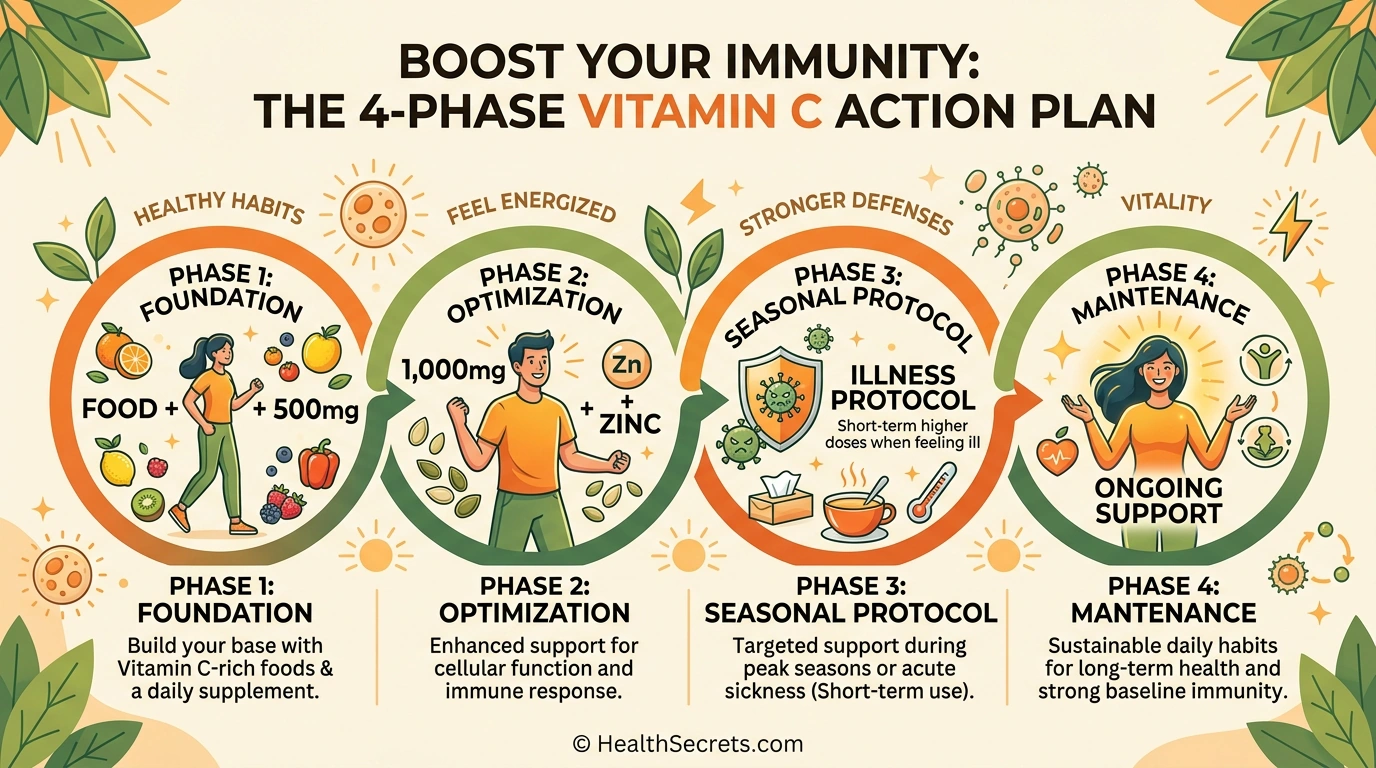
Follow the sequence below, work through each phase in order, and use the checklist as your practical implementation guide.
Start by increasing vitamin C-rich foods in your diet (aim for 5+ servings of fruits and vegetables daily), then add a 500mg supplement taken with breakfast. After one week, assess tolerance and consider adding a second 500mg dose with lunch or dinner for a total of 1,000mg daily.
Phase 1 — Foundation (Week 1–2):
- Add 2–3 servings of vitamin C-rich fruits and vegetables daily (bell peppers, kiwi, strawberries, citrus)
- Start with 500mg vitamin C supplement with breakfast
- Choose your form: ascorbic acid (budget), buffered (sensitive stomach), or liposomal (maximum absorption)
- Assess digestive tolerance
Phase 2 — Optimization (Week 3–4):
- Increase to 1,000mg daily (500mg 2x daily with meals)
- Add zinc (15–30mg daily) and quercetin (500mg daily) for synergistic immune support
- Increase produce intake to 5–9 servings daily
- Track energy levels and frequency of illness
Phase 3 — Seasonal Protocol (Cold/Flu Season):
- Increase to 1,000–2,000mg daily during cold/flu season
- At first sign of illness: increase to 2,000–4,000mg divided throughout the day
- Continue higher dose until symptoms resolve, then return to maintenance
- Keep vitamin C supplement accessible (workplace, travel bag)
Phase 4 — Maintenance (Ongoing):
- Maintain 500–1,000mg daily as baseline
- Continue vitamin C-rich diet
- Combine with overall immune-supporting lifestyle (sleep, exercise, stress management)
- Re-evaluate supplement form annually based on needs and budget