
You've probably felt that searing burn after biting into a jalapeño. Now imagine harnessing that same fiery compound to actually stop pain. That's exactly what capsaicin does — and the science behind it is surprisingly elegant.
Capsaicin is the active compound in chili peppers (genus Capsicum) responsible for their signature heat. But when applied topically to painful areas, it triggers a paradoxical effect: initial burning followed by significant, lasting pain relief. Researchers have spent decades studying this compound, and clinical evidence now supports its use for osteoarthritis, diabetic neuropathy, post-herpetic neuralgia, and other chronic pain conditions.
Whether you're dealing with arthritic knees, nerve pain in your feet, or stubborn lower back discomfort, capsaicin creams and patches offer a drug-free alternative worth considering.
If you're new to reducing inflammation naturally, capsaicin is one of several evidence-based topical options. For a broader look at non-pharmaceutical pain management, check out our guide to natural pain relief alternatives.
What Is Capsaicin and How Does It Relieve Pain?
Capsaicin is a naturally occurring alkaloid found in chili peppers of the Capsicum genus — including cayenne, jalapeño, and habanero varieties — that selectively activates pain-sensing nerve fibers to produce long-lasting analgesia. It's measured on the Scoville scale, where pure capsaicin reaches 16 million SHU (Scoville Heat Units).
What makes capsaicin unique among pain relievers is its mechanism: rather than blocking pain signals like NSAIDs or numbing nerves like lidocaine, it overstimulates pain-sensing neurons until they can no longer transmit pain signals effectively. This process, called defunctionalization, is what makes capsaicin both initially uncomfortable and ultimately therapeutic.
Topical capsaicin has been used medicinally for centuries, but modern formulations — creams, gels, roll-ons, and prescription patches — have dramatically improved its clinical utility.
The FDA has approved the 8% capsaicin patch (Qutenza) specifically for neuropathic pain associated with post-herpetic neuralgia and diabetic peripheral neuropathy ([6]).
How Is Topical Capsaicin Different from Eating Hot Peppers?
When you eat a chili pepper, capsaicin affects your digestive tract — causing that familiar mouth burn and potential GI discomfort. Topical application is entirely different. Applied to the skin, capsaicin targets local nerve endings without significant systemic absorption, which means localized pain relief without the GI, kidney, or cardiovascular risks of oral painkillers ([8]).
How Does Capsaicin Work in the Body to Stop Pain?
Capsaicin selectively activates TRPV1 (transient receptor potential vanilloid 1) receptors on nociceptive nerve endings, causing an initial burning sensation followed by prolonged desensitization through substance P depletion. This three-step process — activation, depletion, desensitization — is what makes capsaicin uniquely effective for chronic pain conditions.
Step 1: How Does Capsaicin Activate TRPV1 Receptors?
TRPV1 is a non-selective cation channel found on pain-sensing C-fiber nerve endings. When capsaicin binds to TRPV1, it triggers calcium ion influx, generating the characteristic burning sensation. This is the same receptor that detects scalding heat — which is why capsaicin literally feels hot ([1]).

Step 2: How Does Substance P Depletion Reduce Pain?
With repeated capsaicin application, nerve endings release and eventually exhaust their stores of substance P — a neuropeptide responsible for transmitting pain signals to the spinal cord and brain. Once depleted, these nerves simply can't send pain signals as effectively ([3]).
Step 3: What Happens During Nerve Desensitization?
After sustained TRPV1 activation, the nerve endings become "defunctionalized" — they retract their epidermal nerve fibers and temporarily lose their ability to sense pain. This process takes 1–2 weeks of regular application and is reversible: stop using capsaicin, and substance P gradually replenishes ([2]).
How Well Is Capsaicin Absorbed Through the Skin?
Topical capsaicin is absorbed locally through the epidermis to reach superficial nerve endings, with minimal systemic bioavailability — typically less than 1% enters the bloodstream. This makes it one of the safest analgesic options available, with virtually no organ toxicity or significant drug interactions.

Absorption depends on several factors:
- Concentration: Higher concentrations (0.075–8%) penetrate more deeply than low-dose (0.025%) formulations.
- Skin condition: Intact, dry skin absorbs capsaicin optimally. Broken or inflamed skin absorbs excessively, causing severe burning.
- Application area: Thinner skin areas (hands, feet) absorb more than thick-skinned areas.
- Formulation: Patches deliver more consistent, sustained exposure than creams, which require repeated application.
- Occlusion: Bandaging over capsaicin (not recommended unless directed) increases absorption significantly.
The 8% patch (Qutenza) delivers a high local dose in a single 30–60 minute application, producing rapid substance P depletion and pain relief lasting up to 12 weeks ([4]).
How Much Capsaicin Should You Use for Pain Relief?
For OTC capsaicin creams, apply a thin layer to the affected area 3–4 times daily using a concentration of 0.025–0.075%, starting low and increasing as tolerated. Pain relief typically begins within 1–2 weeks of consistent application, with full effects by 4 weeks.
| Concentration | Best For | Frequency | Onset |
|---|---|---|---|
| 0.025% (Low-dose OTC) | Mild pain, first-time users, sensitive skin | 3–4× daily | 1–2 weeks |
| 0.075% (High-dose OTC) | Moderate-severe arthritis, chronic pain | 3–4× daily | 1–2 weeks |
| 0.1% (Extra-strength OTC) | Severe pain, non-responders to lower doses | 3–4× daily | 1–2 weeks |
| 8% patch (Qutenza Rx) | Neuropathic pain (PHN, DPN) | Every 12 weeks | 1–3 days |
| Application tips: |
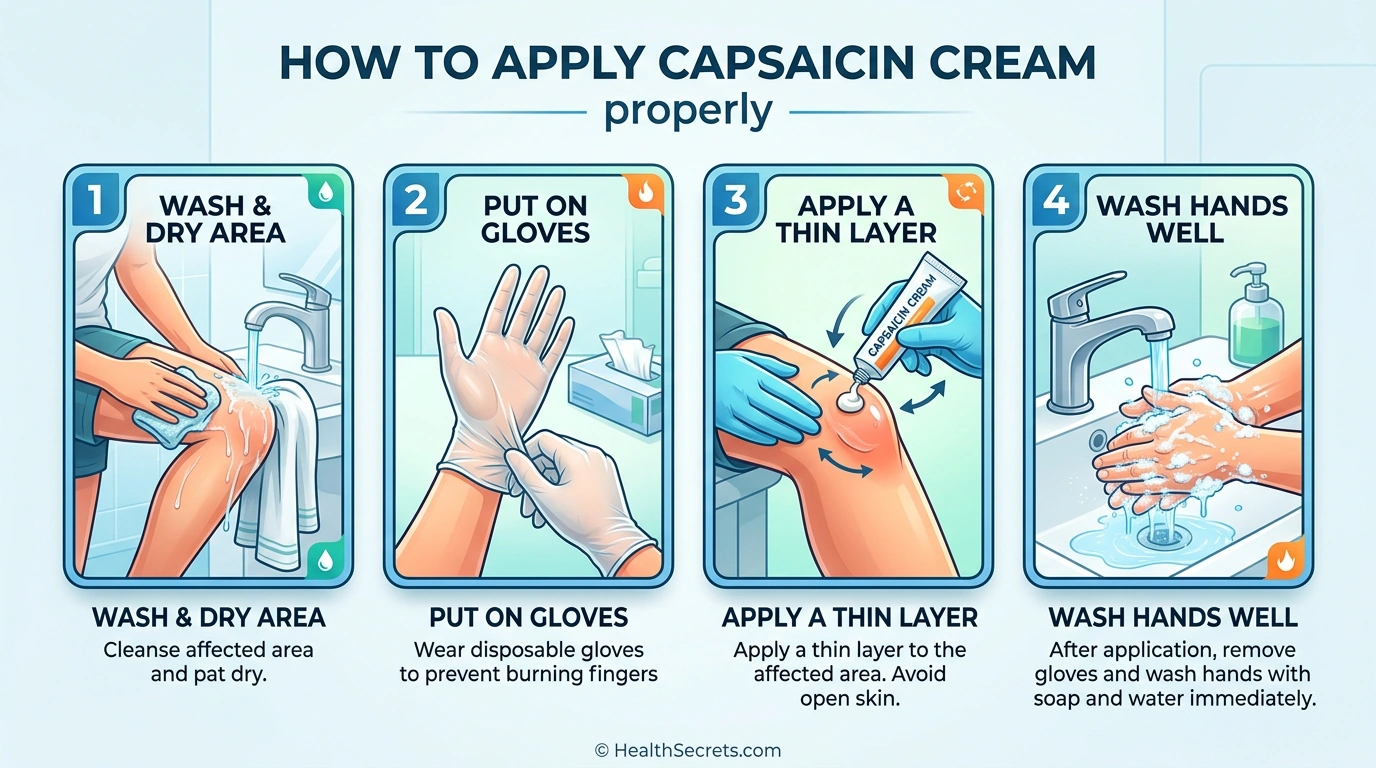
- Clean and dry the skin before applying
- Use a thin, even layer — more is not better
- Wash hands immediately with soap and water (or use disposable gloves)
- Avoid hot showers or heating pads for 30 minutes after application
- Never apply to broken skin, eyes, or mucous membranes

Capzasin-HP Arthritis Pain Relief Cream 0.1%
Editor's ChoiceCapzasin-HP Arthritis · Severe osteoarthritis and chronic joint pain
Zostrix Original Strength 0.025% Capsaicin Cream
Best for BeginnersZostrix Original · First-time capsaicin users and sensitive skin
Zostrix HP 0.075% High Potency Capsaicin Cream
Best OverallZostrix HP · Moderate-to-severe arthritis and musculoskeletal pain
Salonpas Hot Capsaicin Pain Relief Patch
Best PatchSalonpas Hot · Hands-free application for back, shoulder, and knee pain
Capsaicin + Menthol Combination Cream
Best for Burning SensitivityCapsaicin + · People who find pure capsaicin burning intolerable
Capsaicin Roll-On Topical Analgesic
Most ConvenientCapsaicin Roll-On · On-the-go application without mess
Nitrile Disposable Gloves (for Capsaicin Application)
Essential AccessoryNitrile Disposable · Preventing capsaicin transfer to eyes and face
Reusable Gel Ice Packs (for Pre/Post Application)
Best Companion ProductReusable Gel · Managing capsaicin burning sensation
Read the detailed review cards below before opening any retailer link
Top Recommended Products
Capzasin-HP Arthritis
Capzasin-HP Arthritis Pain Relief Cream 0.1%
At 0.1% capsaicin, this is the strongest OTC option available and is best suited for people who have already tolerated lower concentrations. It provides the most aggressive substance P depletion for stubborn pain.
Pros
- + Highest OTC concentration available
- + fast-acting for severe pain
- + widely available in pharmacies
Cons
- - Strong initial burning — not ideal for first-time users
Why we included it: At 0.1% capsaicin, this is the strongest OTC option available and is best suited for people who have already tolerated lower concentrations. It provides the most aggressive substance P depletion for stubborn pain.
Retailer link opens on Amazon after the review details above
Zostrix Original
Zostrix Original Strength 0.025% Capsaicin Cream
The 0.025% concentration is the best starting point for anyone new to capsaicin therapy. It lets you build tolerance gradually before stepping up to stronger formulations.
Pros
- + Gentle introduction to capsaicin
- + minimal burning
- + well-studied concentration
Cons
- - May be insufficient for moderate-severe pain
Why we included it: The 0.025% concentration is the best starting point for anyone new to capsaicin therapy. It lets you build tolerance gradually before stepping up to stronger formulations.
Retailer link opens on Amazon after the review details above
Zostrix HP
Zostrix HP 0.075% High Potency Capsaicin Cream
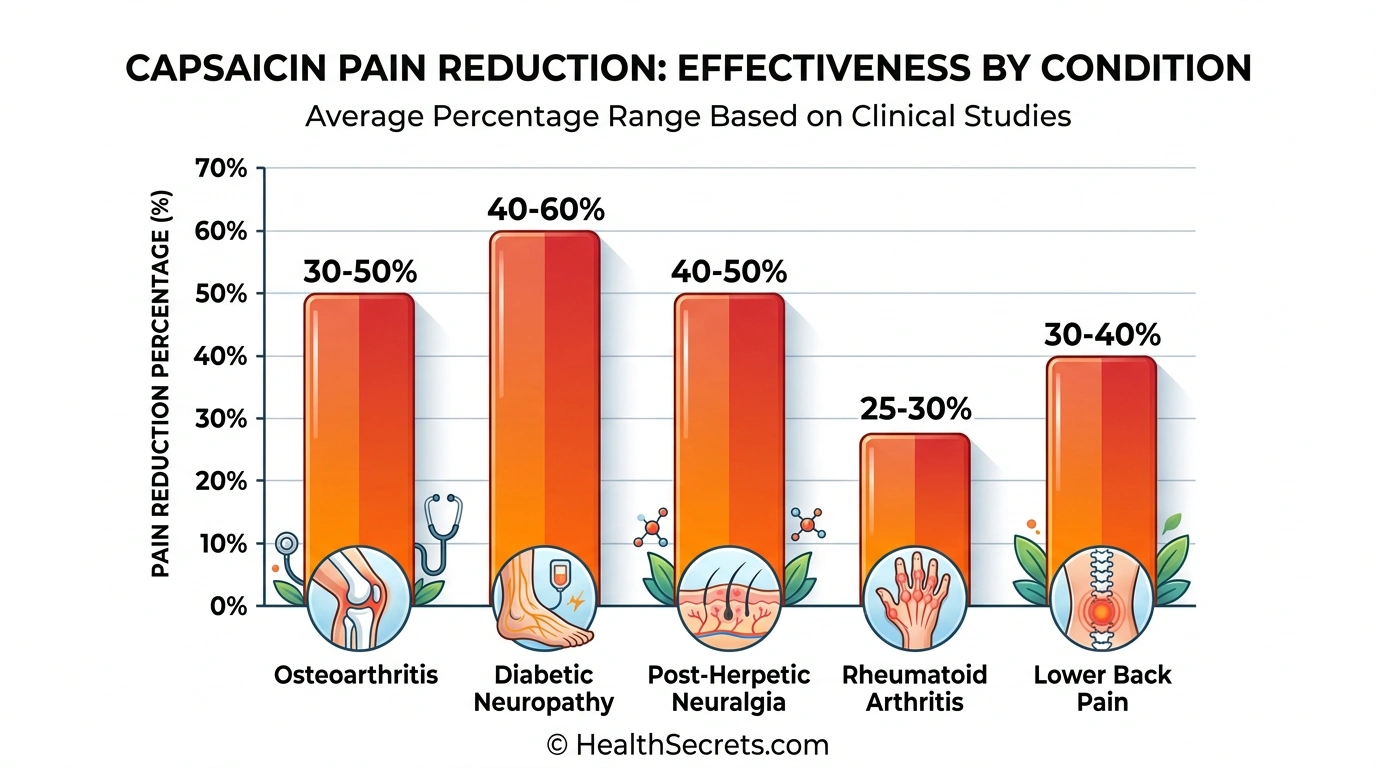
The 0.075% concentration is the most extensively studied in osteoarthritis trials, demonstrating 30–50% pain reduction comparable to topical NSAIDs. It's the sweet spot for most people.
Pros
- + Most commonly studied concentration in clinical trials
- + effective for arthritis
- + good balance of potency and tolerability
Cons
- - Noticeable burning first 3–7 days
Why we included it: The 0.075% concentration is the most extensively studied in osteoarthritis trials, demonstrating 30–50% pain reduction comparable to topical NSAIDs. It's the sweet spot for most people.
Retailer link opens on Amazon after the review details above
Salonpas Hot
Salonpas Hot Capsaicin Pain Relief Patch
Patches eliminate the biggest complaint about capsaicin creams — accidental transfer to eyes and face. They're ideal for back pain and other areas where cream application is awkward.
Pros
- + No hand contact with capsaicin
- + consistent dose delivery
- + convenient for hard-to-reach areas
Cons
- - Lower concentration than creams
- - adhesive may irritate sensitive skin
Why we included it: Patches eliminate the biggest complaint about capsaicin creams — accidental transfer to eyes and face. They're ideal for back pain and other areas where cream application is awkward.
Retailer link opens on Amazon after the review details above
Capsaicin +
Capsaicin + Menthol Combination Cream
The combination of capsaicin heat with menthol cooling makes the treatment much more tolerable, especially during the first week when burning is strongest.
Pros
- + Menthol cooling sensation offsets capsaicin burning
- + dual pain relief mechanisms
- + better tolerated initially
Cons
- - May mask over-application
- - menthol can irritate some skin types
Why we included it: The combination of capsaicin heat with menthol cooling makes the treatment much more tolerable, especially during the first week when burning is strongest.
Retailer link opens on Amazon after the review details above
Capsaicin Roll-On
Capsaicin Roll-On Topical Analgesic
Roll-on applicators solve the hand-washing problem entirely. You get targeted delivery without any risk of accidentally touching your eyes or face.
Pros
- + No hand contact with capsaicin
- + fast-drying
- + portable
- + mess-free
Cons
- - Harder to control exact dose
- - may run on skin
Why we included it: Roll-on applicators solve the hand-washing problem entirely. You get targeted delivery without any risk of accidentally touching your eyes or face.
Retailer link opens on Amazon after the review details above
Nitrile Disposable
Nitrile Disposable Gloves (for Capsaicin Application)
The number one complaint with capsaicin cream is accidentally rubbing your eyes hours later. Disposable gloves completely eliminate this risk and are essential for safe capsaicin use.
Pros
- + Eliminates risk of capsaicin eye contact
- + latex-free
- + powder-free
- + inexpensive
Cons
- - Creates waste
- - must remember to use them
Why we included it: The number one complaint with capsaicin cream is accidentally rubbing your eyes hours later. Disposable gloves completely eliminate this risk and are essential for safe capsaicin use.
Retailer link opens on Amazon after the review details above
Reusable Gel
Reusable Gel Ice Packs (for Pre/Post Application)
Applying a cold pack for 10–15 minutes before capsaicin numbs the area and dramatically reduces the initial burning sensation. It's the simplest trick to make capsaicin therapy tolerable.
Pros
- + Reduces capsaicin burning when applied before and after
- + reusable
- + flexible enough to wrap around joints
Cons
- - Requires freezer storage
- - large packs can be bulky
Why we included it: Applying a cold pack for 10–15 minutes before capsaicin numbs the area and dramatically reduces the initial burning sensation. It's the simplest trick to make capsaicin therapy tolerable.
Retailer link opens on Amazon after the review details above
Can You Get Pain Relief from Eating Capsaicin-Rich Foods?
Eating chili peppers provides capsaicin internally but does not produce the same localized analgesic effect as topical application. Dietary capsaicin has systemic anti-inflammatory and metabolic benefits, but for targeted pain relief, topical formulations are significantly more effective.
That said, capsaicin-rich foods do offer general health benefits:
- Cayenne pepper: 30,000–50,000 SHU — boosts metabolism, supports circulation
- Jalapeño: 2,500–8,000 SHU — mild anti-inflammatory properties
- Habanero: 100,000–350,000 SHU — potent antioxidant content
- Thai chili: 50,000–100,000 SHU — traditional digestive aid
For pain management specifically, though, you need the concentrated, targeted delivery that only topical capsaicin provides. The localized TRPV1 activation and substance P depletion don't happen through dietary intake.
Is Capsaicin Safe for Long-Term Use?
Topical capsaicin is generally considered safe for long-term use, with minimal systemic absorption and no known organ toxicity. The most common side effects are local skin reactions — burning, redness, and itching — which affect 30–70% of users initially but diminish with continued application.
Common side effects (temporary):
- Burning sensation (30–70% of users) — peaks at 15–30 minutes, subsides within 1–2 hours
- Skin redness and warmth at application site
- Mild itching or stinging
Rare side effects:
- Blistering or severe skin irritation — discontinue if this occurs
- Respiratory irritation if inhaled (avoid applying near face)
- Severe eye burning if transferred from hands — flush with milk or water for 15 minutes
Contraindications:
- Broken or irritated skin (open wounds, sunburn)
- Allergy to peppers or nightshade family plants
- Children under 18 (insufficient safety data)
- Pregnancy and breastfeeding (consult your doctor — minimal systemic absorption but limited studies)
- Sensitive skin conditions (eczema, psoriasis) — test a small area first
Drug interactions: Capsaicin has minimal systemic absorption and no significant drug interactions. It can be safely combined with oral pain medications and topical NSAIDs. The only rare interaction is with ACE inhibitors, which may worsen cough if capsaicin is inhaled ([9]).
Managing the initial burn:
- Apply an ice pack for 10–15 minutes before capsaicin to numb the area
- Start with 0.025% concentration and increase after 1–2 weeks
- Apply only 2× daily initially, increasing to 3–4× as tolerated
- Use a cool compress after application
- If severe: wash off with soap and water, then apply milk (fat binds capsaicin)
What Can Capsaicin Actually Do for Your Pain?
Capsaicin is a legitimate, evidence-based topical analgesic that reduces pain by 30–60% in clinical studies — but it requires patience, consistency, and realistic expectations. It manages symptoms rather than treating underlying conditions, and works best as part of a comprehensive pain management approach.
What capsaicin CAN do:
- Reduce osteoarthritis pain by 30–50% with regular application ([5])
- Reduce neuropathic pain by 40–60% with 8% patch ([4])
- Provide localized pain relief without systemic side effects
- Serve as a safer long-term alternative to oral NSAIDs
What capsaicin CANNOT do:
- Provide instant pain relief (takes 1–2 weeks)
- Treat the underlying cause of your pain
- Replace medical treatment for serious conditions
- Work if you skip applications (consistency is essential)
Individual variation matters. Some people respond dramatically to capsaicin; others find the burning intolerable. If you haven't seen improvement after 4 weeks of consistent use at 0.075%, the compound may not be the right fit for you — and that's worth discussing with your doctor.
Action Plan
What Should You Do First to Start Using Capsaicin for Pain?
Follow the sequence below, work through each phase in order, and use the checklist as your practical implementation guide.
Start with a low-concentration (0.025%) capsaicin cream applied to a small test area, then gradually increase frequency and concentration over 2–4 weeks while tracking your pain levels. This phased approach minimizes burning discomfort and maximizes your chance of sticking with it long enough for substance P depletion to work.
Phase 1 — Test and Start (Days 1–7):
- Choose a 0.025% capsaicin cream
- Apply to a small test area once to check for allergic reaction
- Begin applying 2× daily to the painful area
- Use disposable gloves or wash hands immediately after
- Expect and tolerate initial burning (ice pack before, cool compress after)
Phase 2 — Build Tolerance (Days 8–14):
- Increase to 3–4× daily application
- Notice burning beginning to decrease
- Track pain levels daily (1–10 scale)
- Avoid hot water and heating pads for 30 minutes post-application
Phase 3 — Assess and Adjust (Weeks 3–4):
- Evaluate pain relief — you should notice improvement by now
- If insufficient relief: increase to 0.075% concentration
- If intolerable burning: try a capsaicin + menthol combination
- Continue consistent application — skipping doses delays results
Phase 4 — Long-Term Maintenance (Week 5+):
- Continue 3–4× daily application at effective concentration
- Complement with exercise, weight management, and anti-inflammatory diet
- See a doctor if pain doesn't improve after 4 weeks at 0.075%
- For neuropathic pain: ask your doctor about the 8% Qutenza patch


