Who This Is For
Best for readers who want a practical detox action plan.
Who Should Be Careful
Not for self-treating severe symptoms without medical review.
Affiliate Disclaimer | This article may contain affiliate links to products we trust. If you choose to buy through them, we may earn a small commission at no extra cost to you. Full disclosure
Medical Disclaimer | For informational purposes only. Not a substitute for professional medical advice. Read full disclaimer
Key Takeaways
Organic India Whole Husk Psyllium Fiber
Best Overall FiberOrganic India · Daily bowel regularity and gentle colon support
Doctor's Best High Absorption Magnesium Glycinate 200mg
Best for Constipation ReliefDoctor's Best · Occasional constipation and muscle relaxation
Renew Life Ultimate Flora Extra Care Probiotic 50 Billion
Best Probiotic for Colon HealthRenew Life · Restoring gut microbiome balance and digestive regularity
NOW Foods Organic Inulin Prebiotic Powder 1 lb
Best PrebioticNOW Foods · Feeding beneficial colon bacteria
NOW Foods L-Glutamine Powder 1 lb
Best for Gut Lining SupportNOW Foods · Supporting intestinal barrier integrity and gut healing
Traditional Medicinals Organic Tea Variety Pack
Best Digestive TeaTraditional Medicinals · Digestive comfort and gentle daily support
Read the detailed review cards below before opening any retailer link
Colon cleansing is one of those wellness trends that never quite goes away. Scroll through social media and you'll find influencers swearing by juice cleanses, coffee enemas, and colonic irrigation — all promising to flush "pounds of toxic buildup" from your body. It sounds compelling. But here's the thing: most of those claims don't hold up under scientific scrutiny.
Your colon already has a remarkably efficient self-cleaning system. The real question isn't how to cleanse your colon — it's how to support the system your body already has in place. And when you do it right, the results are better than any extreme cleanse could deliver.
In this guide, we'll walk through a step-by-step, evidence-based approach to natural colon health — separating what actually works from what's marketing hype (or outright dangerous). You'll learn which methods are safe, which to avoid, and exactly how to build a protocol that supports long-term digestive wellness.
What Do You Need to Know Before Trying a Colon Cleanse?
Before attempting any colon cleansing method, you should understand that your colon is already designed to eliminate waste efficiently — and most commercial "cleanses" offer no proven benefit while carrying real risks. The safest approach focuses on supporting your body's natural processes through diet, hydration, and lifestyle.
Your colon — the large intestine — is roughly five feet long and performs three critical functions: absorbing water, forming waste, and eliminating it through regular bowel movements. It's also home to trillions of bacteria that make up your gut microbiome, which plays a vital role in digestion, immunity, and even mental health.
How your colon naturally cleanses itself:
- Mucus lining continuously protects and moves waste along the intestinal wall
- Peristalsis — rhythmic muscle contractions — propels waste through the colon
- Gut bacteria break down remaining food particles and produce beneficial short-chain fatty acids
- Regular bowel movements (anywhere from three times daily to three times weekly is considered normal) complete the process
A healthy colon looks like this:
- Regular, predictable bowel movements
- Formed stools (Bristol Stool Chart Types 3–4 are ideal)
- No persistent pain, bloating, or straining
- Transit time of 12–48 hours from eating to elimination
The bottom line: your colon doesn't accumulate "pounds of toxic buildup" on its walls. That's a marketing myth. But if you're experiencing irregular bowel movements, bloating, or sluggish digestion, the steps below can genuinely help.


Step 1: How Do You Increase Fiber for Natural Colon Health?
Increasing dietary fiber to 25–35 grams per day is the single most effective, evidence-based strategy for supporting colon health — it adds bulk to stool, speeds transit time, feeds beneficial gut bacteria, and reduces colorectal cancer risk by up to 26%.
Fiber is the closest thing to a real "colon cleanse" that actually works. A 2022 systematic review and meta-analysis confirmed that fiber supplementation is effective for managing chronic constipation, with psyllium supplements and doses greater than 10 g/day showing the strongest results for improving stool frequency and consistency.
Two types of fiber you need:
- Insoluble fiber (wheat bran, vegetables, whole grains) — adds bulk to stool and speeds transit time
- Soluble fiber (oats, psyllium, chia seeds, beans) — forms a gel that softens stool and feeds beneficial gut bacteria
High-fiber foods to prioritize:
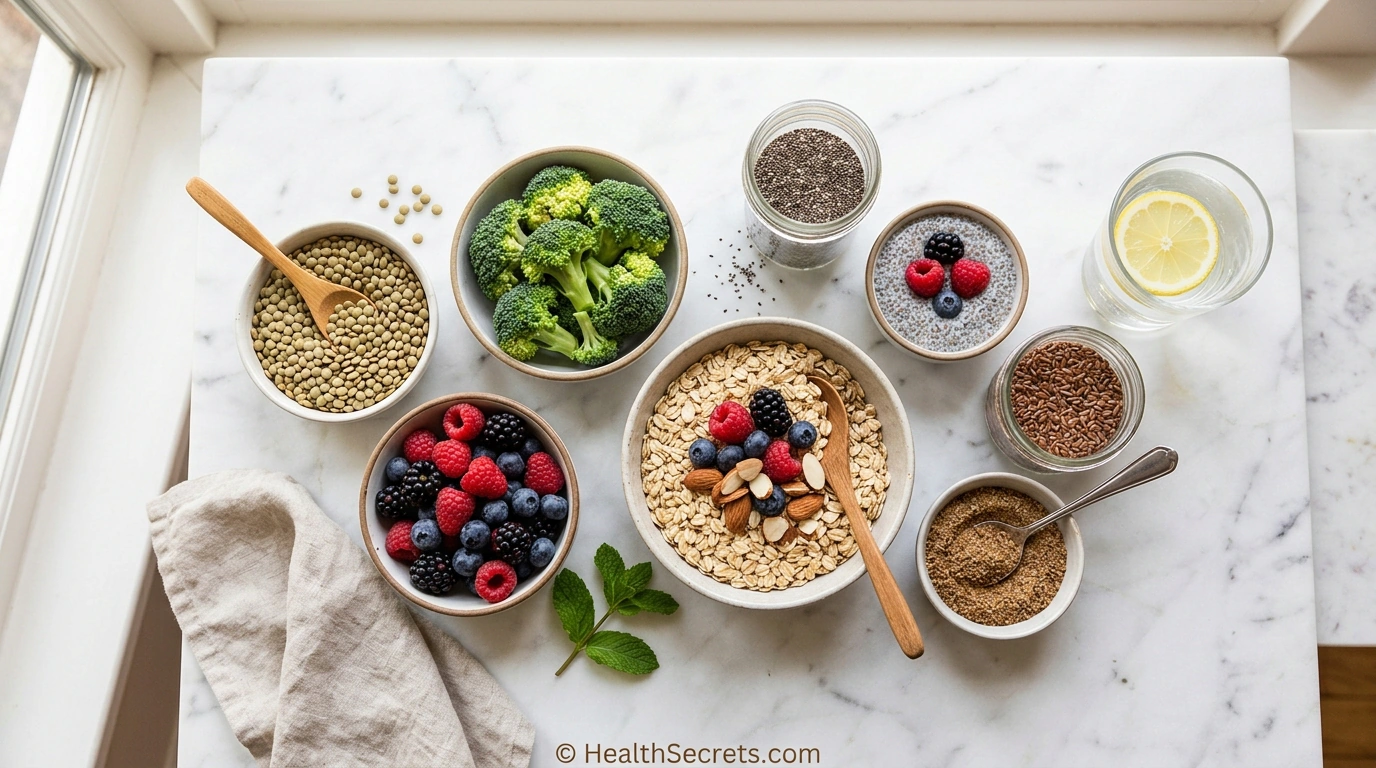
| Food | Fiber (per serving) | Type |
|---|---|---|
| Lentils (1 cup cooked) | 15.6 g | Both |
| Black beans (1 cup) | 15 g | Both |
| Chia seeds (2 tbsp) | 10 g | Mostly soluble |
| Psyllium husk (1 tbsp) | 7 g | Soluble |
| Broccoli (1 cup) | 5.1 g | Insoluble |
| Oats (1 cup cooked) | 4 g | Soluble |
| Flaxseed (2 tbsp) | 3.8 g | Both |
| How to implement: Increase fiber gradually — adding too much too fast causes gas and bloating. Add 5 g per week until you reach 25–35 g daily. Always pair increased fiber with increased water intake. |

Step 2: How Much Water Do You Need for a Healthy Colon?
You need at least 8–10 glasses (64–80 oz) of water daily to support colon function — water softens stool, prevents constipation, and is absolutely essential for fiber to work properly. Without adequate hydration, increasing fiber can actually make constipation worse.
Water is the unsung hero of colon health. Fiber absorbs water to form soft, bulky stools that move easily through the colon. Without enough water, fiber becomes dry and compacted — the opposite of what you want.
Hydration protocol for colon support:
- Morning: Start with 16 oz warm water (with or without lemon) to stimulate the gastrocolic reflex
- Throughout the day: Sip consistently — aim for 64–80 oz total
- With meals: Drink water with fiber-rich meals to aid digestion
- Herbal teas count: Peppermint and ginger tea also support digestion
- Limit: Excess alcohol and caffeine, which are dehydrating
Step 3: How Do Probiotics Support Colon Health?
Probiotics — beneficial bacteria found in supplements and fermented foods — support colon health by balancing your gut microbiome, improving bowel regularity, reducing inflammation, and strengthening the intestinal barrier. A multi-strain formula with 10–50 billion CFU daily is a good starting point.
Your gut microbiome is the real engine of colon health. The trillions of bacteria living in your colon break down waste, produce vitamins, train your immune system, and maintain the integrity of your intestinal lining.
Best probiotic strategies:
- Fermented foods daily: Yogurt, kefir, sauerkraut, kimchi, miso — these provide natural, diverse probiotic strains
- Prebiotic foods: Garlic, onions, asparagus, bananas, and Jerusalem artichokes feed your existing beneficial bacteria
- Probiotic supplement: 10–50 billion CFU multi-strain formula, taken with food
For a complete overview of building a healthy microbiome, see our gut health complete guide.

Step 4: Can Magnesium Help With Occasional Constipation?
Yes — magnesium citrate (300–500 mg taken in the evening) acts as a gentle osmotic laxative by drawing water into the intestines, softening stool, and stimulating bowel movements. It's effective for occasional constipation but should not be used as a daily long-term solution.
Magnesium citrate is one of the safest over-the-counter options for occasional constipation relief. A nationally representative NHANES study found that dietary magnesium intake was inversely associated with chronic constipation in the general population.
How to use magnesium for colon support:
- Dose: Start with 300 mg magnesium citrate in the evening; increase to 500 mg if needed
- Duration: Short-term use only (up to 7 days) unless directed by a doctor
- Caution: Can cause diarrhea at higher doses — reduce if stools become watery
- Contraindications: Kidney disease, heart disease — consult your doctor first
Step 5: How Do You Follow a 7-Day Gentle Colon Support Protocol?
A 7-day colon support protocol combines increased fiber, optimal hydration, probiotics, and magnesium into a structured daily routine — it's a safe, evidence-based alternative to harsh cleanses that produces real results like more regular bowel movements, reduced bloating, and improved digestion.
If you want a structured "reset" without the risks of extreme cleanses, this 7-day protocol uses only evidence-based methods:
Daily Protocol (Days 1–7):
- Morning: 16 oz warm water with lemon → high-fiber breakfast (oatmeal with berries and ground flaxseed)
- Throughout day: 8–10 glasses water; vegetable-heavy, whole-food meals
- Supplements: Psyllium husk (5–10 g in water) + probiotic (10–50 billion CFU) with food
- Evening: Magnesium citrate (300–500 mg)
- Avoid: Processed foods, excess sugar, alcohol, excessive caffeine
What to expect:
- Days 1–2: Slightly increased bowel movements, possible mild gas (fiber adjustment)
- Days 3–5: More regular, easier bowel movements; reduced bloating
- Days 6–7: Improved digestion, increased energy, better stool consistency
After the 7 days: Continue the high-fiber diet, hydration, and probiotics as ongoing daily habits. You can also explore our detox diet plan for a complementary approach.

Step 6: What Colon Cleansing Methods Should You Avoid?
You should avoid colon hydrotherapy (colonics), coffee enemas, and long-term use of stimulant herbal laxatives (senna, cascara sagrada) — these methods carry serious risks including bowel perforation, infection, electrolyte imbalances, kidney damage, and disruption of your beneficial gut bacteria.
This is the most important step in the entire guide. Many popular colon cleansing methods are not just ineffective — they're dangerous.
Colon Hydrotherapy (Colonics):
- Involves flushing large volumes of water through the entire colon
- No scientific evidence supports any health benefits
- Not FDA-approved for general health purposes
- The American College of Gastroenterology, the FDA, and the Mayo Clinic all warn against colonics for routine use
- Serious risks: Bowel perforation (potentially fatal), infection (hepatitis, amebiasis), electrolyte imbalances (can cause heart problems), kidney damage, and destruction of beneficial gut bacteria
Coffee Enemas:
- No proven liver detoxification benefits
- Have been linked to multiple deaths
- Risk of rectal burns, infection, and electrolyte imbalance
Stimulant Herbal Laxatives (senna, cascara sagrada, aloe latex):
- Can cause colon dependency (your colon "forgets" how to function without them)
- Long-term use can damage colon nerve cells (melanosis coli)
- Should only be used short-term (3–7 days maximum) and only when gentler methods have failed
:::warning[Colon cleanse methods comparison:]
| Method | Evidence Level | Safety | Recommendation |
|---|---|---|---|
| Dietary fiber | Strong | Very safe | ✅ Recommended |
| Hydration | Strong | Very safe | ✅ Recommended |
| Probiotics | Moderate | Safe | ✅ Recommended |
| Magnesium (short-term) | Moderate | Safe (short-term) | ✅ Occasional use |
| Colonics | None | Dangerous | ❌ Avoid |
| ::: |

Step 7: When Should You See a Doctor About Colon Issues?
You should see a doctor if you experience blood in your stool, severe constipation lasting more than 7 days, unexplained weight loss, persistent changes in bowel habits lasting more than 2 weeks, severe abdominal pain with fever, or pencil-thin stools — these can be signs of serious conditions requiring medical evaluation.
Red flags — seek medical attention:
- 🚨 Blood in stool (red or black/tarry) — could indicate bleeding, polyps, or colorectal cancer
- 🚨 No bowel movement for 7+ days — possible fecal impaction (medical emergency)
- 🚨 Severe abdominal pain with fever — possible infection or obstruction
- 🚨 Unexplained weight loss — warrants investigation
- 🚨 Persistent change in bowel habits (>2 weeks) — needs evaluation
- 🚨 Pencil-thin stools — could indicate obstruction
Who should NOT attempt any colon cleanse:
- Pregnant or breastfeeding individuals
- People with inflammatory bowel disease (Crohn's, ulcerative colitis)
- People with diverticulitis, severe hemorrhoids, or recent colon surgery
- People with kidney disease or heart disease
- Children
For more on maintaining digestive health through gentle, evidence-based approaches, see our gut detox protocol.

What Are the Most Common Colon Cleanse Mistakes to Avoid?
The most common mistakes are believing you need a dramatic "cleanse," adding too much fiber too quickly, not drinking enough water with fiber, relying on stimulant laxatives, and ignoring warning signs that require medical attention.
:::info[Myth vs. reality:]
| Myth | Reality |
|---|---|
| "Everyone has pounds of impacted fecal matter" | No scientific evidence — healthy colons don't accumulate waste on walls |
| "Colon cleansing removes toxins" | Your liver and kidneys handle detoxification; cleanses remove beneficial bacteria |
| "You need regular colon cleanses" | Your colon self-cleans through regular bowel movements |
| "Colonics are safe and beneficial" | Risks (perforation, infection) outweigh unproven benefits |
| "Weight loss from cleanses is real" | It's water weight and waste — temporary and not fat loss |
| ::: |
Expert tips for success:
- Increase fiber slowly — 5 g per week to avoid gas and bloating
- Always pair fiber increases with extra water
- Eat at regular times to support consistent bowel habits
- Exercise 30–60 minutes most days — physical movement stimulates colon motility
- Manage stress — chronic stress directly impairs digestion through the gut-brain axis
Is Natural Colon Support Safe? What Side Effects Should You Watch For?
Natural colon support through fiber, hydration, probiotics, and short-term magnesium use is safe for most adults. Potential side effects are mild and temporary — gas and bloating from increased fiber (resolves within 1–2 weeks), loose stools from magnesium (dose-dependent), and minor digestive adjustment with new probiotics.
Side effects by method:
- Fiber: Temporary gas, bloating (minimize by increasing gradually)
- Magnesium citrate: Loose stools, diarrhea at higher doses; avoid with kidney disease
- Probiotics: Mild gas or bloating for first few days (normal adjustment)
- Hydration: No side effects (unless extreme overhydration, which is rare)
Stop and consult a doctor if: You experience severe cramping, bloody stools, persistent diarrhea, signs of dehydration, or no improvement after 2 weeks of consistent dietary changes.
What Should You Do First to Support Colon Health Naturally?
Start with the simplest, safest interventions first — increase water intake and add one high-fiber food per day — then build from there over 2–4 weeks.
Phase 1 (Week 1): Foundation
- Increase water to 8–10 glasses daily
- Add 1 serving of high-fiber food per meal (beans, berries, oats, vegetables)
- Start a daily probiotic or add 1 serving of fermented food
Phase 2 (Week 2): Build
- Add psyllium husk supplement (5 g daily, mixed in water)
- Increase fiber to 25 g daily
- Add prebiotic foods (garlic, onions, asparagus)
Phase 3 (Week 3): Optimize
- Reach 25–35 g fiber daily from diverse sources
- Add magnesium citrate (300 mg) if still experiencing occasional constipation
- Exercise 30–60 minutes most days
- Practice stress management (meditation, yoga, deep breathing)
Phase 4 (Week 4+): Maintain
- Continue high-fiber diet, hydration, and probiotics as daily habits
- Use magnesium only as needed (not daily long-term)
- Track bowel movements — aim for 1–3 daily, Bristol Types 3–4
- See a doctor if concerns persist
Top Recommended Products
Organic India
Organic India Whole Husk Psyllium Fiber
Psyllium husk is the most researched fiber for constipation relief, shown in a 2022 meta-analysis to be the most effective fiber type for improving stool frequency and consistency.
Pros
- + Organic whole husk
- + no additives or fillers
- + mixes easily
- + clinically studied fiber type
Cons
- - Must drink with plenty of water
- - can cause gas initially
Why we included it: Psyllium husk is the most researched fiber for constipation relief, shown in a 2022 meta-analysis to be the most effective fiber type for improving stool frequency and consistency.
Retailer link opens on Amazon after the review details above
Doctor's Best
Doctor's Best High Absorption Magnesium Glycinate 200mg
Magnesium glycinate is well-tolerated and absorbable — ideal for daily magnesium supplementation with the added benefit of supporting bowel regularity.
Pros
- + Highly absorbable form
- + gentle on stomach
- + dual benefit for sleep and constipation
- + great value
Cons
- - Glycinate form is gentler laxative than citrate
- - may need higher dose for constipation
Why we included it: Magnesium glycinate is well-tolerated and absorbable — ideal for daily magnesium supplementation with the added benefit of supporting bowel regularity.
Retailer link opens on Amazon after the review details above
Renew Life
Renew Life Ultimate Flora Extra Care Probiotic 50 Billion
High-potency multi-strain formula with delayed-release technology ensures live bacteria reach the colon where they're needed most.
Pros
- + 50 billion CFU multi-strain
- + delayed-release survives stomach acid
- + 12 probiotic strains
- + reputable brand
Cons
- - Requires refrigeration
- - higher price point than basic probiotics
Why we included it: High-potency multi-strain formula with delayed-release technology ensures live bacteria reach the colon where they're needed most.
Retailer link opens on Amazon after the review details above
NOW Foods
NOW Foods Organic Inulin Prebiotic Powder 1 lb
Inulin is a well-researched prebiotic fiber that selectively feeds beneficial gut bacteria, supporting microbiome diversity and colon health.
Pros
- + Organic blue agave-sourced inulin
- + unflavored mixes easily
- + feeds Bifidobacterium
- + excellent value
Cons
- - Can cause gas and bloating if started at full dose
- - increase gradually
Why we included it: Inulin is a well-researched prebiotic fiber that selectively feeds beneficial gut bacteria, supporting microbiome diversity and colon health.
Retailer link opens on Amazon after the review details above
NOW Foods
NOW Foods L-Glutamine Powder 1 lb
L-glutamine is the primary energy source for intestinal epithelial cells and research supports its role in maintaining gut barrier integrity — essential for long-term colon health.
Pros
- + Primary fuel for intestinal cells
- + supports gut barrier repair
- + unflavored
- + versatile dosing
Cons
- - Must be mixed into liquid
- - mild taste
Why we included it: L-glutamine is the primary energy source for intestinal epithelial cells and research supports its role in maintaining gut barrier integrity — essential for long-term colon health.
Retailer link opens on Amazon after the review details above
Traditional Medicinals
Traditional Medicinals Organic Tea Variety Pack
Peppermint and ginger teas have traditional and research-backed roles in supporting digestion, reducing bloating, and soothing the GI tract — a pleasant daily addition to any colon health protocol.
Pros
- + Includes peppermint and ginger varieties
- + pharmacopoeial-grade herbs
- + organic
- + caffeine-free options
Cons
- - Effects are mild and supportive rather than therapeutic
Why we included it: Peppermint and ginger teas have traditional and research-backed roles in supporting digestion, reducing bloating, and soothing the GI tract — a pleasant daily addition to any colon health protocol.
Retailer link opens on Amazon after the review details above
Further Reading
Further Reading
"Gut: The Inside Story of Our Body's Most Underrated Organ"
by Giulia Enders
Understanding of how digestion works; practical dietary tips; myth-busting about cleanses and detoxes
Why it adds value here
This international bestseller makes complex gut science accessible and entertaining — ideal for readers who want to understand why natural methods work better than extreme cleanses.
Best for: Anyone wanting an engaging, science-based introduction to digestive health
View book detailsFurther Reading
"Fiber Fueled: The Plant-Based Gut Health Program"
by Will Bulsiewicz
Science-backed fiber protocol; meal plans; microbiome diversity strategies; recipes
Why it adds value here
Written by a practicing gastroenterologist, this book provides the most comprehensive, evidence-based guide to using dietary fiber for gut and colon health — exactly the approach this article recommends.
Best for: Readers ready to transform their colon health through diet
View book detailsAEO FAQ
Frequently Asked Questions
12 common questions answered
No — your colon is a self-cleaning organ that eliminates waste through regular bowel movements, mucus lining, and peristalsis. Most healthy people do not need any form of colon cleansing. Focus on supporting your body's natural processes with fiber, hydration, and probiotics instead.
No — colon hydrotherapy is not recommended by the American College of Gastroenterology, the FDA, or the Mayo Clinic. Risks include bowel perforation, infection, electrolyte imbalances, kidney damage, and disruption of beneficial gut bacteria. There is no scientific evidence for health benefits.
Adults should aim for 25–35 grams of fiber per day from a variety of sources including vegetables, fruits, whole grains, legumes, nuts, and seeds. Most Americans consume only about 15 grams daily, so gradual increases are important to avoid gas and bloating.
No — there is no scientific evidence that coffee enemas detoxify the liver or provide any health benefit. Coffee enemas have been linked to multiple deaths and carry risks of rectal burns, infection, and electrolyte imbalances. Your liver detoxifies your body naturally.
Yes, magnesium citrate (300–500 mg) is generally safe for occasional, short-term constipation relief. It works by drawing water into the intestines to soften stool. However, it should not be used long-term without medical supervision, and people with kidney or heart disease should consult a doctor first.
The Bristol Stool Chart classifies stool into 7 types based on shape and consistency. Types 3 (sausage-shaped with cracks) and 4 (smooth, soft sausage) indicate healthy, ideal bowel movements. Types 1–2 suggest constipation, while Types 6–7 indicate diarrhea.
Most people notice improved bowel regularity within 1–2 weeks of increasing fiber intake to 25–35 g daily with adequate hydration. A 2022 meta-analysis found that treatment durations of 4 weeks or more were optimal for improving stool frequency and transit time.
No — stimulant herbal laxatives like senna, cascara sagrada, and aloe latex should only be used short-term (3–7 days maximum). Long-term use can cause colon dependency, damage colon nerve cells, and lead to electrolyte imbalances. Fiber and hydration are safer alternatives.
Yes — research suggests probiotics can improve bowel movement frequency and stool consistency. Specific strains like Bifidobacterium lactis and Lactobacillus rhamnosus have shown benefit. A multi-strain formula with 10–50 billion CFU daily, taken with food, is recommended.
Limit processed foods (low in fiber, high in additives), excess red meat (slows transit time), fried foods (hard to digest), excess sugar (feeds harmful bacteria), and alcohol (dehydrating and inflammatory). Focus on whole, plant-rich foods for optimal colon function.
See a doctor immediately if you experience blood in your stool, no bowel movement for 7+ days, severe abdominal pain with fever, unexplained weight loss, or persistent changes in bowel habits lasting more than 2 weeks. Colorectal cancer screening is recommended starting at age 45.
Yes — regular exercise (30–60 minutes most days) stimulates colon motility through physical movement and reduces stress, which directly impacts digestion through the gut-brain axis. Even daily walking has been shown to improve bowel regularity.
Was this article helpful?
Written & Reviewed By Experts
Author
Dr. Amara Osei
Medical Reviewer
Dr. Sarah Chen
All content is evidence-based, peer-reviewed by qualified professionals, and updated regularly. Our editorial team follows strict guidelines for accuracy and transparency.
References & Citations
15 sources cited
Medical Disclaimer
This article is for informational purposes only and does not constitute medical advice. Read the full medical disclaimer. Always consult with a qualified healthcare provider before starting any new supplement, treatment, or major dietary change.