
If you've ever watched a child tug at their ear at 2 a.m., face scrunched in pain, you already know — ear infections are brutal. And incredibly common. Roughly 5 out of 6 children will experience at least one ear infection before their third birthday, making acute otitis media (AOM) one of the top reasons for pediatric doctor visits in the United States ([1]).
Here's what might surprise you: natural remedies for ear infection relief actually have decent clinical evidence behind them. Herbal ear drops containing garlic, mullein, and calendula have been shown to relieve ear pain as effectively as conventional anesthetic drops ([2]).
Xylitol — yes, the sugar substitute — can reduce recurrent ear infections by roughly 30% ([9]). And watchful waiting, recommended by the American Academy of Pediatrics, allows many mild ear infections to resolve without antibiotics at all ([5]).
But let me be clear about something critical: these natural approaches are for pain relief and prevention, not for treating an active bacterial infection. When antibiotics are warranted — for severe symptoms, very young infants, or infections that aren't improving — they remain essential.
This guide walks you through each evidence-based step, from immediate pain relief to long-term prevention strategies.
For more natural health approaches, explore our complete guide to natural remedies and immune system support strategies.
What Do You Need to Know Before Trying Natural Ear Infection Remedies?
Before reaching for any remedy, you need to understand what you're actually dealing with. An ear infection isn't one condition — it's several, and the approach differs for each. Understanding the basics helps you make smarter decisions about when natural approaches are appropriate and when professional care is non-negotiable.
There are two main types.
Middle ear infections (acute otitis media or AOM) involve fluid and inflammation behind the eardrum, usually following a cold or upper respiratory infection.
Outer ear infections (otitis externa or swimmer's ear) affect the ear canal itself, often from water exposure or minor injury. Most of this guide focuses on AOM, since it's overwhelmingly more common in children.
The symptoms are familiar to most parents: ear pain, fever, difficulty sleeping, tugging or pulling at the ear, irritability, and sometimes fluid drainage or temporary hearing difficulty. In children, the Eustachian tubes — the tiny channels connecting the middle ear to the back of the throat — are shorter and more horizontal than in adults. That anatomical reality means fluid doesn't drain as easily, creating a perfect environment for bacteria to multiply ([13]).
Here's the important part: you cannot diagnose an ear infection at home. A healthcare provider needs to examine the eardrum with an otoscope. What you can do is manage pain, support healing, and take preventive steps. That's exactly what this guide covers.
Expected timeline: most mild ear infections improve within 2–3 days with or without antibiotics. Natural pain relief works within minutes to hours. Prevention strategies like xylitol require consistent daily use over weeks to months.
How Do You Decide Between Watchful Waiting and Seeking Immediate Care?
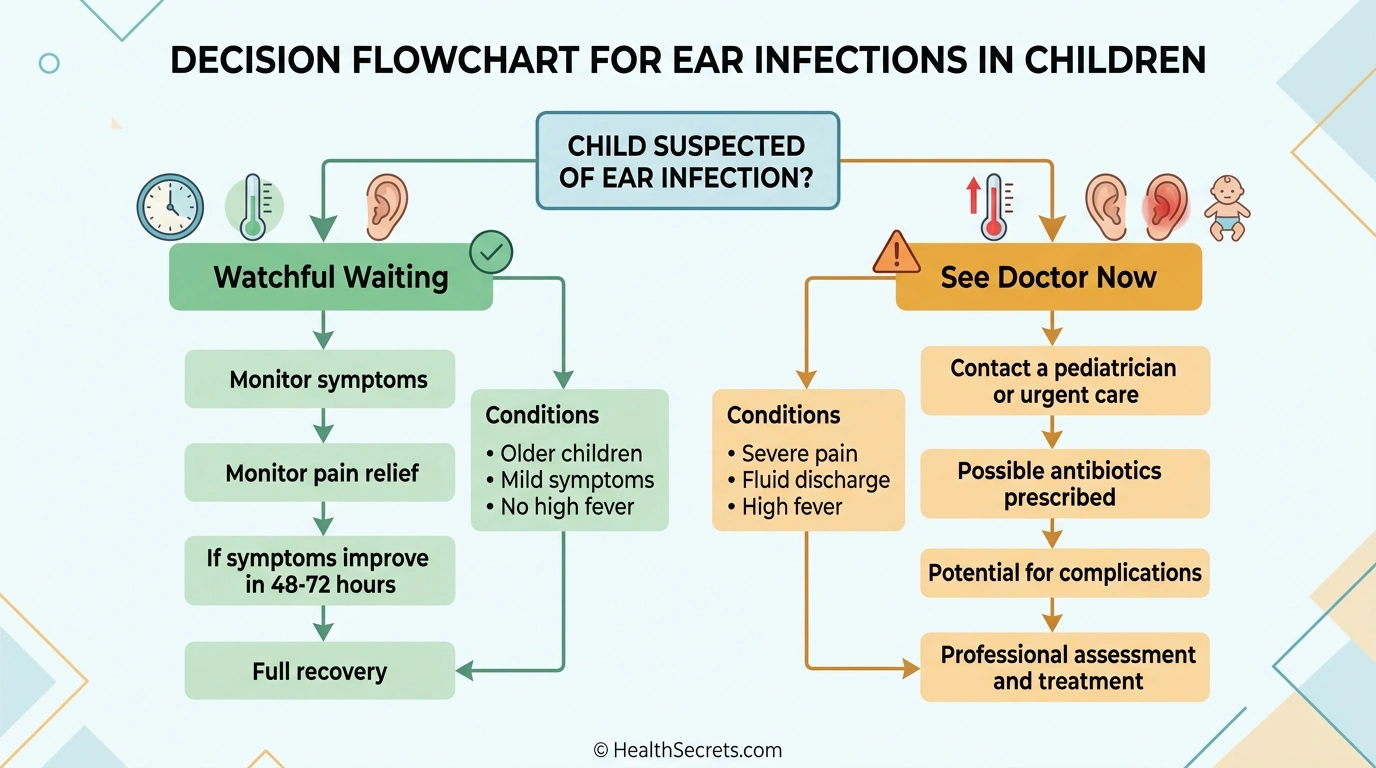
The first and most important step is figuring out whether your child's ear infection needs antibiotics right now — or whether watchful waiting is appropriate. Research consistently shows that most children with mild ear infections get better without antibiotics. The CDC states that two out of three children with mild ear infections recover on their own ([5]).
The American Academy of Pediatrics recommends watchful waiting — observing for 48–72 hours before starting antibiotics — when specific criteria are met ([6]). A meta-analysis found that 78% of AOM cases spontaneously resolve without complications within 10–12 days ([7]).
Watchful waiting is appropriate when:
- The child is older than 6 months
- Symptoms are mild (moderate ear pain, fever below 102.2°F / 39°C)
- Only one ear is affected (unilateral)
- The child is otherwise healthy and not immunocompromised
Go directly to the doctor — antibiotics likely needed — when:
- The child is under 6 months old
- Severe ear pain or high fever (above 102.2°F / 39°C)
- Both ears are infected in a child under 2 years old
- Fluid is draining from the ear (possible ruptured eardrum)
- Symptoms worsen or don't improve after 48–72 hours
- The child is immunocompromised or has recurrent infections
During watchful waiting, your job is managing pain and keeping the child comfortable. That's where the next steps come in.
How Do You Use Herbal Ear Drops for Ear Pain Relief?
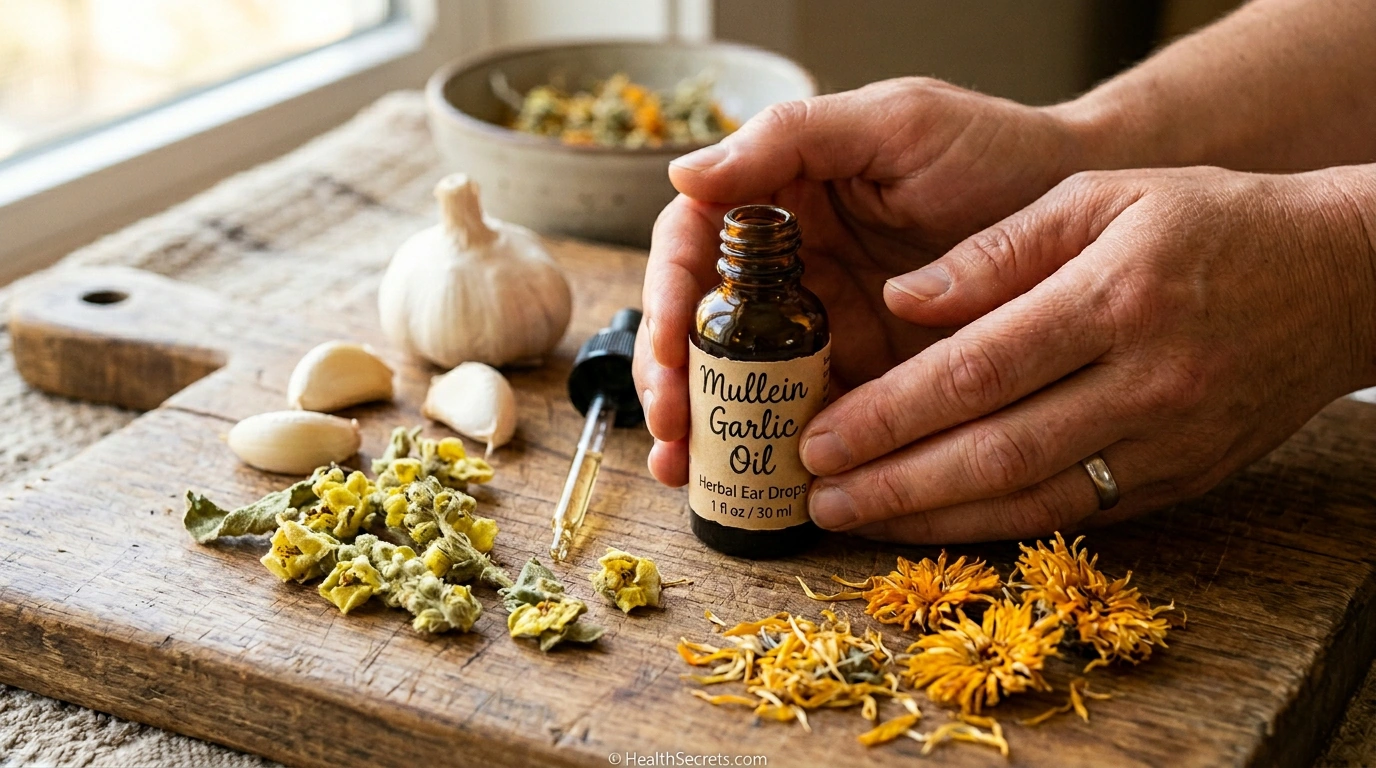
Herbal ear drops are one of the best-studied natural remedies for ear infection pain. A clinical trial published in Pediatrics found that naturopathic herbal ear drops (containing garlic, mullein, calendula, and St. John's wort in olive oil) were as effective as conventional anesthetic ear drops for managing AOM-associated ear pain in children ([1]). An earlier trial in JAMA Pediatrics confirmed similar findings, with a statistically significant improvement in pain scores (P = .007) ([2]).
But — and this is essential — herbal ear drops do not treat the infection. They relieve pain. The active compounds in garlic and mullein have anti-inflammatory and mild antimicrobial properties, but they cannot penetrate the eardrum to reach a middle ear infection ([4]). Laboratory studies confirm garlic derivatives inhibit common ear infection bacteria, but this hasn't translated to clinical infection treatment ([3]).
How to apply herbal ear drops:
- Warm the bottle to body temperature by holding it in your hands for a few minutes (never microwave)
- Have the child lie on their side with the affected ear facing up
- Place 2–3 drops into the ear canal
- Keep the child lying on their side for 5–10 minutes
- Repeat 2–3 times daily as needed
Critical safety warning: NEVER put drops in the ear if you suspect a ruptured eardrum. Signs of rupture include fluid or pus draining from the ear. If you see drainage, stop and see a doctor immediately.
How Do You Use Warm Compresses and OTC Pain Relievers for Earache?
While herbal drops work directly in the ear canal, warm compresses and over-the-counter pain medication tackle pain from the outside. Together, they form the backbone of at-home ear pain management during watchful waiting — and they're recommended by major medical centers including the Cleveland Clinic ([12]).
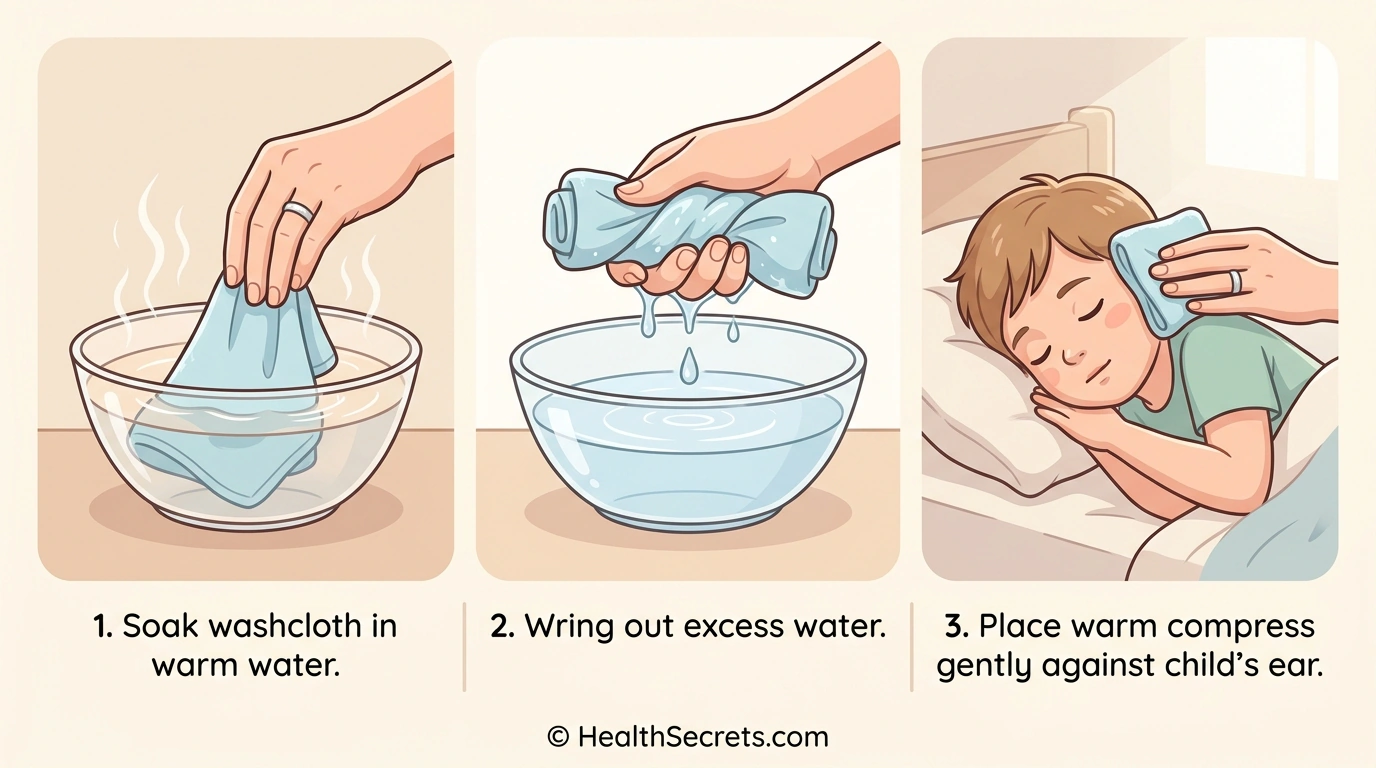
Warm compress method:
- Soak a clean washcloth in warm (not hot) water, wring it out
- Place against the affected ear for 10–15 minutes
- Repeat as often as needed throughout the day
- Alternative: a warm water bottle wrapped in a thin towel, or a heating pad on low setting
- Some children prefer alternating warm and cold compresses every 30 minutes
The warmth increases blood flow to the area, relaxes surrounding muscles, and encourages fluid drainage through the Eustachian tubes.
OTC pain relievers:
- Ibuprofen (for children over 6 months): provides both pain relief and anti-inflammatory effects — dose by weight, not age
- Acetaminophen: safe for younger children, effective for pain and fever
- Follow package directions carefully and never exceed recommended doses
Additional comfort measures:
- Elevate the child's head during sleep (extra pillow or elevated mattress head) to reduce pressure
- Encourage chewing and swallowing — this helps open the Eustachian tubes (offer gum to older children, fluids to younger ones)
- Keep the child hydrated and resting
How Does Xylitol Prevent Recurrent Ear Infections?
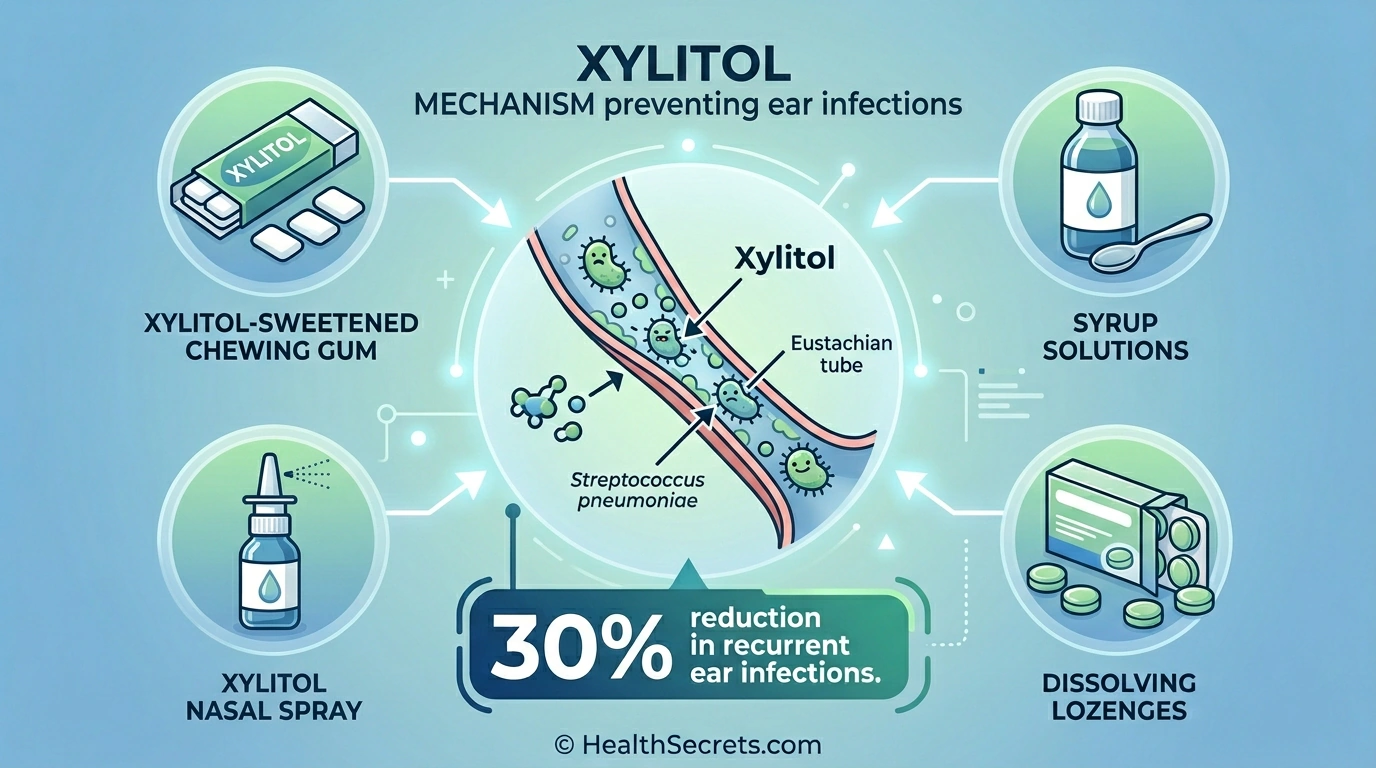
If your child gets ear infections repeatedly, xylitol deserves serious attention. This natural sugar alcohol — found in birch bark, plums, and strawberries — has been studied extensively for ear infection prevention. A Cochrane systematic review of five clinical trials involving 3,405 children found moderate-quality evidence that xylitol reduces the risk of AOM from about 30% to around 22% in healthy children ([9]).
The mechanism is elegant: xylitol prevents Streptococcus pneumoniae and Haemophilus influenzae — the main bacteria responsible for ear infections — from adhering to the cells lining the Eustachian tubes and nasopharynx ([10]). A more recent randomized controlled trial confirmed xylitol's preventive potential in children aged 1–5 years ([11]).
Dosing for prevention:
- Total daily dose: 8–10 grams of xylitol divided into 5 doses throughout the day
- Chewing gum (for children old enough to chew safely): 1.7g xylitol per piece, 5 times daily — showed approximately 40% efficacy
- Syrup (for younger children): showed approximately 30% efficacy
- Lozenges: another option for children who can't use gum
Important limitations:
- Xylitol is for prevention only — it does not treat an active infection
- Must be used consistently (daily) to maintain protective effect
- Less effective in children already prone to recurrent ear infections or those with tympanostomy tubes
- May cause mild digestive upset (gas, bloating) at higher doses — start low and increase gradually
- Keep xylitol products away from dogs — xylitol is toxic to canines

Herb Pharm Mullein Garlic Herbal Oil
Editor's ChoiceHerb Pharm · Natural ear pain relief in adults and older children
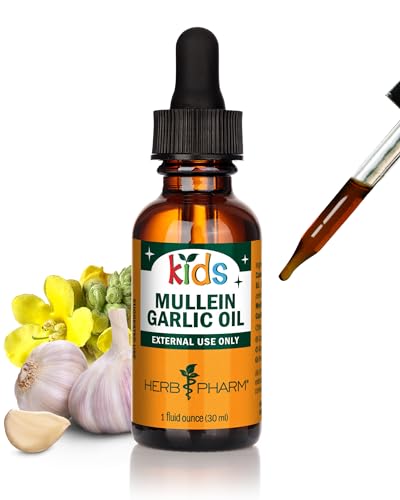
Herb Pharm Kids Ear Oil with Mullein and Garlic
Best for ChildrenHerb Pharm · Gentle ear pain relief for children ages 1 and up

Spry Fresh Natural Xylitol Chewing Gum
Best for PreventionSpry Fresh · Preventing recurrent ear infections in children old enough to chew gum
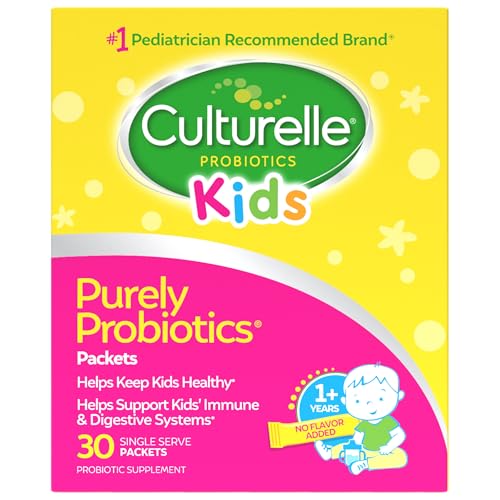
Culturelle Kids Daily Probiotic Packets
Best ProbioticCulturelle Kids · Daily immune support for children ages 1 and up
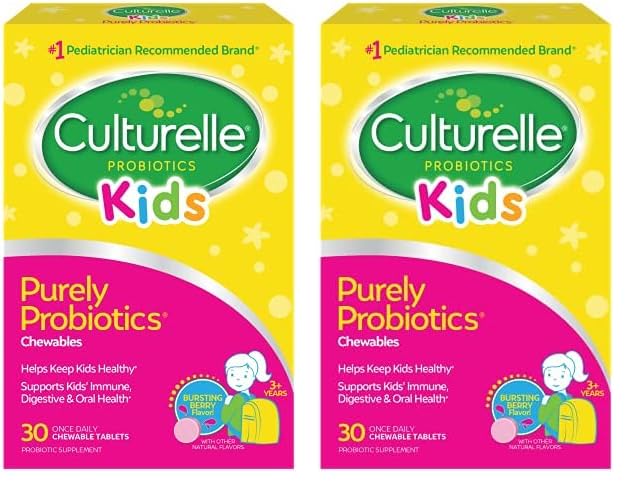
Culturelle Kids Chewable Daily Probiotic
Best ValueCulturelle Kids · Probiotic immune support for children ages 3+ who prefer chewables
Read the detailed review cards below before opening any retailer link
Top Recommended Products
Herb Pharm
Herb Pharm Mullein Garlic Herbal Oil
This formulation closely matches the naturopathic ear drops used in clinical trials that demonstrated pain relief comparable to anesthetic drops. Organic certification and herbal identity assurance add quality confidence.
Ưu điểm
- + Certified organic ingredients
- + contains garlic
- + mullein
- + calendula
- + and St. John's wort matching clinical trial formulations
- + gentle olive oil base
Nhược điểm
- - Not suitable if eardrum ruptured
- - strong garlic scent may bother some children
Tại sao chúng tôi đưa vào: This formulation closely matches the naturopathic ear drops used in clinical trials that demonstrated pain relief comparable to anesthetic drops. Organic certification and herbal identity assurance add quality confidence.
Liên kết nhà bán lẻ sẽ mở trên Amazon sau phần chi tiết đánh giá ở trên
Herb Pharm
Herb Pharm Kids Ear Oil with Mullein and Garlic
The kid-specific formulation provides age-appropriate dosing guidelines and uses herbs with established safety profiles in children, matching the clinical evidence for naturopathic ear pain relief.
Ưu điểm
- + Specifically formulated for children
- + lower dosing instructions for young kids
- + trusted brand with pediatric line
- + same effective herbal ingredients
Nhược điểm
- - Still requires parental supervision for application
- - not for use with ruptured eardrum
Tại sao chúng tôi đưa vào: The kid-specific formulation provides age-appropriate dosing guidelines and uses herbs with established safety profiles in children, matching the clinical evidence for naturopathic ear pain relief.
Liên kết nhà bán lẻ sẽ mở trên Amazon sau phần chi tiết đánh giá ở trên
Spry Fresh
Spry Fresh Natural Xylitol Chewing Gum
This gum delivers the xylitol dose per piece that matches Cochrane-reviewed clinical trials showing 30–40% reduction in ear infections. The variety pack keeps kids interested in consistent daily use.
Ưu điểm
- + High xylitol content per piece matching clinical trial dosing
- + no artificial sweeteners
- + also supports dental health
- + pleasant flavors
Nhược điểm
- - Only suitable for children old enough to chew gum safely (typically 4+)
- - requires 5x daily use for prevention
Tại sao chúng tôi đưa vào: This gum delivers the xylitol dose per piece that matches Cochrane-reviewed clinical trials showing 30–40% reduction in ear infections. The variety pack keeps kids interested in consistent daily use.
Liên kết nhà bán lẻ sẽ mở trên Amazon sau phần chi tiết đánh giá ở trên
Culturelle Kids
Culturelle Kids Daily Probiotic Packets
Culturelle uses the LGG strain, the most-studied probiotic strain for children's immune health. The broader immune support may help reduce respiratory infections that trigger ear infections.
Ưu điểm
- + Contains LGG strain with research backing for immune and digestive support
- + flavorless powder mixes easily
- + suitable from age 1
- + convenient single-serve packets
Nhược điểm
- - Requires daily consistent use
- - probiotic evidence for ear infection prevention specifically is mixed
Tại sao chúng tôi đưa vào: Culturelle uses the LGG strain, the most-studied probiotic strain for children's immune health. The broader immune support may help reduce respiratory infections that trigger ear infections.
Liên kết nhà bán lẻ sẽ mở trên Amazon sau phần chi tiết đánh giá ở trên
Culturelle Kids
Culturelle Kids Chewable Daily Probiotic
For older children who resist powder packets, the chewable format dramatically improves daily compliance — and consistency is key for probiotic immune benefits that may help reduce ear infection frequency.
Ưu điểm
- + Berry flavor kids enjoy
- + easy chewable form improves compliance
- + same LGG strain as powder version
- + no artificial flavors
Nhược điểm
- - Only for ages 3+
- - flavored options may contain added sweeteners
- - requires consistent daily use
Tại sao chúng tôi đưa vào: For older children who resist powder packets, the chewable format dramatically improves daily compliance — and consistency is key for probiotic immune benefits that may help reduce ear infection frequency.
Liên kết nhà bán lẻ sẽ mở trên Amazon sau phần chi tiết đánh giá ở trên
Can Probiotics Help Prevent Ear Infections in Children?
The evidence here is genuinely mixed, and I think it's important to be honest about that. Some research found that supplementation with probiotics, prebiotics, or synbiotics was associated with a significant reduction in AOM incidence in children. However, another study concluded that probiotics may not benefit children who are already prone to recurrent ear infections specifically.
The theory makes sense: probiotics support immune function and reduce the respiratory infections that often precede ear infections. Oral probiotics containing Lactobacillus rhamnosus GG reduced otitis media incidence in healthy children in some — but not all — trials. Nasal probiotic formulations showed a significant difference in roughly half of studies examined.
If you decide to try probiotics:
- Choose strains with evidence: Lactobacillus rhamnosus GG, Lactobacillus acidophilus, or Bifidobacterium
- Dose: 5–10 billion CFU daily for children
- Give consistently — immune benefits require ongoing supplementation
- Generally safe with few side effects
Probiotics aren't a silver bullet for ear infections. But as part of a broader immune-support strategy — combined with good nutrition, adequate sleep, and the prevention habits in Step 6 — they may contribute to fewer infections over time.
What Daily Prevention Habits Reduce Ear Infection Risk?
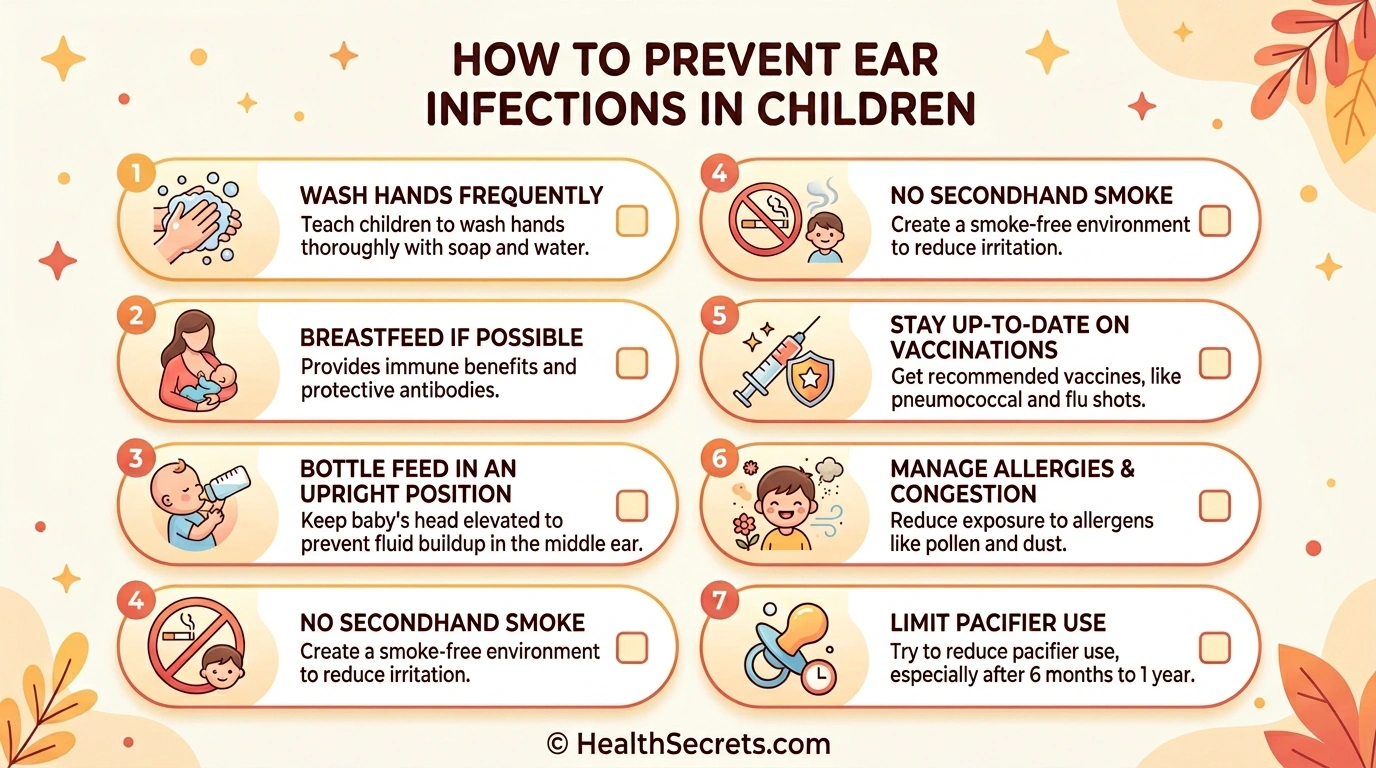
Prevention is the long game, and honestly, it's where you get the biggest return on effort. These evidence-based strategies address the root factors that make ear infections more likely in the first place.
Reduce respiratory infections (the #1 trigger):
- Frequent handwashing — teach children proper technique
- Avoid close contact with sick individuals when possible
- Stay current on vaccinations, particularly flu and pneumococcal (PCV13), which directly reduce ear infection rates
Feeding and early childhood practices:
- Breastfeed if possible — breast milk contains antibodies that support the developing immune system
- Avoid bottle propping — always feed babies in an upright position (lying flat allows fluid to flow into Eustachian tubes)
- Limit pacifier use after 6 months — studies associate prolonged pacifier use with increased ear infection risk
Environmental factors:
- Eliminate secondhand smoke exposure — a well-documented risk factor for recurrent ear infections
- Manage allergies proactively — allergic congestion blocks Eustachian tube drainage
- Dry ears thoroughly after swimming to prevent outer ear infections (tilt head, gently towel-dry)
Adults are less susceptible, but when ear infections do occur, they may signal underlying issues like allergies, Eustachian tube dysfunction, or immune concerns. Adults more commonly experience outer ear infections (swimmer's ear). If you're getting ear infections regularly as an adult, see an ENT specialist.
What Are the Most Common Mistakes When Treating Ear Infections Naturally?
Even well-intentioned parents make mistakes that can worsen symptoms or delay proper care. Avoiding these errors is just as important as following the treatment steps correctly.
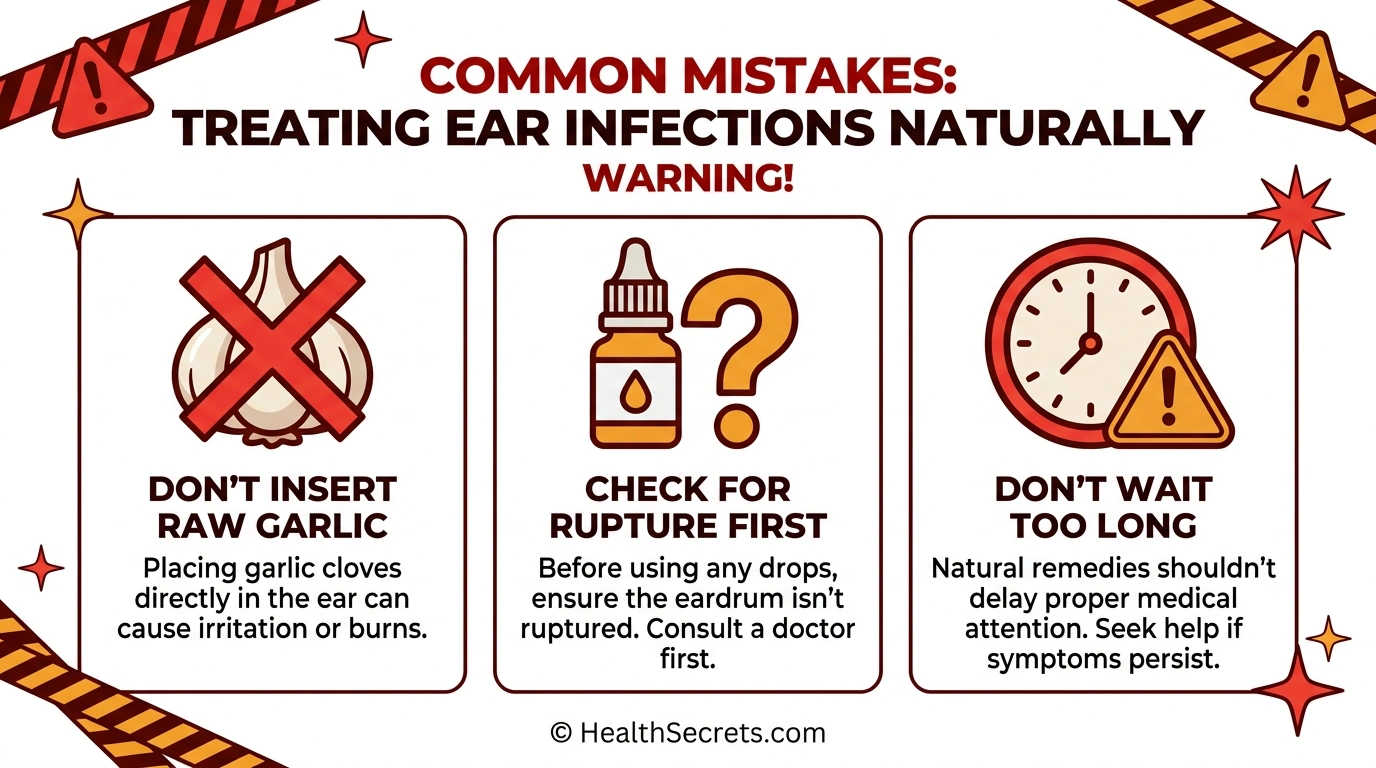
- Mistake #1: Using ear drops when the eardrum may be ruptured. If there's any fluid or pus draining from the ear, stop. Do not put anything in the ear canal. See a doctor.
- Mistake #2: Assuming natural remedies replace medical evaluation. You cannot diagnose an ear infection at home. Even if you're using herbal drops and warm compresses for pain, get a professional diagnosis — especially for children under 2.
- Mistake #3: Waiting too long during watchful waiting. The 48–72 hour window exists for a reason. If symptoms are worsening — increasing pain, rising fever, new drainage — don't wait for the clock to run out. Call your doctor.
- Mistake #4: Giving xylitol inconsistently. Xylitol only works for prevention when given consistently, multiple times daily. Occasional use provides no meaningful protection.
- Mistake #5: Inserting garlic cloves directly into the ear canal. Despite internet advice, raw garlic can burn and irritate the delicate ear canal skin. Only use properly formulated garlic oil ear drops.
- Mistake #6: Refusing antibiotics when they're clearly indicated. Natural remedies and antibiotics aren't enemies. When a child has severe symptoms, bilateral infection, or isn't improving, antibiotics prevent real complications including hearing loss and mastoiditis.
Are Natural Ear Infection Remedies Safe? When Should You Stop and See a Doctor?
Most natural ear remedies carry minimal risk when used appropriately. Herbal ear drops are generally safe for external use, warm compresses pose no risk, xylitol has an excellent safety profile, and probiotics rarely cause issues beyond mild digestive effects. The real safety concern isn't the remedies themselves — it's delaying appropriate medical care.
See a doctor immediately if:
- Your child is under 6 months with any ear infection symptoms
- Severe ear pain that isn't responding to OTC pain medication
- Fever above 102.2°F (39°C)
- Symptoms persist beyond 2–3 days or are worsening
- Fluid or pus is draining from the ear
- You notice hearing loss
- Recurrent infections (more than 3 in 6 months, or 4+ in a year)
- Swelling or redness behind the ear (possible mastoiditis — seek emergency care)
- Dizziness, severe headache, or facial weakness (rare but serious complications)
While most resolve on their own, untreated or undertreated ear infections can lead to temporary or permanent hearing loss, ruptured eardrum, spread of infection to nearby bones (mastoiditis), and in rare cases, meningitis. These complications underscore why professional diagnosis matters.
What Should You Do First When Your Child Has an Ear Infection?
Start with pain management and assessment. The first 24 hours are about comfort and deciding whether watchful waiting is appropriate. Prevention strategies should become part of your daily routine going forward.
Phase 1 — Immediate (First 24 Hours):
- Assess severity: check temperature, observe symptoms, note which ear(s) affected
- Apply warm compress for 10–15 minutes to the affected ear
- Give age-appropriate OTC pain reliever (ibuprofen or acetaminophen)
- Consider herbal ear drops if no signs of eardrum rupture (no drainage)
- Contact healthcare provider for diagnosis — determine if watchful waiting is appropriate
Phase 2 — Watchful Waiting (Days 1–3):
- Continue pain management (warm compress + OTC medication + herbal drops)
- Monitor symptoms closely — note any worsening
- Keep child hydrated, rested, and head elevated during sleep
- Contact doctor if symptoms worsen or don't improve by 48–72 hours
Phase 3 — Long-Term Prevention (Ongoing):
- Start daily xylitol if recurrent infections are an issue (8–10g in 5 doses)
- Consider probiotics (Lactobacillus rhamnosus GG, 5–10 billion CFU daily)
- Implement prevention habits: handwashing, upright feeding, allergy management, smoke-free environment
- Stay current on flu and pneumococcal vaccinations
- Keep herbal ear drops stocked at home for future episodes


