
St. John’s Wort interacts with many common medications including antidepressants (serotonin syndrome risk), birth control pills, blood thinners, immunosuppressants, HIV medications, and cancer drugs.
NEVER take St. John’s Wort with any antidepressant medication. Consult your healthcare provider before use if you take any prescription medications.
St. John’s Wort (Hypericum perforatum) has been used for centuries to treat “melancholy” and nervous conditions, and modern science has largely validated this traditional use — at least for mild-to-moderate depression. With over 30 clinical trials and multiple meta-analyses, it ranks among the most rigorously studied herbal medicines in existence.
The Cochrane Collaboration’s review of 29 trials with 5,489 patients concluded that St. John’s Wort extracts are superior to placebo, similarly effective as standard antidepressants, and have fewer side effects. A 2023 meta-analysis comparing it directly to SSRIs confirmed comparable efficacy with significantly better tolerability.
However, this herb carries a paradox: while it has fewer direct side effects than pharmaceutical antidepressants, it has far more drug interactions — affecting the metabolism of hundreds of medications through CYP450 enzyme induction. This makes informed decision-making and medical guidance essential.
This guide provides a comprehensive, evidence-based review of St. John’s Wort — who it can help, who must avoid it, how to use it safely, and what the best products are.
This content is for informational purposes only and does not constitute medical advice or replace professional mental health care. Depression is a serious medical condition that requires proper diagnosis and treatment.
🆘 If you or someone you know is in crisis:
988 Suicide & Crisis Lifeline: Call or text 988
Crisis Text Line: Text HOME to 741741
SAMHSA National Helpline: 1-800-662-4357 (24/7, free, confidential)
Emergency: Call 911 or go to the nearest emergency room
St. John’s Wort is effective for mild-to-moderate depression, with Cochrane Review evidence showing it’s comparable to SSRIs with fewer side effects
The active compounds hyperforin (3–5%) and hypericin (0.3%) work by inhibiting reuptake of serotonin, dopamine, norepinephrine, GABA, and glutamate simultaneously
⚠️ CRITICAL: It induces CYP3A4, CYP2C9, and P-glycoprotein, reducing the effectiveness of hundreds of medications including birth control, blood thinners, and immunosuppressants
NEVER combine with antidepressants (SSRIs, SNRIs, MAOIs, tricyclics) — risk of life-threatening serotonin syndrome
Standard dosing is 300 mg three times daily (900 mg total) of extract standardized to 0.3% hypericin and 3–5% hyperforin
Effects take 4–6 weeks to fully develop, similar to pharmaceutical antidepressants — patience is essential
Photosensitivity is a common side effect — use SPF 30+ sunscreen and limit sun exposure while taking St. John’s Wort
Not effective for severe or major depression — professional treatment with therapy and/or medication is required for serious cases
Contraindicated in bipolar disorder (can trigger manic episodes), pregnancy, breastfeeding, and before surgery (stop 2 weeks prior)
What Is St. John’s Wort and How Has It Been Used Historically?
St. John’s Wort (Hypericum perforatum) is a yellow-flowering perennial plant native to Europe, now found worldwide. Its name derives from its traditional harvesting around St. John’s Day (June 24), when the plant is in full bloom. For over 2,000 years — from ancient Greek physicians to medieval European herbalists — it has been used to treat “melancholy,” wound healing, nerve pain, and what we now recognize as depression.
What Are the Active Compounds in St. John’s Wort?
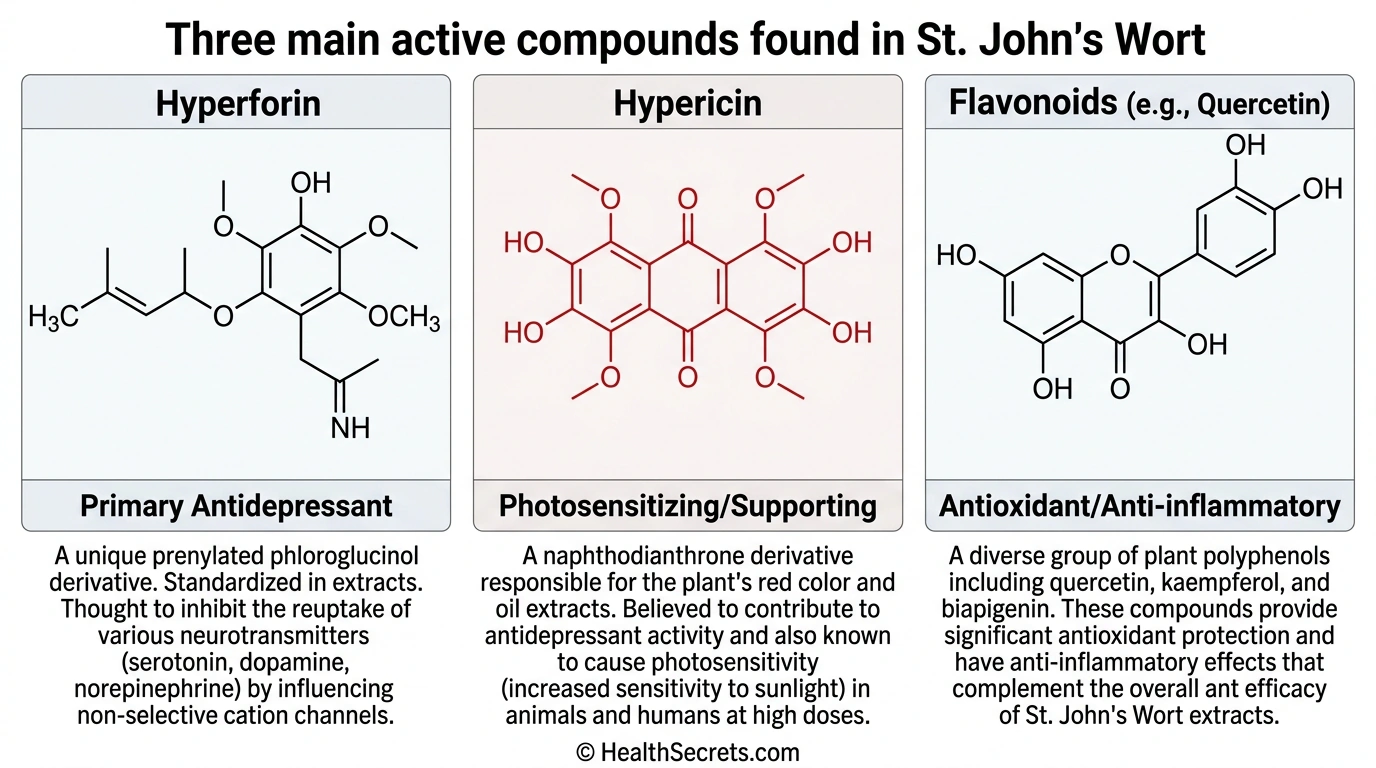
The herb contains several bioactive compounds that work synergistically.
- Hyperforin (a phloroglucinol derivative) is now recognized as the primary antidepressant compound — a clinical trial using two extracts with different hyperforin concentrations confirmed it as the main active principle.
- Hypericin (a naphthodianthrone, the red pigment) was initially thought to be primary but plays a supporting role along with anti-inflammatory and HPA-axis modulating effects.
- Flavonoids including quercetin, rutin, and hyperoside provide antioxidant and anti-inflammatory support. Quality products are standardized to 0.3% hypericin and 3–5% hyperforin.
How Is St. John’s Wort Different from Pharmaceutical Antidepressants?
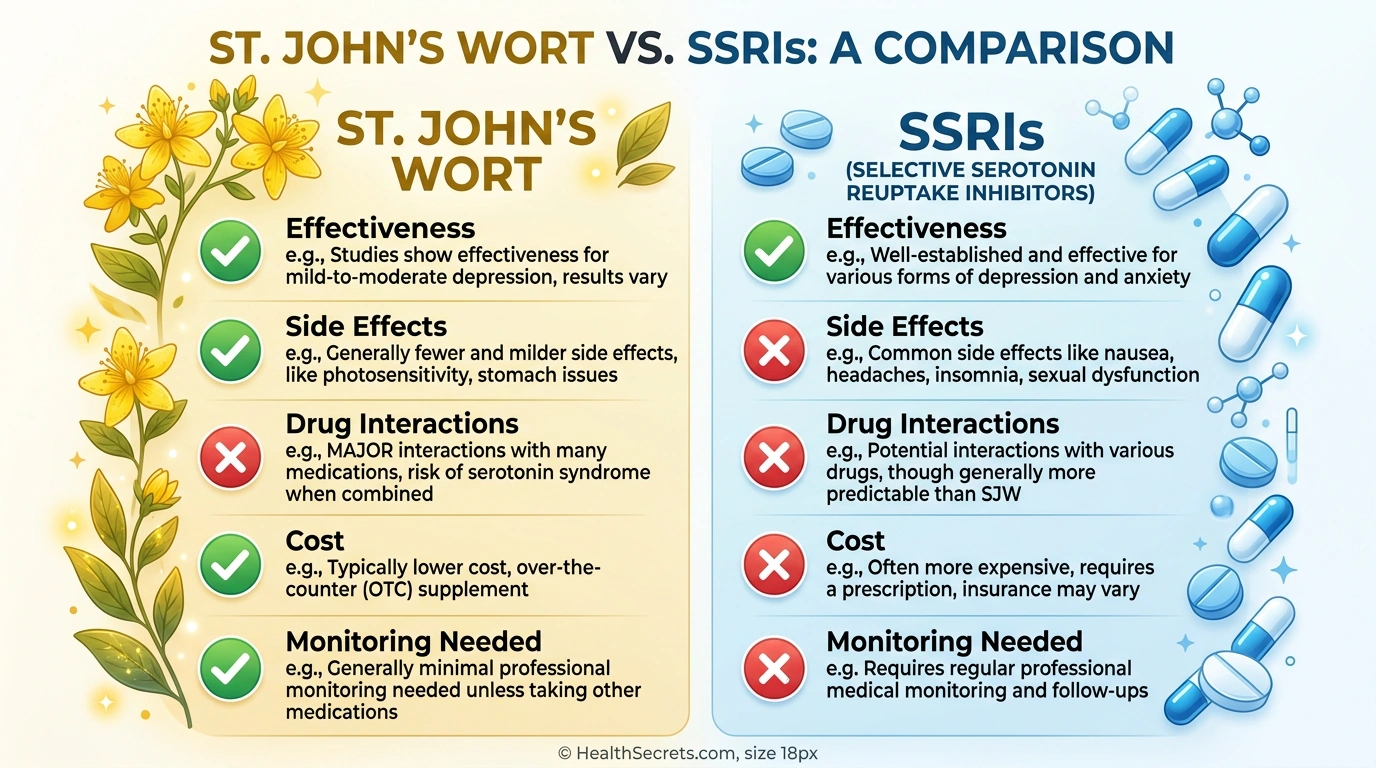
Unlike SSRIs which target a single neurotransmitter (serotonin), St. John’s Wort has a multi-targeted mechanism — it modestly inhibits reuptake of serotonin, dopamine, norepinephrine, GABA, and glutamate simultaneously. This broader but weaker mechanism may explain both its comparable efficacy in mild-to-moderate depression and its generally better side effect profile compared to SSRIs.
How Does St. John’s Wort Work as an Antidepressant?
St. John’s Wort’s antidepressant mechanism is more complex and multi-targeted than any single pharmaceutical antidepressant. Research has identified several interconnected pathways through which it modulates mood and brain function.
How Does Hyperforin Affect Neurotransmitters in the Brain?
Hyperforin activates TRPC6 (transient receptor potential canonical 6) ion channels, which allows sodium and calcium to enter neurons. This ion influx inhibits the reuptake of five key neurotransmitters simultaneously: serotonin, norepinephrine, dopamine, GABA, and glutamate, with IC50 values of 0.05–0.10 mcg/mL. Unlike SSRIs that bind directly to serotonin transporters, hyperforin’s mechanism works through sodium conductive pathways — a fundamentally different and broader approach.

Does St. John’s Wort Affect the Stress Response?
Research shows that hypericin and pseudohypericin act as selective antagonists of corticotropin-releasing factor (CRF) genes, helping to modulate the hyperactive HPA (hypothalamic-pituitary-adrenal) axis commonly seen in depression. Additionally, chronic administration leads to downregulation of beta-adrenergic receptors and upregulation of serotonin 5-HT2 receptors in the frontal cortex — changes that mirror the neuroadaptive effects of conventional antidepressants.
How Does St. John’s Wort Compare to SSRIs Mechanistically?
| Factor | St. John’s Wort | SSRIs |
|---|---|---|
| Targets | 5 neurotransmitters (5-HT, DA, NE, GABA, Glu) | Primarily serotonin |
| Mechanism | TRPC6 channel activation, ion-based | Direct transporter binding |
| Potency | Weaker per-target inhibition | Stronger serotonin inhibition |
| Additional effects | Anti-inflammatory, HPA axis modulation, antioxidant | Neuroplasticity (BDNF) |
| Onset | 4–6 weeks | 4–6 weeks |
How Should You Take St. John’s Wort for Depression?
Proper dosing of St. John’s Wort requires attention to standardization, gradual titration, and consistent daily use. Most clinical trials showing efficacy used specific standardized extracts at defined doses.
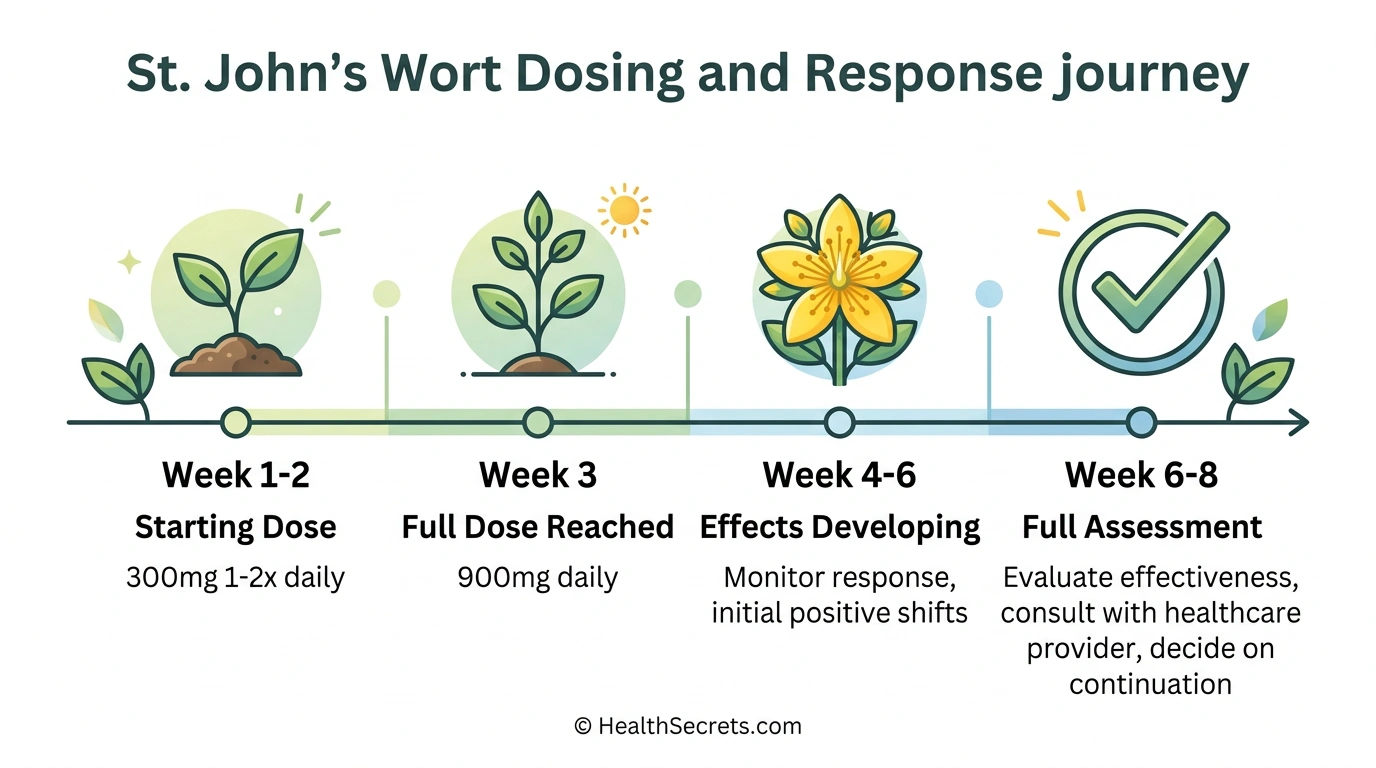
| Phase | Daily Dose | Duration | Notes |
|---|---|---|---|
| Starting dose | 300 mg, 1–2x/day | Week 1–2 | Assess tolerance |
| Target dose | 300 mg, 3x/day (900 mg) | Week 3+ | Most studied dose |
| Assessment | Continue 900 mg/day | Week 4–6 | Full effects develop |
| Maintenance | 300–900 mg/day | Long-term if effective | Reassess every 3–6 months |
| Critical dosing principles: |
- Standardization matters: Look for products standardized to 0.3% hypericin and ideally 3–5% hyperforin
- Take with meals: Improves absorption and reduces stomach upset
- Divide doses: Three times daily maintains more consistent blood levels
- Be patient: Like pharmaceutical antidepressants, full effects require 4–6 weeks
- Don’t exceed 1,800 mg/day without medical supervision
- Consistency is key: Take at the same times each day
- If no improvement after 6–8 weeks: Discontinue and consult a healthcare provider for alternative treatment

Nature’s Way Perika St. John’s Wort
Editor’s ChoiceNature’s Way · Overall best St. John’s Wort — the most clinically studied extract with verified hyperforin content

Gaia Herbs St. John’s Wort
Best Liquid Phyto-CapGaia Herbs · Those preferring liquid-filled capsules with full-spectrum herbal extraction

NOW Foods St. John’s Wort 300 mg
Best BudgetNOW Foods · Affordable, standardized St. John’s Wort from a trusted brand

Jarrow Formulas St. John’s Wort 300 mg
Best Clinical-GradeJarrow Formulas · Science-focused consumers wanting a well-formulated clinical-grade extract

Oregon’s Wild Harvest St. John’s Wort
Best OrganicOregon’s Wild · Organic supplement enthusiasts wanting pesticide-free, non-GMO herbal quality

Solaray St. John’s Wort One Daily 900 mg
Best ConvenienceSolaray St. · People who prefer once-daily dosing rather than three separate doses

Herb Pharm St. John’s Wort Liquid Extract
Best Liquid ExtractHerb Pharm · Those who prefer tincture form or cannot swallow capsules

Nature’s Answer St. John’s Wort Alcohol-Free
Best Alcohol-Free LiquidNature’s Answer · People wanting liquid format without alcohol content
Read the detailed review cards below before opening any retailer link
Top Recommended Products
Nature’s Way
Nature’s Way Perika St. John’s Wort
Nature’s Way Perika uses the exact WS 5570 extract studied in double-blind clinical trials showing efficacy for mild-to-moderate depression — the gold standard for evidence-based St. John’s Wort supplementation.
Pros
- + Uses the WS 5570 extract studied in clinical trials
- + verified hyperforin content (critical for efficacy)
- + TRU-ID DNA-verified identity
Cons
- - Must take 3x daily
- - not the cheapest option
- - requires sun protection
Why we included it: Nature’s Way Perika uses the exact WS 5570 extract studied in double-blind clinical trials showing efficacy for mild-to-moderate depression — the gold standard for evidence-based St. John’s Wort supplementation.
Retailer link opens on Amazon after the review details above
Gaia Herbs
Gaia Herbs St. John’s Wort
Gaia Herbs sets the gold standard for herbal traceability and transparency, with liquid phyto-caps that preserve a broader range of St. John’s Wort’s active compounds.
Pros
- + Full transparency via [meetyourherbs.com](http://meetyourherbs.com/) (trace every herb to origin)
- + liquid format for faster absorption
- + Certified B Corporation
Cons
- - More expensive
- - only 2x daily dosing (different from 3x studied dose)
- - standardized to hypericin only
Why we included it: Gaia Herbs sets the gold standard for herbal traceability and transparency, with liquid phyto-caps that preserve a broader range of St. John’s Wort’s active compounds.
Retailer link opens on Amazon after the review details above
NOW Foods
NOW Foods St. John’s Wort 300 mg
NOW Foods offers the best value per capsule with proper hypericin standardization and GMP quality assurance — ideal for those trying St. John’s Wort for the first time at minimal cost.
Pros
- + Excellent value (250 capsules)
- + trusted brand
- + properly standardized
- + vegan
Cons
- - Standardized to hypericin only (hyperforin not specified)
- - no third-party cert beyond GMP
Why we included it: NOW Foods offers the best value per capsule with proper hypericin standardization and GMP quality assurance — ideal for those trying St. John’s Wort for the first time at minimal cost.
Retailer link opens on Amazon after the review details above
Jarrow Formulas
Jarrow Formulas St. John’s Wort 300 mg
Jarrow Formulas is a science-first supplement company with a strong reputation for quality control and evidence-based formulations.
Pros
- + Science-driven formulation
- + good value
- + well-established brand in clinical nutrition
- + clean formula
Cons
- - Standardized to hypericin only
- - no explicit hyperforin standardization
- - no third-party testing noted
Why we included it: Jarrow Formulas is a science-first supplement company with a strong reputation for quality control and evidence-based formulations.
Retailer link opens on Amazon after the review details above
Oregon’s Wild
Oregon’s Wild Harvest St. John’s Wort
Oregon’s Wild Harvest offers the highest organic certification standard for St. John’s Wort, with a fully traceable supply chain from organic farms to finished product.
Pros
- + USDA Organic certified
- + Non-GMO Project Verified
- + farm-to-capsule traceability
- + clean label
Cons
- - Premium organic pricing
- - unique dosing (375 mg vs standard 300 mg)
- - fewer capsules per bottle
Why we included it: Oregon’s Wild Harvest offers the highest organic certification standard for St. John’s Wort, with a fully traceable supply chain from organic farms to finished product.
Retailer link opens on Amazon after the review details above
Solaray St.
Solaray St. John’s Wort One Daily 900 mg
Solaray’s one-daily format delivers the full clinical dose of 900 mg with two-stage timed release, eliminating the need to remember three separate doses throughout the day.
Pros
- + Full 900 mg daily dose in one tablet
- + timed-release technology
- + lab verified
- + convenient
Cons
- - Larger tablet size
- - cannot easily adjust dose
- - timed-release may not suit everyone
Why we included it: Solaray’s one-daily format delivers the full clinical dose of 900 mg with two-stage timed release, eliminating the need to remember three separate doses throughout the day.
Retailer link opens on Amazon after the review details above
Herb Pharm
Herb Pharm St. John’s Wort Liquid Extract
Herb Pharm is one of America’s most respected herbal extract companies, harvesting St. John’s Wort at peak bloom and extracting fresh flowering tops for maximum potency.
Pros
- + USDA Organic
- + rapid absorption
- + flexible dosing
- + harvested at peak bloom
- + long shelf life
Cons
- - Alcohol base (not for those avoiding alcohol)
- - harder to standardize exact dose
- - taste may be strong
- - smaller bottle
Why we included it: Herb Pharm is one of America’s most respected herbal extract companies, harvesting St. John’s Wort at peak bloom and extracting fresh flowering tops for maximum potency.
Retailer link opens on Amazon after the review details above
Nature’s Answer
Nature’s Answer St. John’s Wort Alcohol-Free
Nature’s Answer provides the only alcohol-free liquid St. John’s Wort using their proprietary Bio-Chelated cold extraction process, perfect for those who prefer or require alcohol-free supplements.
Pros
- + Alcohol-free
- + gentle taste
- + flexible dosing
- + fast absorption
- + Kosher certified
Cons
- - Glycerin base has shorter shelf life
- - harder to standardize active compounds
- - smaller quantity
Why we included it: Nature’s Answer provides the only alcohol-free liquid St. John’s Wort using their proprietary Bio-Chelated cold extraction process, perfect for those who prefer or require alcohol-free supplements.
Retailer link opens on Amazon after the review details above
What Forms of St. John’s Wort Are Available?
St. John’s Wort is available in several forms, each with different advantages for bioavailability and consistent dosing. Choosing the right form affects both effectiveness and your ability to maintain a standardized dose.

- Capsules/tablets (standardized extract): Most common and most studied form. Allows precise, consistent dosing standardized to hypericin and hyperforin content. This is the recommended form.
- Liquid tincture/extract: Faster absorption but harder to standardize. Useful for those who cannot swallow capsules. Alcohol-based or glycerin-based available.
- Tea: NOT recommended for depression treatment. Inconsistent dosing, much lower potency, and active compounds are poorly extracted in hot water.
- Topical preparations: Used traditionally for wound healing and nerve pain. Not relevant for depression treatment.
Quality selection checklist:
- ✅ Standardized to 0.3% hypericin AND 3–5% hyperforin
- ✅ Third-party tested (USP, NSF, ConsumerLab)
- ✅ GMP-certified manufacturing
- ✅ Reputable brand with transparent labeling
- ❌ Avoid: unstandardized products, teas for depression, unrealistic claims, very cheap products
Is St. John’s Wort Safe? Understanding Side Effects and Critical Drug Interactions
St. John’s Wort has fewer direct side effects than SSRIs, but its extensive drug interactions make it one of the most potentially dangerous herbal supplements when combined with medications. Understanding both aspects is essential for safe use.
What Are the Common Side Effects of St. John’s Wort?
Direct side effects are generally mild and affect only a minority of users. The most reported include digestive upset (nausea, stomach discomfort — take with food), dry mouth, mild dizziness, fatigue or paradoxical restlessness, headache, and photosensitivity (increased sun sensitivity due to hypericin — use SPF 30+ sunscreen, wear protective clothing, limit sun exposure).
⚠️ Why Are St. John’s Wort Drug Interactions So Dangerous?
Hyperforin is a potent activator of the pregnane X receptor (PXR), which induces production of
CYP3A4,
CYP2C9,
CYP2C19, and
P-glycoprotein — the liver enzymes and transporters responsible for metabolizing and eliminating hundreds of medications. When these enzymes are induced, medications are broken down faster, their blood levels drop, and they may become ineffective. This effect takes 10–14 days to reach maximum and a similar time to reverse after stopping.
| Drug Category | Examples | Risk |
|---|---|---|
| Antidepressants | SSRIs, SNRIs, MAOIs, tricyclics | ☠️ Serotonin syndrome (potentially fatal) |
| Birth control | Pills, patch, ring | Reduced effectiveness → pregnancy risk |
| Blood thinners | Warfarin (Coumadin) | Reduced effectiveness → clot/stroke risk |
| Immunosuppressants | Cyclosporine, tacrolimus | ☠️ Organ rejection (life-threatening) |
| HIV medications | Protease inhibitors, NNRTIs | Treatment failure, drug resistance |
| Also interacts with: Cancer medications (irinotecan, imatinib), heart medications (digoxin, calcium channel blockers), seizure medications (phenytoin, carbamazepine), migraine triptans (serotonin syndrome risk), benzodiazepines (alprazolam), opioids, statins, thyroid medications, diabetes medications, and many others. |
Other supplement interactions: Do NOT combine with 5-HTP, SAM-e, or tryptophan — serotonin syndrome risk.
- Anyone taking any prescription medication (consult doctor first)
- People with bipolar disorder (can trigger mania/hypomania)
- Those with severe depression or suicidal thoughts (requires professional treatment)
- Pregnant or breastfeeding individuals (insufficient safety data)
- People scheduled for surgery (stop 2 weeks before — interacts with anesthesia)
- Organ transplant recipients (affects immunosuppressants)
- Those taking antidepressants of any kind
What Can St. John’s Wort Realistically Do for Your Mood?
When used appropriately for the right type of depression and without contraindicated medications, St. John’s Wort offers a well-evidenced natural option with meaningful benefits and clear limitations.

Realistic timeline:
- Week 1–2: Most people notice no significant change. Subtle improvements in sleep or anxiety possible.
- Week 2–4: Gradual mood improvement begins for some. Energy and motivation may start increasing.
- Week 4–6: Full antidepressant effects develop. This is when clinical trials measure primary outcomes.
- Week 6–8: If no meaningful improvement, the herb is unlikely to work for you. Consult a healthcare provider.
What it CAN do:
- Improve mild-to-moderate depression symptoms comparably to SSRIs
- Reduce anxiety symptoms (some evidence)
- Improve mood with generally fewer side effects than pharmaceuticals
- Support seasonal affective disorder management
What it CANNOT do:
- Treat severe or major depression effectively
- Replace professional therapy (especially CBT, which has the strongest long-term evidence)
- Work if you’re taking medications that interact
- Produce results overnight — it requires the same 4–6 week patience as pharmaceutical antidepressants
What Steps Should You Follow to Use St. John’s Wort Safely?
Using St. John’s Wort safely requires a methodical approach, especially regarding medication interactions and proper product selection.
Phase 1 — Assess Appropriateness (Before Starting):
- Confirm your depression is mild-to-moderate (not severe — seek professional help for severe symptoms)
- Review ALL current medications and supplements for interactions
- Consult your healthcare provider, pharmacist, or prescriber
- Rule out bipolar disorder with your provider
- Confirm you are not pregnant, breastfeeding, or planning surgery
Phase 2 — Choose a Quality Product (Week 1):
- Select a standardized extract: 0.3% hypericin, 3–5% hyperforin
- Verify third-party testing (USP, NSF, or ConsumerLab)
- Choose capsule/tablet form for consistent dosing
- Purchase SPF 30+ sunscreen for photosensitivity protection
Phase 3 — Start and Titrate (Weeks 1–3):
- Begin with 300 mg once or twice daily with food
- After 1 week, increase to 300 mg three times daily (900 mg total) if tolerated
- Apply sunscreen daily and limit sun exposure
- Track mood, sleep, energy, and any side effects in a daily journal
Phase 4 — Evaluate and Continue (Weeks 4–8):
- Allow 4–6 full weeks for antidepressant effects to develop
- If improving: continue at 900 mg/day, reassess every 3–6 months
- If no improvement by week 6–8: discontinue and consult a healthcare provider
- If worsening or suicidal thoughts: stop immediately and seek emergency help

