Have you ever spent days feeling groggy, unfocused, and unable to fall asleep at a reasonable hour, even though you know you need rest? That sluggish, out-of-sync feeling often traces back to one root cause: a disrupted circadian rhythm.
Your circadian rhythm is far more than a simple sleep-wake cycle. It is a 24-hour biological clock, orchestrated by a tiny cluster of roughly 20,000 neurons called the suprachiasmatic nucleus (SCN) in your hypothalamus, that coordinates hormone release, body temperature, digestion, immune function, and cellular repair across every organ and tissue in your body [1]. When this master clock is properly aligned with the sun, everything hums along. When it is not, your health pays the price.
The good news? Your circadian rhythm is remarkably responsive to the right signals. Research shows that strategic morning light exposure of 10,000 lux for 30 minutes can advance your circadian phase by up to 2 hours, while maintaining evening darkness below 10 lux preserves natural melatonin production [2]. A consistent sleep-wake schedule can fully entrain your rhythm within 7 to 14 days [3].
Whether you are battling jet lag, adjusting to shift work, or simply trying to undo weeks of late nights and screen scrolling, this guide provides a step-by-step, research-backed protocol to reset your body clock and reclaim your energy, mood, and long-term health.
Related reading: mental wellness strategies | sleep optimization guide | cortisol management | longevity and anti-aging
What Do You Need to Know Before Resetting Your Circadian Rhythm?
Resetting your circadian rhythm requires understanding the key signals your master clock responds to and setting realistic expectations for the timeline. Most people can fully realign their sleep-wake cycle within 7 to 14 days using consistent light exposure, darkness cues, and schedule regularity, though shift workers and frequent travelers may need ongoing strategies.
Who Is This Guide For?
This protocol is designed for anyone experiencing circadian disruption, including people with irregular sleep schedules, shift workers, frequent travelers dealing with jet lag, night owls trying to shift earlier, and anyone whose screen habits or lifestyle have pushed their body clock out of alignment.
What Causes Circadian Disruption?
The most common causes of circadian misalignment include shift work (affecting 20% of the workforce), jet lag from crossing time zones, social jetlag (weekend sleep schedules differing from weekdays by more than 2 hours, affecting 70% of the population), evening artificial light exposure that suppresses melatonin by 50%, blue light from screens at 460 to 480nm wavelength, irregular bedtimes that prevent entrainment, and late-night eating that disrupts metabolic peripheral clocks [18].
What Are the Consequences of Misalignment?
Chronic circadian disruption carries serious health risks: insomnia and fragmented sleep, doubled risk of depression and anxiety, 50% higher diabetes risk due to impaired glucose tolerance, 40% higher cardiovascular disease risk, classification of shift work as a probable carcinogen by the International Agency for Research on Cancer, and accelerated biological aging through telomere shortening and chronic inflammation [10].
Expected Timeline
- Days 1 to 3: Improved morning alertness, melatonin production begins normalizing
- Days 4 to 7: Falling asleep becomes easier, daytime energy improves
- Days 7 to 14: Full circadian entrainment, optimized sleep quality
- Weeks 2 to 4+: Sustained metabolic and mood improvements
How Do You Use Morning Light Exposure to Reset Your Body Clock?
Morning bright light is the single most powerful tool for resetting your circadian rhythm. Exposing your eyes to 10,000 lux of light within 1 to 2 hours of waking suppresses melatonin, signals daytime to the SCN, and can advance your circadian phase by up to 2 hours, improving sleep quality by approximately 40%.
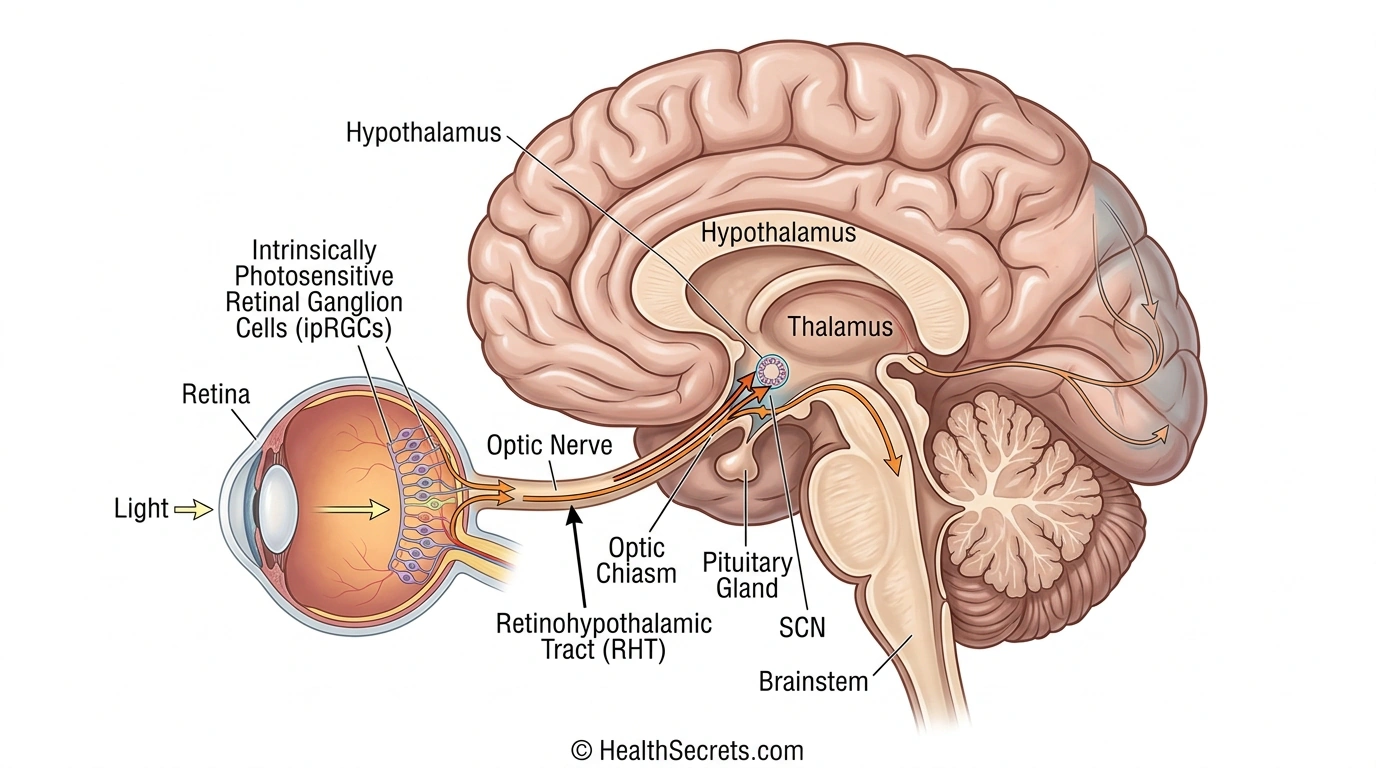
Light enters the eye and activates intrinsically photosensitive retinal ganglion cells (ipRGCs), which are most sensitive to blue light at 460 to 480nm. These cells send signals directly to the SCN via the retinohypothalamic tract, resetting the master clock [1].
A 2026 study published in Sleep Epidemiology confirmed that morning sunlight exposure significantly influences sleep midpoint regulation and overall sleep quality, reinforcing its role as the primary circadian zeitgeber [5].
How to implement:
- Timing: Within 1 to 2 hours of waking (the critical reset window)
- Duration: 30 minutes minimum (longer is beneficial)
- Intensity: 10,000 lux (outdoor sunlight provides 10,000 to 100,000 lux; indoor lighting is only 100 to 500 lux)
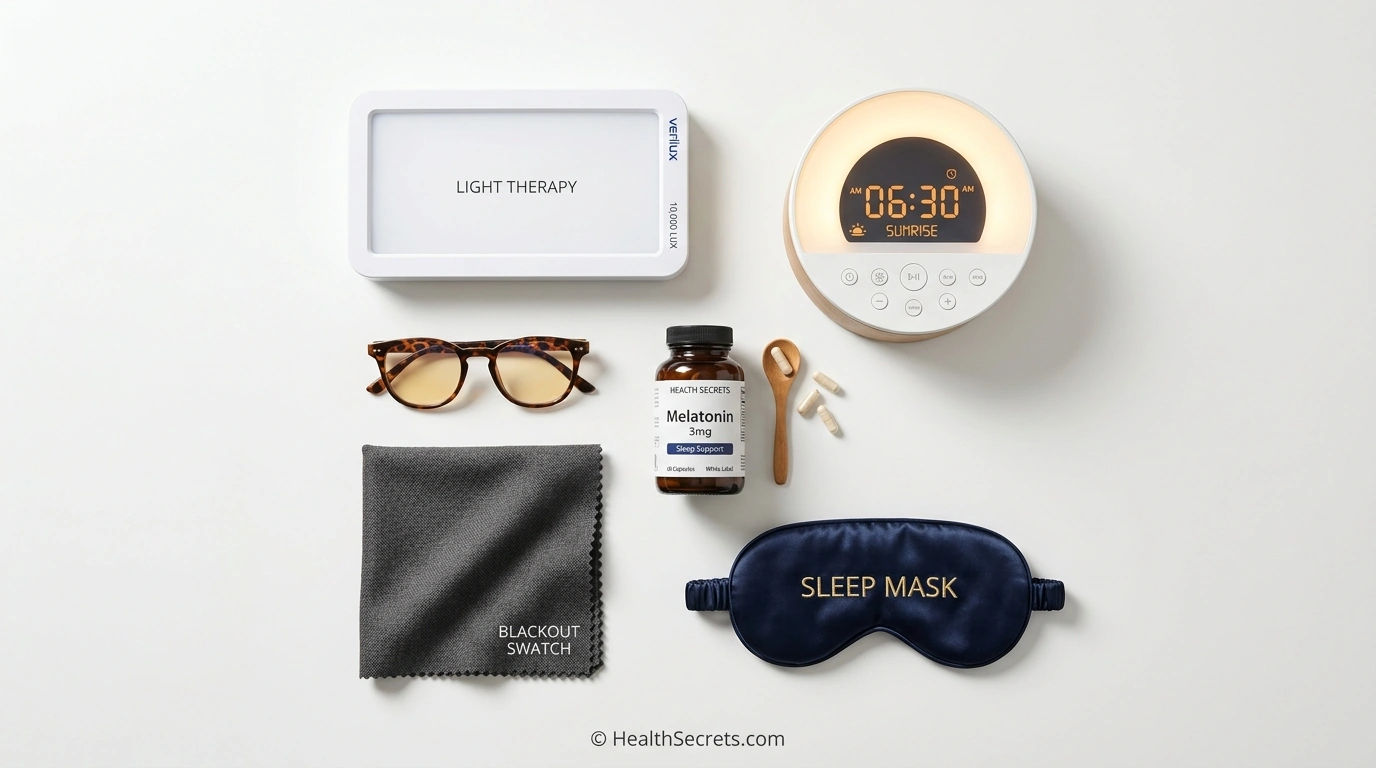
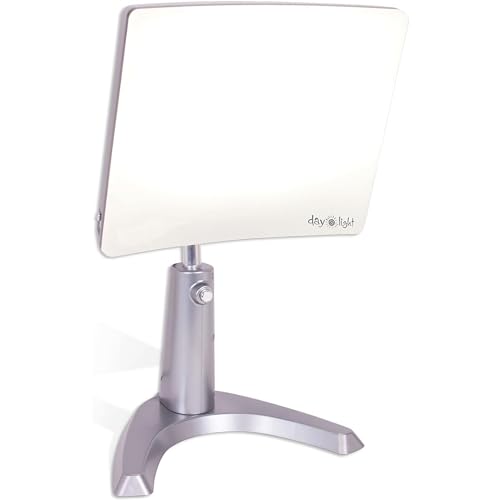
- Method: Go outside facing east without sunglasses, or use a 10,000 lux light therapy box positioned 12 to 24 inches from your face
- Overcast days: Outdoor light on cloudy days still provides 1,000 to 5,000 lux, far exceeding indoor levels

How Does Evening Darkness Preserve Your Melatonin Production?
Maintaining dim lighting below 10 lux after sunset allows your pineal gland to produce melatonin naturally, signaling nighttime to your brain and body. This preserves your circadian phase and prevents the delayed sleep onset caused by evening bright light exposure.
Research from the CDC's NIOSH program shows that light exposure in the evening, approximately 2 hours before and after your usual bedtime, can shift the circadian system about 2 hours later per day, while morning light shifts it about 1 hour earlier [4]. This means evening light is actually more disruptive than morning light is corrective.
How to implement:
- After sunset: Keep ambient lighting below 10 lux (candlelight is approximately 1 lux)
- Use amber or red lights: These wavelengths do not suppress melatonin the way blue and white light do
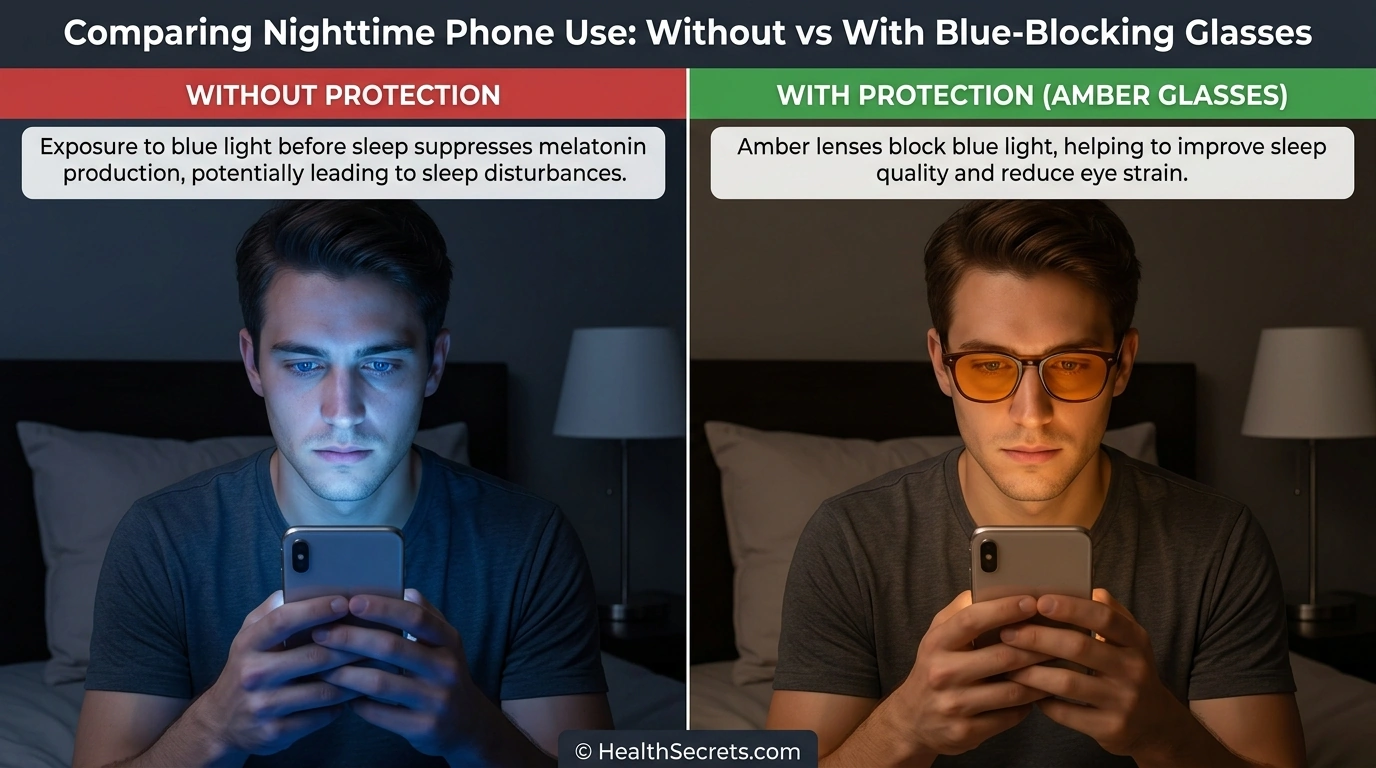
- Dim screens: Enable night mode, use f.lux software, or wear blue light blocking glasses with amber lenses
- Bedroom: Complete darkness for sleep using blackout curtains and covering LED indicators

Why Is a Consistent Sleep-Wake Schedule Essential for Circadian Entrainment?
Maintaining the same bedtime and wake time every day, including weekends, provides the predictability your SCN needs to lock onto a stable rhythm. Research from Yale School of Medicine confirms that a regular sleep-wake schedule, combined with consistent light cues, can fully entrain the circadian system within 7 to 14 days.
"Daylight, exercise, social activity, meal timing, and a regular sleep-wake schedule allow us to keep a normal rhythm," explains Dr. Brienne Miner of Yale School of Medicine. "Any changes to these behaviors or lack of these cues from the environment can disrupt the circadian rhythm" [3].
How to implement:
- Same bedtime and wake time daily: Including weekends (no sleeping in)
- Variation under 30 minutes: Minimal disruption to your rhythm
- Set a bedtime alarm: Not just a wake-up alarm, to ensure consistency
- Eliminate social jetlag: Weekend schedules should match weekday schedules
How Does Blocking Blue Light in the Evening Protect Your Sleep?
Evening blue light from screens and LED lighting suppresses melatonin production by up to 50% and delays your circadian phase by 1 to 2 hours, making it significantly harder to fall asleep at your desired bedtime. Blue light at 460 to 480nm is the most potent suppressor because it matches the peak sensitivity of ipRGCs in the retina.
A comprehensive review in Chronobiology International found that wearing blue-blocking glasses in the evening advanced circadian rhythms in patients with delayed sleep phase disorder, while controlled laboratory studies confirmed that blue-blocking lenses minimize the physiological effects of light at night [9].
How to implement:
- No screens 2 to 3 hours before bed: Ideal approach (or use blue blockers)
- Blue light blocking glasses: Amber lenses that block 99% of blue light, worn 2 to 3 hours before bed
- Night mode and f.lux: Software that reduces blue light emission from screens
- Dim ambient lights: Below 10 lux using amber or red bulbs
How Does Time-Restricted Eating Strengthen Your Circadian Rhythms?
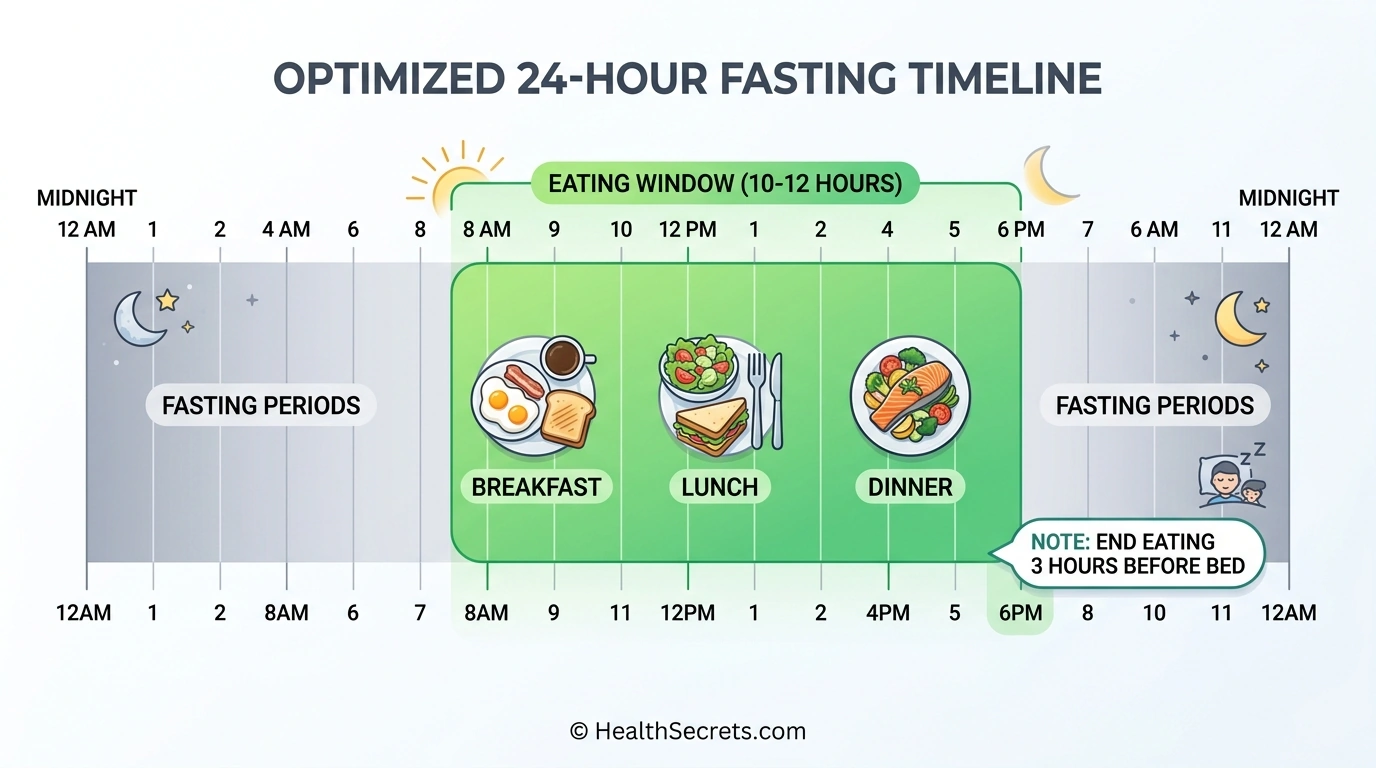
Confining your meals to a 10 to 12 hour daily window synchronizes peripheral circadian clocks in the liver, pancreas, and gut, reinforcing the master clock signal and improving metabolic health. Finishing your last meal at least 3 hours before bed aligns eating with your period of highest insulin sensitivity.
A landmark study in Current Biology demonstrated that a 5-hour delay in meal timing significantly altered peripheral circadian rhythms in humans, even without changes to the central SCN clock, confirming that meal timing acts as an independent zeitgeber for metabolic tissues [6]. A 2020 systematic review found that time-restricted eating improved body weight, fat mass, and metabolic markers, with an average 80% adherence rate [7].
How to implement:
- 10 to 12 hour eating window: For example, 8am to 6pm or 10am to 8pm
- Finish eating 3 hours before bed: Allows digestion and aligns with circadian insulin sensitivity
- Consistent timing daily: Same window every day to entrain metabolic clocks
- Avoid late-night eating: Disrupts glucose tolerance and peripheral clock alignment
When Should You Exercise to Support Circadian Alignment?
Morning or early afternoon exercise advances your circadian phase and promotes earlier, deeper sleep, while vigorous evening exercise can delay your rhythm and interfere with sleep onset. Exercise functions as a secondary zeitgeber that reinforces the light-driven signal from the SCN.
How to implement:
- Morning or early afternoon: Best timing for circadian entrainment
- 150 minutes per week: Moderate activity such as brisk walking, cycling, or swimming
- Avoid vigorous exercise within 3 hours of bedtime: Raises core body temperature and cortisol, which may delay sleep onset
- Outdoor exercise in morning sunlight: Combines two zeitgebers (light plus physical activity) for maximum effect
How Does Temperature Regulation Help You Fall Asleep Faster?
Your core body temperature naturally drops in the evening to initiate sleep, reaching its lowest point around 4 to 5am. Keeping your bedroom cool at 65 to 68 degrees Fahrenheit (18 to 20 degrees Celsius) supports this natural decline, while a warm bath 90 minutes before bed triggers a compensatory temperature drop that accelerates sleep onset.
How to implement:
- Cool bedroom: 65 to 68 degrees Fahrenheit (18 to 20 degrees Celsius)
- Warm bath or shower: 90 minutes before bed at 104 to 109 degrees Fahrenheit for 20 to 30 minutes
- Cover LED lights: Even small light sources disrupt melatonin
- Breathable bedding: Supports temperature regulation throughout the night
When Should You Use Melatonin to Reset Your Circadian Phase?
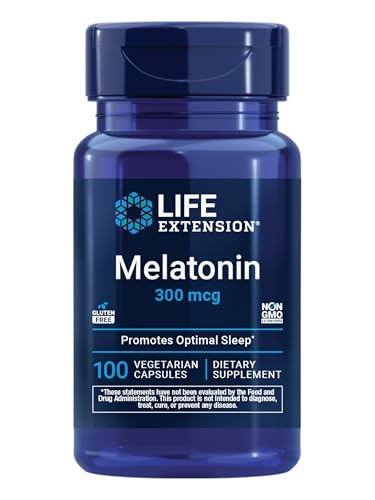
Exogenous melatonin at low doses of 0.3 to 1mg taken 30 to 60 minutes before your desired (not current) bedtime can signal nighttime to the SCN and help shift your circadian phase. It is most effective as a short-term reset tool for 1 to 2 weeks, not as a long-term sleep aid.
Research from Burgess et al. found that combining afternoon melatonin with morning bright light produced the largest circadian advances of approximately 2.5 hours, supporting the additive phase-shifting effects of these two interventions [8].
How to implement:
- Dose: 0.3 to 1mg (physiological dose; less is often more effective)
- Timing: 30 to 60 minutes before your desired new bedtime
- Duration: 1 to 2 weeks for circadian reset, then discontinue
- Quality: Choose third-party tested brands (unregulated supplements may contain up to 400% of stated dose)
- Caution: May suppress natural production with long-term use; consult your doctor if you have autoimmune conditions or take blood thinners
What Are the Most Common Mistakes When Resetting Your Circadian Rhythm?
The biggest mistakes people make include relying on melatonin alone without addressing light exposure, getting bright light at the wrong time of day, and allowing weekend sleep-ins to undo a full week of progress. Avoiding these pitfalls dramatically increases your chances of a successful reset.
Common mistakes to avoid:
- Skipping morning light: Indoor lighting at 100 to 500 lux is insufficient; you need 10,000 lux
- Wearing sunglasses in the morning: Blocks the ipRGC activation your SCN needs
- Sleeping in on weekends: Even 2 hours creates social jetlag that undoes weekday alignment
- Using screens in bed: Blue light suppresses melatonin exactly when you need it most
- Taking high-dose melatonin: Doses above 3mg can cause grogginess and suppress natural production
- Eating late at night: Desynchronizes peripheral metabolic clocks from the central clock
- Expecting instant results: Full entrainment takes 7 to 14 days of consistent effort
Shift work protocol:
- Wear bright light (10,000 lux) at your workstation during night shifts
- Wear dark sunglasses on the commute home to prevent morning light from advancing your clock
- Use blackout curtains, eye mask, and earplugs for daytime sleep
- Take 0.5 to 3mg melatonin before daytime sleep after a night shift
- Limit caffeine to the first half of your shift (avoid the last 4 to 6 hours)
Jet lag protocol:
- Pre-adjust your schedule 1 to 2 hours per day for 3 to 5 days before travel
- Eastward travel: seek morning light at your destination to advance your clock
- Westward travel: seek evening light at your destination to delay your clock
- Take 0.5 to 3mg melatonin at your destination bedtime for 3 to 5 days
- Adopt local meal and sleep times immediately upon arrival
Is Resetting Your Circadian Rhythm Safe? When Should You See a Doctor?
For most healthy adults, the strategies in this guide are safe and well-tolerated. However, certain conditions require medical supervision before starting light therapy or melatonin supplementation, and persistent sleep problems despite circadian optimization warrant professional evaluation.
See a doctor if:
- Persistent insomnia continues despite 3 or more months of circadian optimization
- Excessive daytime sleepiness occurs despite 7 to 9 hours of sleep
- You suspect sleep apnea, narcolepsy, or advanced or delayed sleep phase disorder
- You have bipolar disorder (light therapy can trigger mania)
- You have eye conditions such as glaucoma or retinal disease
- You are pregnant or breastfeeding (consult before using melatonin)
- Shift work is causing metabolic, cardiovascular, or mental health concerns
Action Plan
What Should You Do First to Reset Your Circadian Rhythm?
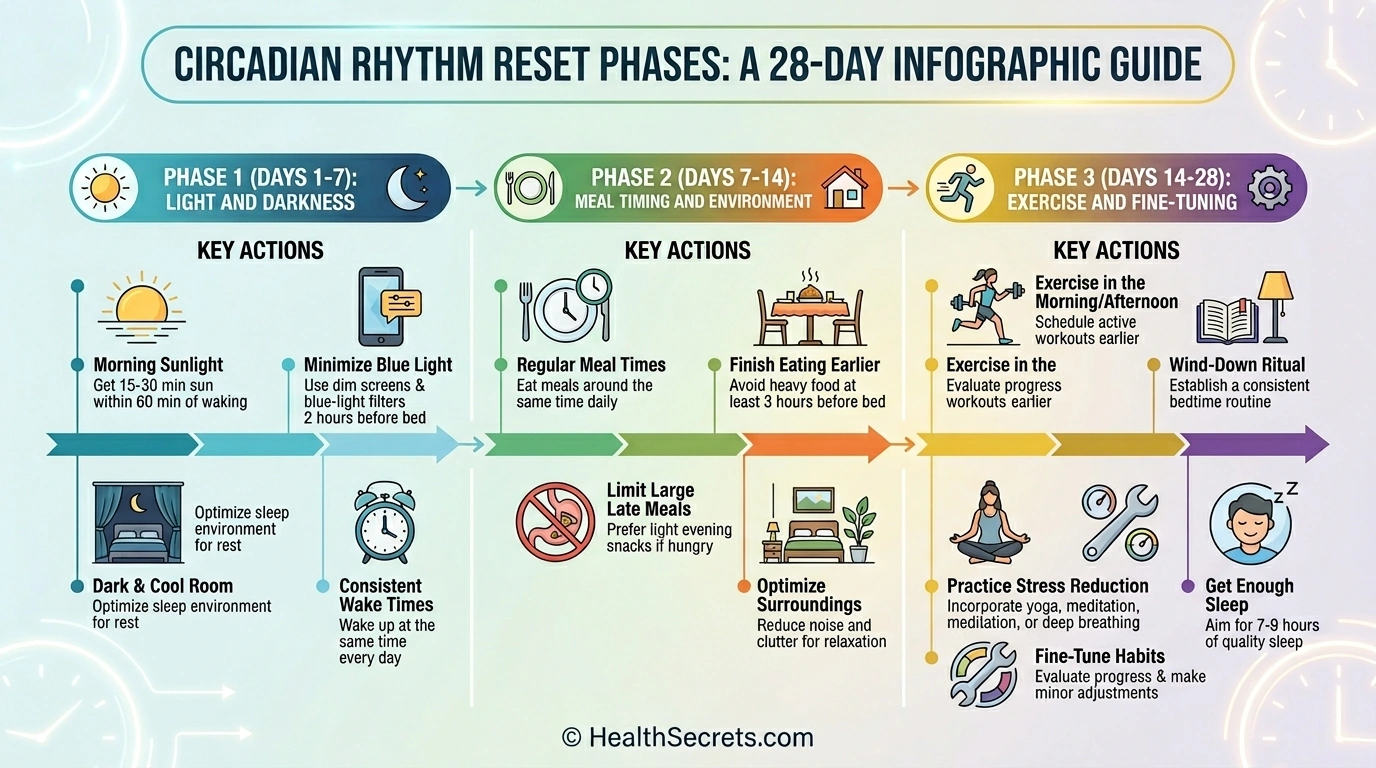
Follow the sequence below, work through each phase in order, and use the checklist as your practical implementation guide.
Start with the two most impactful interventions, morning light and evening darkness, then layer in additional strategies over 2 to 4 weeks. This phased approach prevents overwhelm and allows you to track which changes produce the most noticeable improvements in your sleep and energy.
Phase 1: Light and Darkness (Days 1 to 7)
- Get 30 minutes of 10,000 lux light within 1 to 2 hours of waking
- Reduce evening lighting below 10 lux after sunset
- Wear blue light blocking glasses 2 to 3 hours before bed
- Set consistent bedtime and wake time (including weekends)
Phase 2: Meal Timing and Environment (Days 7 to 14)
- Establish a 10 to 12 hour eating window
- Finish last meal 3 hours before bed
- Cool bedroom to 65 to 68 degrees Fahrenheit
- Install blackout curtains or use a sleep mask
Phase 3: Exercise and Fine-Tuning (Days 14 to 28)
- Schedule morning or early afternoon exercise (150 minutes per week)
- Consider short-term melatonin (0.3 to 1mg) if reset is slow
- Track sleep quality and daytime energy
- Maintain consistency for full circadian entrainment